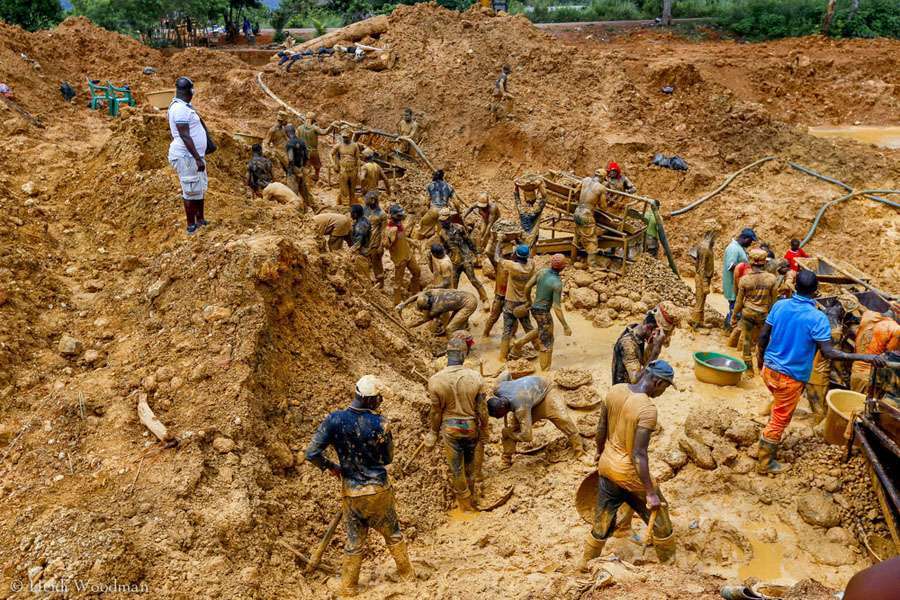
The European Union has formally acknowledged that illegal artisanal mining, locally known as galamsey, is directly eroding the returns on its development investments in Ghana, with Deputy Head of EU Delegation Jonas Claes warning at the public launch of three Gold for Good baseline studies that the bloc’s programming across sustainable agriculture, water sanitation, security, and reforestation is being systematically undermined by unregulated mining activity.
A Shift in EU Engagement: From Avoidance to Active Partnership
For years, the EU treated galamsey as a politically sensitive issue it preferred to sidestep. Claes was candid about that institutional posture: “Three to four years ago, the European Union did not have any engagement in this field. It was considered politically risky, too complex a problem.” That calculation has since changed, driven not by altruism alone but by a recognition that illegal mining directly undermines EU interests and the EU-Ghana bilateral partnership. The shift marks a meaningful recalibration in how Brussels frames its engagement with natural resource governance in West Africa, moving from a donor-recipient dynamic toward a co-stakeholder model in which European programming funds are visibly at risk.
The EU’s revised position is now backed by concrete financial commitment. The €3 million Gold for Good project, funded by the EU and implemented by Swiss-based security governance organization Coginta, anchors this new approach. The project’s baseline studies, launched publicly in Accra, are designed to generate the empirical foundation needed for evidence-based policy on artisanal and small-scale mining (ASM). Coginta’s Country Director in Ghana, Rev. Fr. Dr Clement Aapengnuo, framed the initiative as an opportunity to strengthen natural resource governance frameworks and address the compounding security risks that unregulated mining generates, particularly in northern Ghana where resource competition intersects with existing fragility dynamics.
The Governance Deficit at the Core of the Galamsey Crisis
Ghana’s galamsey problem is, at its foundation, a governance failure. The country’s Minerals and Mining Act provides a legal framework for small-scale mining licensing, but enforcement capacity at the district and community level remains chronically underfunded and subject to political interference. The result is a regulatory gap that illegal operators exploit at scale, with consequences that extend well beyond environmental degradation. Water bodies contaminated by mercury and cyanide from unregulated mining operations compromise public health infrastructure and raise the cost of water treatment, directly undermining the sanitation investments that the EU and other development partners channel into Ghana each year. The Ghana Water Company Limited has repeatedly flagged the impact of mining runoff on treatment costs, a signal of the fiscal burden that governance failure in one sector imposes across others.
Aapengnuo was specific about the security dimension, noting that mining activity in northern Ghana carries risks that reach beyond environmental harm. Artisanal mining sites in fragile zones can become nodes of armed group activity, illicit financial flows, and community conflict over land rights, all of which destabilize the social cohesion that underpins sustainable local development. His call for government to treat natural resource management as a security governance issue, not merely an environmental regulation problem, reflects a more sophisticated understanding of the galamsey challenge than the enforcement-only approach that has characterized previous government crackdowns.
Community Incentives and the Political Economy of Illegal Mining
One of the more analytically significant points raised at the Gold for Good launch was the EU’s acknowledgment that galamsey persists in part because it delivers tangible short-term benefits to mining communities. Financial income, informal social services, and a degree of economic agency in communities with limited formal employment options make illegal mining genuinely attractive, not simply a product of ignorance or criminality. The EU’s call for intensified public education on galamsey’s long-term consequences, while valid, must be situated within this political economy. Education campaigns that ignore the structural conditions driving community participation will struggle to shift behavior at scale.
This is where the Gold for Good baseline studies carry particular policy value. By generating disaggregated data on community-level incentives, livelihood dependencies, and governance gaps, the studies can inform the design of alternative livelihood programs that are calibrated to actual community conditions rather than generic development templates. Ghana has attempted such programs before, most notably through the Minerals Commission’s Community Mining Scheme, but implementation has been inconsistent and funding irregular. A rigorous baseline methodology, if properly used, gives policymakers and donors a more credible starting point for designing interventions that can compete with the immediate returns galamsey offers.
Regional Dimensions: Ghana’s Galamsey Problem in a West African Context
Ghana’s illegal mining crisis does not exist in isolation. Across West Africa, artisanal and small-scale gold mining operates in a regional ecosystem shaped by cross-border labor mobility, shared river systems, and overlapping regulatory jurisdictions. In Côte d’Ivoire, illegal mining in the western forest zones has triggered similar deforestation and water contamination concerns. In Burkina Faso and Mali, ASM sites have become entangled with armed group financing in ways that pose direct security threats to regional stability. ECOWAS has a framework for harmonizing mining sector governance among member states, but implementation remains fragmented, and the political will to enforce cross-border regulatory alignment has been inconsistent.
For Ghana, the stakes of getting galamsey governance right extend beyond domestic policy. As one of West Africa’s most institutionally stable democracies and a key ECOWAS member, Ghana’s approach to natural resource governance sends signals to the region. A credible, evidence-based response to illegal mining, anchored in strengthened institutions and community-inclusive policy design, would reinforce Ghana’s standing as a governance reference point for the region. Conversely, continued regulatory failure risks normalizing a model of resource exploitation that other states in the sub-region may be reluctant to diverge from. The EU’s decision to invest in baseline data and governance capacity, rather than simply funding enforcement operations, suggests a more durable theory of change, one that prioritizes institutional reform over short-term suppression.
Policy Pathways: What Institutions Must Now Deliver
The Gold for Good baseline studies represent a starting point, not a solution. Ghana’s Minerals Commission, the Environmental Protection Agency, and the Ministry of Lands and Natural Resources each carry institutional responsibility for translating the data these studies generate into enforceable policy. The Bank of Ghana also has a role: gold purchased through informal channels bypasses the formal export system, reducing foreign exchange earnings and weakening the monetary authority’s ability to manage Ghana’s external position. Tightening the gold purchasing and export chain is as much a monetary governance issue as it is a mining regulation matter.
The EU, for its part, has signaled a sustained commitment through the Gold for Good project, but the initiative’s long-term impact depends on whether Ghanaian institutions absorb and act on the evidence it produces. Coginta’s implementation role gives the project technical credibility, but institutional ownership must rest with Ghanaian agencies if the governance improvements are to outlast the project cycle. Rev. Fr. Dr Aapengnuo’s emphasis on natural resource management as a prerequisite for sustainable peace points toward the right framing: galamsey is not a mining problem with development consequences, but a governance problem with mining as its most visible symptom.