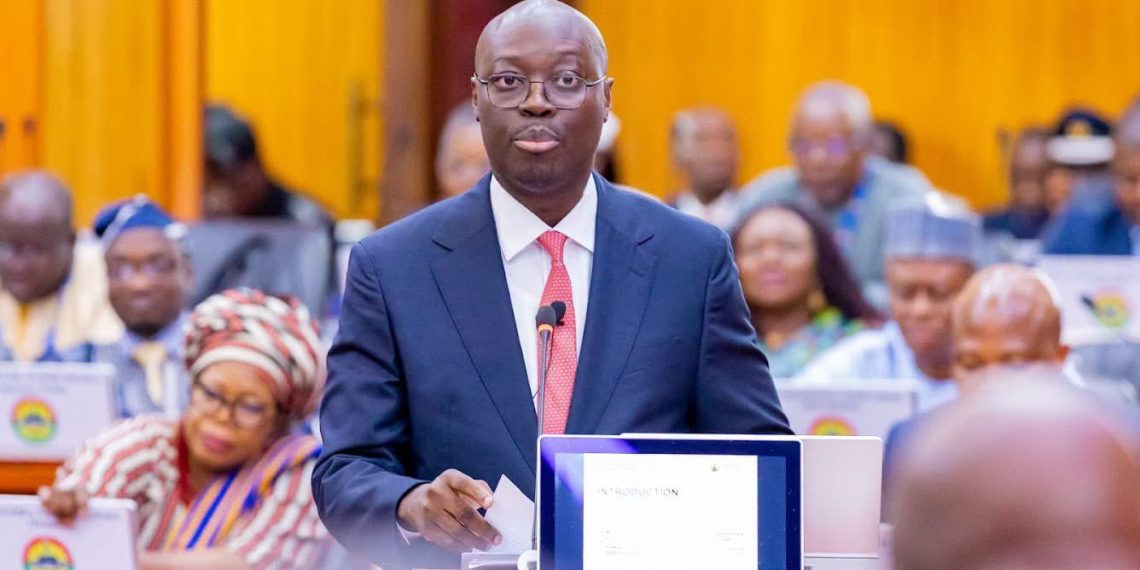
Ghana’s 2027 Budget, presented to Parliament on 12 November by Finance Minister Dr. Cassiel Ato Forson, encodes a deliberate policy pivot: the Mahama administration is loosening its fiscal stance to fund infrastructure and productive-sector investment, betting that accelerated growth will validate a wider deficit path. The central thesis of the budget is that stabilisation, substantially achieved, should now yield ground to expansion. Whether that bet holds depends on institutional credibility, reserve adequacy, and the tolerance of Ghana’s external creditors.
A Calculated Retreat from Surplus Orthodoxy
The most consequential number in the budget is not the growth target. It is the primary surplus, which the government plans to cut from 1.5% of GDP in 2026 to at least 0.5% in 2027. That single percentage-point reduction releases significant fiscal space, freeing resources for capital expenditure under what the administration brands the New Economy Programme. The move is deliberate and carries real risk.
Ghana remains under an IMF Extended Credit Facility, and the Fund has historically treated primary surplus targets as non-negotiable anchors during debt restructuring programmes. A downward revision of this magnitude, even if technically within programme flexibility, signals that Accra is willing to test the boundaries of its external commitments. Peer economies navigating similar post-restructuring environments, including Zambia and Sri Lanka, have faced programme suspensions when fiscal relaxation outpaced growth delivery. Ghana’s institutional memory of the 2022 debt crisis is recent enough that the Bank of Ghana and Ministry of Finance will need to communicate this pivot with precision.
The overall fiscal deficit is projected at 2.9% of GDP on a commitment basis, equivalent to GHS 51.9 billion, widening to 3.6% of GDP, or GHS 65.8 billion, on a cash basis. Both figures exceed the provisional January-to-October 2026 outturns of 1% and 2.3% respectively. The gap is not an accounting error; it reflects the government’s explicit intention to spend more in the second half of the fiscal cycle on capital projects.
Growth Ambition Anchored in Non-Oil Performance
The 5.2% real GDP growth target for 2027 builds modestly on the 4.8% programmed for 2026, and the provisional 6.2% recorded in the first half of 2026 lends the projection credibility. More revealing is the non-oil economy target of 5.7%, up from 4.9% in 2026, against a provisional non-oil outturn of 5.9% in the first half of the year. Ghana’s policymakers are signalling that the growth story they are constructing is structurally broader than hydrocarbons, a message with direct relevance for regional peers still dependent on commodity cycles.
Within the ECOWAS zone, this positions Ghana alongside Côte d’Ivoire as one of the few economies actively targeting diversified, non-extractive growth leadership. Nigeria’s growth trajectory remains heavily oil-dependent, while Senegal’s new gas revenues introduce a different set of structural questions. Ghana’s emphasis on non-oil expansion, if backed by credible infrastructure investment and regulatory reform, could strengthen its case as a regional hub for manufacturing and services under the AfCFTA framework.
The inflation target of 8% for 2027, maintaining single-digit commitment, sits above the October 2026 outturn of 5.5% year-on-year. This is not a contradiction. It reflects the government’s expectation that increased public spending will introduce modest demand-side pressure, and that the Bank of Ghana’s monetary policy committee will need to calibrate accordingly. The credibility of that 8% ceiling depends on the central bank’s operational independence remaining intact, a governance variable that markets will watch closely given recent political cycles in the sub-region.
Reserve Adequacy as a Regional Governance Benchmark
The external sector target is among the budget’s most significant governance commitments. The government is targeting gross international reserves equivalent to at least six months of import cover by end-2027, up from 4.5 months, valued at US$12.7 billion, recorded at end-September 2026. Six months of import cover is the ECOWAS convergence criterion threshold, and reaching it would mark Ghana’s first sustained compliance with that benchmark since the pre-crisis period.
Reserve adequacy is not merely a macroeconomic comfort metric. It functions as a direct signal to regional monetary cooperation frameworks and to private capital. The West African Monetary Zone (WAMZ), which includes Ghana, Nigeria, Sierra Leone, Liberia, Guinea, and The Gambia, has repeatedly deferred its monetary union timeline, partly because member-state reserve positions have been too divergent to underpin a credible common currency. Ghana achieving and sustaining six months of import cover would materially improve the zone’s aggregate reserve profile and reinforce the case for accelerating WAMZ convergence discussions.
For FDI flows, the reserve signal matters independently. Investors pricing Ghana-specific risk, particularly in manufacturing and agro-processing sectors relevant to AfCFTA supply chains, treat reserve adequacy as a proxy for exchange rate stability. The cedi’s volatility between 2021 and 2023 inflicted real losses on investors with GHS-denominated revenues and USD-denominated costs. A credible six-month reserve floor reduces that risk premium and could unlock investment in sectors that have remained on hold pending exchange rate normalisation.
Debt Reduction and the Institutional Credibility Test
The government targets a reduction in public debt to 45% of GDP in 2027, from the provisional 47.5% recorded in October 2026. That 2.5 percentage-point reduction, if achieved, would represent meaningful progress on the post-restructuring debt sustainability path. It would also bring Ghana closer to the ECOWAS convergence criterion of 70% of GDP, a threshold the country exceeded significantly during the crisis years.
The policy architecture of the 2027 Budget rests on a coherent internal logic: use the fiscal space created by lower surplus requirements to invest in productive capacity, generate non-oil growth that expands the tax base, and reduce the debt ratio through denominator growth rather than austerity alone. That logic is sound. Its execution depends on the quality of public investment management, the government’s capacity to absorb capital spending without leakage, and the Bank of Ghana’s ability to hold the monetary line as fiscal conditions ease.
Ghana’s Parliament, the Auditor-General’s office, and civil society budget monitors will serve as the first line of institutional accountability. Their effectiveness in tracking capital expenditure delivery against the New Economy Programme’s stated targets will determine whether the 2027 Budget becomes a genuine inflection point or another cycle of announced ambition and fiscal slippage. The targets are set. The governance architecture that delivers them is what requires scrutiny.