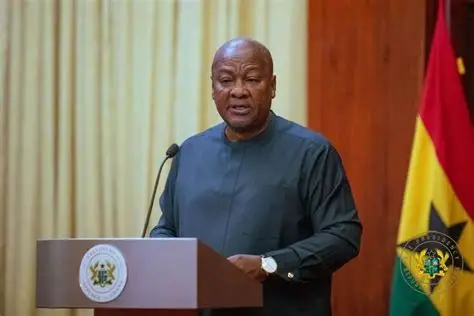
When chiefs from the Western North Region arrived at the seat of government for a courtesy call earlier this week, they carried with them a grievance familiar to many of Ghana’s newer administrative regions: the absence of any operational commercial airport, and the life-threatening consequences that follow when emergencies strike in remote communities hours from the nearest landing strip. President John Dramani Mahama’s response to their delegation cut to the heart of a structural deficit that Ghana’s regional reorganisation, which created six new regions in 2019, has yet to fully reckon with. He announced that his administration would construct airstrips of approximately two kilometres in length in every region that currently lacks an airport, each equipped with a small control office capable of receiving aircraft during emergencies.
The announcement is deceptively simple in its framing, but the governance stakes are considerable. Ghana’s territorial expansion into ten then sixteen regions over the past decade was driven by legitimate demands for administrative proximity and equitable resource distribution. Yet the infrastructure logic that should accompany decentralisation has lagged behind the political logic that enabled it. Western North Region, carved out of the Western Region in 2019 and home to significant cocoa-producing communities and parts of the country’s forest belt, illustrates the contradiction precisely: it gained regional status without gaining the connectivity that makes regional governance functional. A medical emergency in Sefwi Wiawso, the regional capital, can require ground transport over difficult terrain before any air evacuation becomes possible, a gap that costs lives and compounds the developmental disadvantage of interior communities.
President Mahama framed the initiative explicitly around emergency access and medical evacuation rather than commercial aviation, a distinction that matters both fiscally and institutionally. Ghana’s Ghana Airports Company Limited manages the country’s major airport infrastructure, and the capital requirements for full commercial facilities are substantial. Airstrips designed for emergency landings occupy a different regulatory and financial category, potentially falling under civil aviation authority frameworks that allow for faster development timelines and lower maintenance burdens. The two-kilometre specification Mahama cited is consistent with light aircraft and small turboprop operations, the category most relevant to air ambulance services and emergency response rather than scheduled passenger traffic.
Regional Equity and the Infrastructure Debt of Decentralisation
Ghana’s experience sits within a West African pattern that ECOWAS member states have repeatedly confronted: administrative decentralisation that outpaces infrastructure investment creates new centres of political authority without the corresponding capacity to deliver services. Senegal’s expansion of regional governance under its Acte III de la décentralisation encountered similar tensions, as did Nigeria’s proliferation of states and local government areas, which generated administrative units chronically under-resourced relative to their mandates. The difference in Ghana’s current moment is that the airstrip initiative represents an attempt to close a specific, measurable gap rather than make a generalised commitment to regional development.
Within Ghana’s sixteen regions, the ones most directly affected by the absence of airport infrastructure are concentrated among those created in 2019: Ahafo, Bono East, North East, Savannah, Oti, and Western North. Each of these regions contains communities whose distance from Accra, Kumasi, or Tamale, the country’s three primary aviation hubs, creates genuine vulnerability during medical crises or natural disasters. The Savannah Region, for instance, borders Burkina Faso and Ivory Coast and sits at the intersection of climate-stressed agricultural zones and historically underserved public health infrastructure. An emergency airstrip in Damongo, the regional capital, would not merely serve domestic needs; it would position Ghana to coordinate cross-border emergency responses in a sub-region where ECOWAS protocols on humanitarian assistance remain aspirationally written but operationally constrained by physical infrastructure gaps.
The regional integration dimension of this initiative deserves more analytical attention than it typically receives in domestic Ghanaian coverage. Under the ECOWAS Protocol on Free Movement and the African Union’s Agenda 2063 infrastructure commitments, improving intra-regional connectivity is not merely a national development objective but a continental one. Ghana’s airstrip programme, if executed with interoperability standards compatible with regional aviation frameworks, could contribute to the kind of last-mile connectivity that makes AfCFTA’s trade facilitation provisions meaningful for interior communities. Landlocked and semi-landlocked zones across West Africa depend on air access for high-value, time-sensitive goods, including pharmaceuticals, perishable agricultural exports, and emergency humanitarian supplies, and the absence of landing infrastructure is a non-tariff barrier as consequential as any customs regime.
Investor confidence in Ghana’s interior regions also turns on questions of physical accessibility. The Western North Region’s cocoa and timber sectors attract agribusiness interest, but supply chain reliability, including the capacity to move personnel and priority cargo by air when road conditions deteriorate, factors into investment decisions in ways that aggregate infrastructure indices rarely capture. Mahama’s announcement signals an awareness that connectivity is a precondition for the kind of private-sector-led regional development that Ghana’s current economic stabilisation programme, conducted under IMF oversight, nominally prioritises. Whether that signal translates into funded, time-bound construction commitments will determine whether the initiative registers as policy or rhetoric.
The accountability architecture around infrastructure announcements in Ghana has historically been weak. Projects announced during courtesy calls or political visits frequently lack published feasibility studies, procurement timelines, or budget lines in the national estimates. Parliament’s infrastructure committees and the Public Interest and Accountability Committee, which oversees petroleum revenue allocation, provide some oversight mechanisms, but neither is systematically positioned to track smaller regional infrastructure commitments of this kind. Civil society organisations working on regional equity, including those monitoring the implementation of the Regional Reorganisation Act’s development commitments, represent a more proximate accountability layer, and their capacity to demand transparency on the airstrip programme will shape its credibility.
For Western North’s chiefs and the communities they represent, the immediate stakes are straightforward: a landing strip means the difference between a medical evacuation that succeeds and one that does not. Scaled across six or more regions, that calculation represents a governance dividend that decentralisation promised and has not yet delivered. The policy question now is whether Ghana’s Ministry of Transport and the Ghana Civil Aviation Authority can translate a presidential announcement into a procurement process, a construction schedule, and an operational framework that meets both domestic safety standards and the regional interoperability requirements that would make these strips genuinely useful within a West African emergency response architecture. That is the institutional test this initiative sets, and it is one Ghana’s regional neighbours will watch with considerable interest.