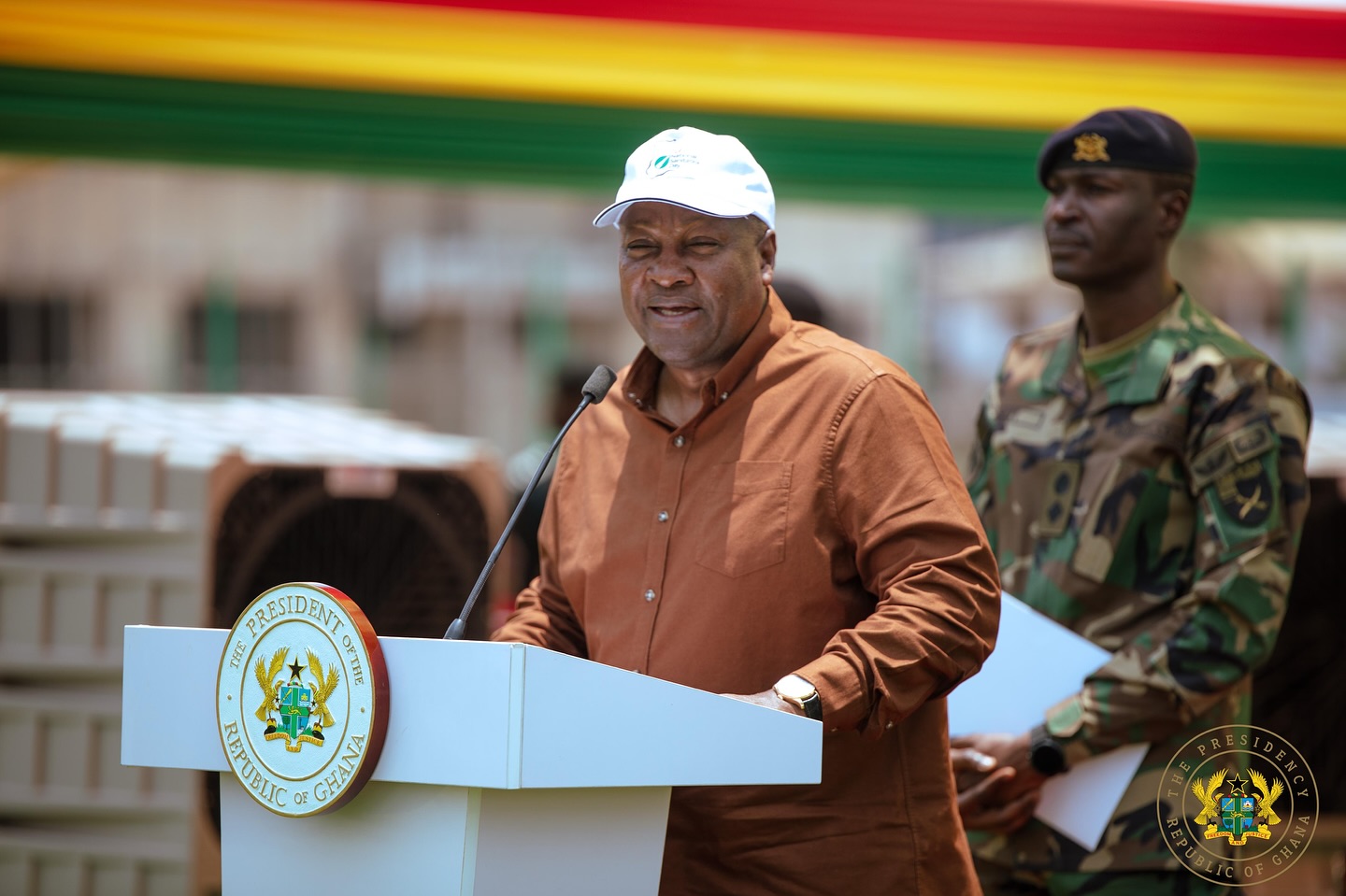
When President John Dramani Mahama addressed citizens in the Volta Region on 17 July 2025, the central question hanging over his remarks was not whether Ghana should fight corruption, but whether its institutions can do so without becoming instruments of political retribution. That distinction, between legitimate accountability and politically motivated prosecution, sits at the heart of Ghana’s governance credibility, and it carries direct consequences for how regional partners and investors assess the country’s rule-of-law environment.
Mahama stated plainly that his administration harbours no malice against any individual and derives no satisfaction from prosecuting those who have committed no wrong. “I believe that our prosecutorial system, investigative system, and judicial system grant enough leverage for people to have justice,” he told the gathering. He added that cases advance only when evidence has been assessed as sufficient, and that anyone wrongfully prosecuted retains full recourse through the courts. These are not merely rhetorical assurances; they describe, at least in principle, the institutional architecture that is supposed to insulate prosecution from executive interference.
Ghana operates a layered anti-corruption framework built around several distinct bodies. The Economic and Organised Crime Office (EOCO) handles financial crimes and asset recovery. The Office of the Special Prosecutor (OSP), created under the Special Prosecutor Act of 2017, was designed specifically to investigate and prosecute corruption implicating public officials, with a mandate that includes sitting and former government members. The Attorney General’s office retains overall prosecutorial authority. Mahama’s point, that arrests by EOCO or the OSP typically follow months of evidence review, reflects a procedural reality, but it also raises a governance question that independent observers have pressed repeatedly: who audits the investigators, and what mechanisms prevent selective case activation against political opponents while shielding allies?
That question is not abstract in the West African context. Across the sub-region, anti-corruption bodies have repeatedly been deployed as tools of factional politics rather than impartial law enforcement. Nigeria’s Economic and Financial Crimes Commission (EFCC) has faced sustained criticism for pursuing opposition figures while high-profile cases involving ruling-party affiliates stall indefinitely. Senegal witnessed the weaponisation of its judicial apparatus against opposition leader Ousmane Sonko ahead of the 2024 elections, a sequence that drew condemnation from civil society and strained ECOWAS’s capacity to credibly arbitrate democratic norms. Ghana has historically distinguished itself from these patterns, and that distinction carries real institutional value, both domestically and within ECOWAS’s democratic governance architecture under the Protocol on Democracy and Good Governance.
The OSP in particular was conceived as a structural answer to the problem of politically influenced prosecution. Its founding legislation granted the Special Prosecutor security of tenure and operational independence from the Attorney General. In practice, however, the office has faced resource constraints, questions about the scope of its mandate, and, critically, the challenge of building public confidence that its case selection is driven by evidence rather than by the political calendar. Mahama’s remarks implicitly acknowledge this credibility deficit, and his framing, that due process provides the safeguard, shifts the burden of proof onto the institutional machinery itself rather than onto executive intent. That is a defensible position, but it requires that the machinery function transparently and consistently.
For Ghana’s investment environment and its standing within AfCFTA’s governance expectations, the stakes are concrete. Foreign direct investment decisions increasingly incorporate rule-of-law assessments, and the World Bank’s Worldwide Governance Indicators consistently show that perceived control of corruption and regulatory quality move in tandem with capital inflows across Sub-Saharan Africa. Ghana’s score on the corruption perceptions index compiled by Transparency International has fluctuated, sitting at 43 out of 100 in 2023, placing it mid-tier regionally but still below the threshold that signals robust institutional integrity to risk-averse institutional investors. A credible, non-partisan anti-corruption drive could meaningfully shift that score; a politicised one would entrench cynicism and accelerate capital flight toward Côte d’Ivoire or Rwanda, both of which have aggressively marketed governance reform as a competitive advantage.
Mahama’s insistence that “accountability is still our priority” also needs to be read against the backdrop of Ghana’s recent fiscal turbulence. The country completed a debt restructuring under an IMF programme in 2023 and 2024, a process that exposed systemic weaknesses in public financial management and procurement oversight. Several of the cases now under investigation by EOCO and the OSP relate directly to that period of fiscal stress, involving allegations of inflated contracts, state enterprise mismanagement, and irregular payments. The political sensitivity is unavoidable: the officials most exposed are largely from the previous New Patriotic Party administration, which governed during the years of fiscal deterioration. Mahama’s National Democratic Congress won the December 2024 election partly on an accountability platform, which means the anti-corruption drive is simultaneously a governance imperative and a political asset, a combination that demands especially rigorous institutional safeguards to prevent the two from collapsing into each other.
The institutional path forward is well-documented in comparative governance literature and in ECOWAS’s own frameworks. Independent prosecutorial oversight boards, transparent case-filing registries, and time-bound disclosure requirements for investigation outcomes all reduce the space for selective enforcement without compromising operational security. Ghana’s Parliament, which retains oversight authority over both EOCO and the OSP, has a direct role to play in demanding those mechanisms, as does civil society, which in Ghana has historically been robust enough to hold both government and opposition to account. The AU’s African Peer Review Mechanism, to which Ghana is a signatory, provides an additional external audit layer that has been underutilised in translating governance commitments into institutional practice.
What Mahama’s Volta Region remarks ultimately signal is that his administration understands the reputational stakes of getting this balance wrong. Saying the right things about due process is necessary but not sufficient. The test is whether the OSP pursues cases that implicate NDC-affiliated actors with the same rigour it applies to NPP-affiliated ones, whether EOCO’s asset recovery actions follow the evidence regardless of political direction, and whether Ghana’s judiciary, which the President himself cited as a safeguard, continues to function with the independence that has historically set it apart in the ECOWAS space. Those outcomes will not be determined by presidential speeches; they will be determined by institutional conduct, case by case, over the course of this administration’s term.