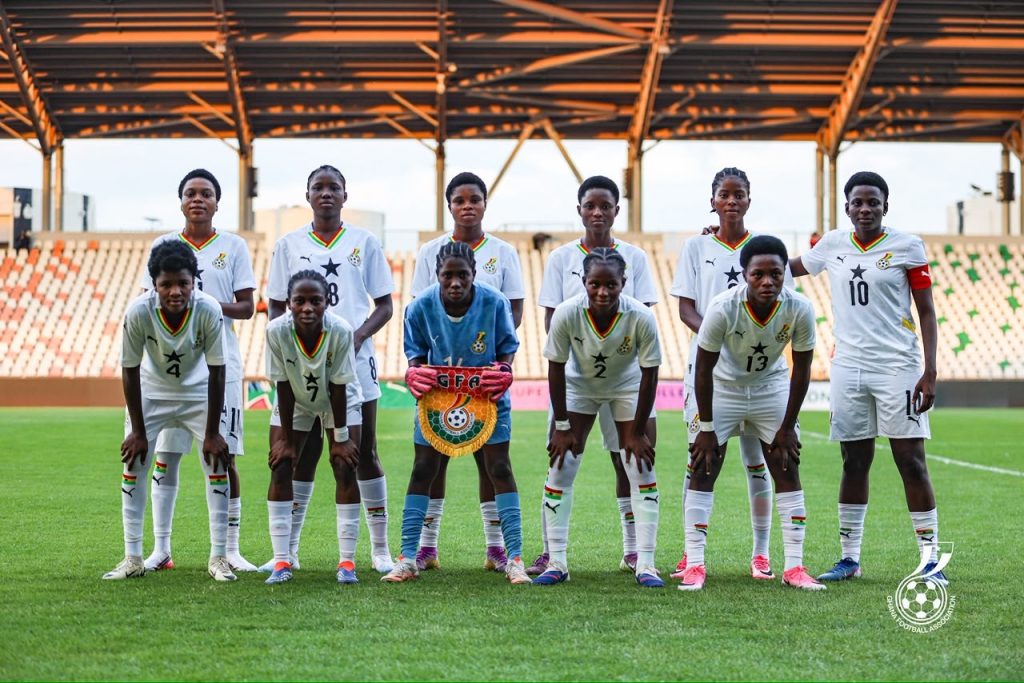
Ghana’s Black Maidens launched their WAFU B U17 Girls Cup campaign on 15 May 2025 with a commanding 4-0 defeat of Burkina Faso, a result that carries significance beyond the scoreline. Within the architecture of West African football governance, the WAFU B U17 Girls Cup functions as both a competitive proving ground and a structural mechanism for identifying talent ahead of the CAF U17 Africa Cup of Nations. Ghana’s performance in this opening fixture positions the Black Maidens as the team to beat in a zone that includes Nigeria, Ivory Coast, and Senegal, all of whom regard youth women’s football as a strategic investment in continental competitiveness.
A Structured Performance Built on Set-Piece Discipline
The match’s decisive sequence began just before the interval, when Linda Achiaa won a penalty that Seidatu Wahab converted with composure in the 45+3rd minute. That moment of set-piece efficiency encapsulated a broader truth about high-functioning youth football programs: technical preparation and mental discipline, not raw athleticism alone, separate well-governed football associations from their regional peers. Ghana’s Football Association has invested in structured coaching pipelines at the youth level, and the Black Maidens’ penalty conversion under tournament pressure reflects that institutional groundwork. Burkina Faso, by contrast, entered the fixture with a program that continues to grapple with funding constraints and the downstream effects of political instability on sports governance, making the gap between the two sides as institutional as it is athletic.
The second half reinforced Ghana’s structural superiority. Gloria Ameaa extended the lead shortly after the restart, Benedicta Danso added a third to put the result beyond doubt, and Hajara Adams completed the scoring in the 84th minute. Four different scorers across the ninety minutes points to squad depth and tactical flexibility, two attributes that distinguish youth programs with genuine development infrastructure from those relying on one or two standout individuals. For Ghana’s coaching staff, the distribution of goals across multiple players is a data point as meaningful as the margin of victory itself.
WAFU B as a Governance and Development Framework
The West African Football Union’s zonal championship structure is not merely a competition format. It is a governance instrument through which ECOWAS-aligned football associations coordinate talent development, refereeing standards, and pathway management toward continental tournaments. WAFU B, covering anglophone and francophone West Africa, operates within the broader Continental mandate of the Confederation of African Football, and its U17 women’s tier serves as a direct feeder into CAF’s flagship youth competitions. Ghana’s ability to field a disciplined, multi-scorer lineup in the opening match signals that its football governance institutions, specifically the GFA’s women’s football division, are functioning with a degree of coherence that several regional peers have struggled to sustain.
The comparison with Burkina Faso is instructive precisely because it is not simply a football story. Burkina Faso’s sports institutions have operated under significant strain since the political transitions of 2022, with budget allocations to youth sport among the first casualties of fiscal retrenchment under military governance. Ivory Coast and Senegal, Ghana’s most credible regional competitors in women’s youth football, have each made explicit national investments in women’s football infrastructure over the past three years, with Senegal in particular benefiting from FIFA Forward funding channeled through a relatively stable federation governance structure. Ghana’s 4-0 win over Burkina Faso does not resolve this regional competitive picture, but it establishes a benchmark that Ivory Coast and Senegal will note as they progress through the group stage.
What the Result Means for Ghana’s Continental Trajectory
Ghana has historically used WAFU B tournaments as preparation for CAF qualification campaigns, and the Black Maidens carry the institutional memory of previous continental appearances. A strong run in this edition of the WAFU B U17 Girls Cup would strengthen the GFA’s case for sustained public and private investment in women’s youth football, an argument that gains traction when results are concrete and visible. Beyond domestic politics, consistent WAFU B performance also affects Ghana’s standing within ECOWAS sporting diplomacy, where football results carry soft-power implications for bilateral relationships and regional institutional credibility.
For investors and development partners tracking women’s sport as an emerging asset class in West Africa, Ghana’s youth football program represents a relatively low-cost, high-visibility entry point. The Black Maidens’ opening performance demonstrates that the pipeline from grassroots identification to tournament-ready squads is operational. Whether the GFA can sustain that pipeline through the tournament and into the CAF qualification cycle will depend on decisions made at the governance level, specifically around coaching continuity, logistics funding, and federation accountability mechanisms, none of which are resolved by a single 4-0 victory. What that victory does accomplish is establish Ghana’s institutional seriousness in a regional competition where seriousness, measured in goals, squad depth, and tactical preparation, is the only credible currency.