What has Ghana actually decided, and who made the call?
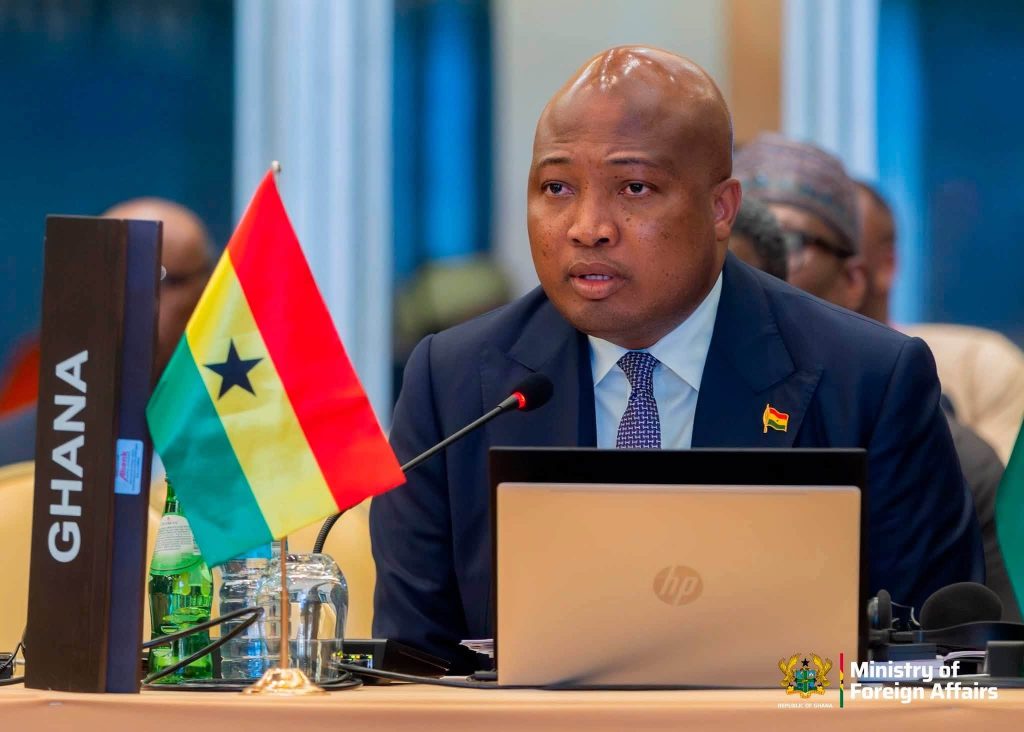
Ghana’s Cabinet, under President John Dramani Mahama, has formally resolved to apply for membership in BRICS, the intergovernmental grouping that now encompasses Brazil, Russia, India, China, South Africa, and a cohort of newer members including Egypt, Ethiopia, Iran, and the United Arab Emirates. Foreign Affairs Minister Samuel Okudzeto Ablakwa disclosed the decision publicly for the first time during the official visit of India’s External Affairs Minister, Dr Subrahmanyam Jaishankar, to Accra, framing it as a strategic recalibration of Ghana’s external partnerships rather than a rupture with existing alliances.
The announcement carries institutional weight precisely because it originated at Cabinet level. This is not a ministerial trial balloon or a diplomatic courtesy extended to a visiting counterpart. It reflects a deliberate foreign policy posture adopted by the Mahama administration, one that positions Ghana’s international economic relationships as a governance question, not merely a diplomatic preference. Ablakwa was explicit: the goal is to “diversify our base and our partnerships” and to expand what he called “economic options” within a South-South cooperation framework.
Ghana has already approached India, a founding BRICS member with significant institutional leverage within the grouping, to assist with the formal application process. Two Memoranda of Understanding were signed during the Jaishankar visit, covering agricultural research and training as well as biodiversity, signalling that the bilateral relationship is being operationalised in parallel with the multilateral bid.
Why does BRICS membership matter as a governance and economic question?
BRICS is no longer the compact five-member club it was at its inception. The grouping’s 2023 expansion round admitted six new members, and a further cohort of “partner states” has since been designated, reflecting a deliberate institutional strategy to build a counterweight to Western-led multilateral architecture, including the IMF, World Bank, and G7 frameworks. For Ghana, which concluded a US$3 billion IMF Extended Credit Facility programme in 2023 following one of the most severe sovereign debt crises in its post-independence history, the appeal of alternative financing and trade structures is not abstract.
The New Development Bank, BRICS’s multilateral lending arm headquartered in Shanghai, offers infrastructure and development financing outside IMF conditionality structures. Ghana’s access to NDB instruments, should membership be confirmed, would diversify its creditor base at a moment when the Ministry of Finance is managing a complex domestic debt restructuring and attempting to restore investor confidence in Ghanaian sovereign instruments. That is a concrete institutional mechanism, not a rhetorical gesture toward multipolarity.
Dr Jaishankar, for his part, framed the bilateral dimension in explicitly developmental terms, noting that Ghana’s flagship programmes, including the Accra Reset economic stabilisation agenda, the Feed Ghana agricultural initiative, and the One Million Coders digital skills programme, carry structural parallels with Indian development models. He called for stronger coordination at the United Nations, including on the contentious question of UN Security Council reform, a position that aligns Ghana with a broader Global South consensus on multilateral institutional redesign.
How does this sit within ECOWAS and West African regional frameworks?
Ghana’s BRICS application raises a question that regional integration analysts will press: does deepening engagement with a grouping that includes Russia and China, two states whose relationships with West African governance institutions have grown complicated in the context of the Sahel’s democratic backsliding, create tension with ECOWAS’s normative commitments to democratic governance and rule of law?
ECOWAS suspended Mali, Burkina Faso, Guinea, and Niger following unconstitutional changes of government, and the bloc’s Authority of Heads of State and Government has consistently invoked its 2001 Supplementary Protocol on Democracy and Good Governance as the institutional basis for those sanctions. BRICS, by contrast, operates on a strict non-interference principle and does not impose political conditionalities on members. Ghana joining BRICS does not formally contradict its ECOWAS obligations, but it does position Accra within a multilateral framework whose normative architecture differs substantially from the one underpinning West African regional integration.
The more immediate regional dynamic concerns trade and investment flows. South Africa, already a BRICS member, is Ghana’s most significant African trading partner outside the ECOWAS zone. China, through its bilateral Belt and Road engagements, is a major infrastructure creditor across West Africa, with projects in Senegal, Ivory Coast, Nigeria, and Ghana itself. BRICS membership could give Ghana a more structured institutional channel through which to negotiate the terms of Chinese capital deployment, including questions of ownership, local content requirements, and debt transparency, that have been poorly governed under purely bilateral arrangements.
Under the African Continental Free Trade Area, which Ghana hosts through the AfCFTA Secretariat in Accra, the ambition is to build intra-African trade from its current level of roughly 15 percent of total African trade to something approaching the 60 percent intra-regional trade shares seen in Europe and Southeast Asia. BRICS membership, if managed with institutional discipline, could complement that agenda by opening preferential market access and technology transfer channels with the grouping’s larger economies, provided Ghana negotiates entry terms that protect its AfCFTA commitments and do not subordinate domestic industrial policy to the export interests of larger BRICS members.
What are the governance risks and investor confidence implications?
The risks are real and deserve direct treatment. Ghana’s credibility with Western institutional investors and multilateral creditors, including the IMF, the World Bank, and the European Union’s development finance instruments, rests partly on its positioning as a stable, rules-based democracy within a regional framework committed to constitutional governance. Any perception that Accra is tilting toward a bloc whose members include states under Western sanctions or whose governance standards diverge sharply from Ghana’s own constitutional norms could introduce a risk premium into Ghanaian sovereign debt pricing at precisely the moment when the Ministry of Finance is attempting to re-access international capital markets.
That said, the framing of BRICS membership as inherently incompatible with Western partnerships is analytically lazy. India, a liberal democracy and a member of the Quad security dialogue alongside the United States, Australia, and Japan, sits comfortably within BRICS. Brazil and South Africa maintain deep institutional relationships with Western multilateral bodies. Ghana’s application, if processed successfully, would place it in company that includes democracies as well as authoritarian states, and its own institutional conduct, through the Bank of Ghana’s monetary governance, the judiciary’s independence, and the Electoral Commission’s credibility, will matter more to investors than membership of a heterogeneous multilateral forum.
Dr Jaishankar’s explicit endorsement of Ghana’s role in the African Union and ECOWAS, and his call for stronger Ghana-India coordination at the United Nations, signals that India at least does not read the BRICS bid as a withdrawal from multilateral engagement. It reads it as an addition to Ghana’s institutional portfolio.
What institutional steps and policy choices come next?
Ghana must now navigate the formal BRICS application process, which since the 2023 expansion has involved a review by existing members and a consensus decision by the bloc’s heads of state summit. With India’s assistance secured and South Africa already a member, Accra has two of the grouping’s founding five in its corner. The application timeline will depend on when the next BRICS summit convenes and whether the bloc has resolved its internal debates about the pace and criteria for further expansion.
Domestically, the Ministry of Foreign Affairs and the Ministry of Finance will need to coordinate on the terms of engagement, particularly around NDB access, trade protocol alignment, and the management of any tensions between BRICS commitments and Ghana’s obligations under AfCFTA, ECOWAS trade protocols, and its IMF programme conditionalities. Parliament’s Foreign Affairs Committee should subject the application to structured scrutiny, examining the specific institutional benefits Ghana expects to derive, the conditionalities or reciprocal obligations membership would entail, and the mechanisms through which Ghana would maintain its normative commitments to democratic governance within a non-interference-based multilateral framework.
The sectors identified for deeper Ghana-India cooperation, pharmaceuticals, railways, ICT, defence, agriculture, and digital technology, represent precisely the productive capacity investments that Ghana’s structural transformation agenda requires. Whether BRICS membership accelerates or merely rebrands those bilateral flows will be the empirical test of whether Accra’s Cabinet decision translates into durable governance and development gains, or remains a diplomatic signal without institutional substance.