
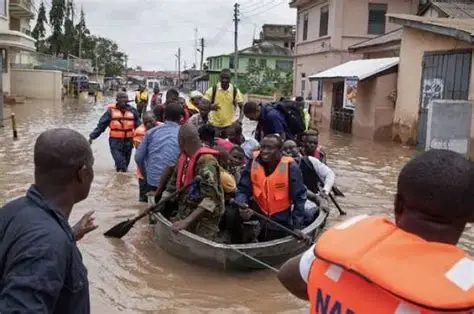
Floodwater does not merely destroy property. It transforms ordinary food products into vectors of disease, and Ghana’s Food and Drugs Authority is now confronting exactly that regulatory challenge following the June 29 floods that swept through parts of the Greater Accra Region.
What triggered the FDA’s alert, and why now?
On 2 July 2025, the FDA issued a formal food safety alert after observing unidentified individuals retrieving food products from flooded sites across Greater Accra. The alert was not precautionary in the abstract: the Authority had already identified social media activity in which individuals publicly announced their intention to distribute recovered items to unsuspecting members of the public, including students. That specific targeting of vulnerable, institutional consumers, such as school populations, elevated the concern from a general public health advisory to an active enforcement matter.
The FDA’s legal mandate under Ghana’s food safety regulatory framework gives it authority to prohibit the sale, distribution, and consumption of products it cannot certify as safe. The June 29 floods created precisely those conditions: mass displacement of food stock, broken cold chains, exposure to contaminated water, and informal redistribution networks operating outside any regulatory oversight.
What makes flood-recovered food dangerous?
The contamination risk is not hypothetical. Floodwaters in urban environments like Accra routinely carry a concentrated mixture of sewage overflow, industrial chemicals, agricultural runoff, and pathogenic microorganisms, including those responsible for cholera, typhoid fever, and dysentery. When food packaging, storage containers, or raw produce come into contact with that mixture, surface contamination is immediate and, in many cases, irreversible without industrial-grade decontamination.
The FDA stated plainly that it “cannot vouch for the safety or quality of these products, as they may have been contaminated by floodwaters and mishandling.” That institutional disclaimer carries regulatory weight: it signals that no product recovered from the June 29 floods can be presumed safe, regardless of its original certification status or intact packaging appearance.
Each of these diseases places direct pressure on Ghana’s public health infrastructure, and each is preventable through the enforcement mechanisms the FDA is now activating.
What does the FDA require households and vendors to do?
The FDA’s alert is structured around a clear set of behavioural and procedural requirements, moving from the most immediate individual actions to broader community-level obligations.
The reporting mechanism is significant. It transforms the public from passive recipients of regulatory guidance into active participants in enforcement, a model that functions most effectively when citizens trust the regulatory institution and believe their reports will generate a response.
How does this fit within Ghana’s broader food safety governance architecture?
Ghana’s FDA operates within a regional regulatory environment where food safety standards are increasingly subject to harmonisation pressure from ECOWAS and the African Continental Free Trade Area (AfCFTA). The ECOWAS Regional Food Safety Policy, adopted to align member states’ regulatory frameworks, establishes baseline standards for food surveillance, contamination response, and cross-border product safety that Ghana is institutionally committed to meeting.
Post-disaster food safety enforcement is a direct test of that institutional commitment. When informal markets redistribute flood-damaged goods, the contamination risk does not respect municipal boundaries. Products originating in Greater Accra can move through informal trade networks into neighbouring regions or across borders into Togo, Côte d’Ivoire, or Burkina Faso, all of which share porous land borders with Ghana and active informal trade corridors. A localised flood event in Accra therefore carries the structural potential to generate a regional food safety incident if domestic enforcement is weak.
The FDA’s statement that it is “working closely with relevant agencies to monitor the safety of food supplies in affected communities” suggests inter-agency coordination is underway. The quality and speed of that coordination, particularly between the FDA, the Ghana Health Service, and local government authorities in Greater Accra, will determine whether the regulatory response contains the risk or merely documents it.
What should regulators and institutions prioritise from here?
The June 29 floods expose a structural governance gap that recurs with each major rainfall event in Accra: the absence of a pre-positioned, rapid-deployment food safety response protocol that activates automatically when flood thresholds are crossed. Reactive alerts, however well-drafted, follow the contamination event rather than anticipate it.
Three institutional priorities emerge from this episode. First, the FDA should formalise a flood-response annex to its standard operating procedures, with pre-agreed coordination roles for the Ghana Health Service, the National Disaster Management Organisation (NADMO), and municipal authorities, so that enforcement capacity deploys within hours of a flood event rather than days. Second, Greater Accra’s chronic drainage infrastructure deficit, which amplifies the severity and reach of each flood, demands sustained capital investment as a food safety precondition, not merely a public works project. Third, regional coordination through ECOWAS food safety channels should include a notification protocol for post-flood contamination events in major urban centres, ensuring that neighbouring states can apply appropriate border-level precautions on food products moving out of affected areas.
The FDA’s alert is technically sound and institutionally appropriate. Whether it translates into effective protection for Greater Accra’s population, and for the broader regional food system, depends on enforcement capacity, inter-agency coordination, and the longer-term political will to treat urban flood infrastructure as a food safety investment.