When food suppliers contracted by the Ghanaian state to feed hundreds of thousands of secondary school students under the Free Senior High School programme find themselves forced to picket government-linked institutions to recover debts, the episode reveals something more significant than a scheduling dispute over invoices. It exposes a structural fault line in Ghana’s public procurement architecture, one where the obligations of state-backed entities to private suppliers remain inadequately enforced, and where the credibility of flagship social programmes rests on payment mechanisms that demonstrably fail the businesses sustaining them.
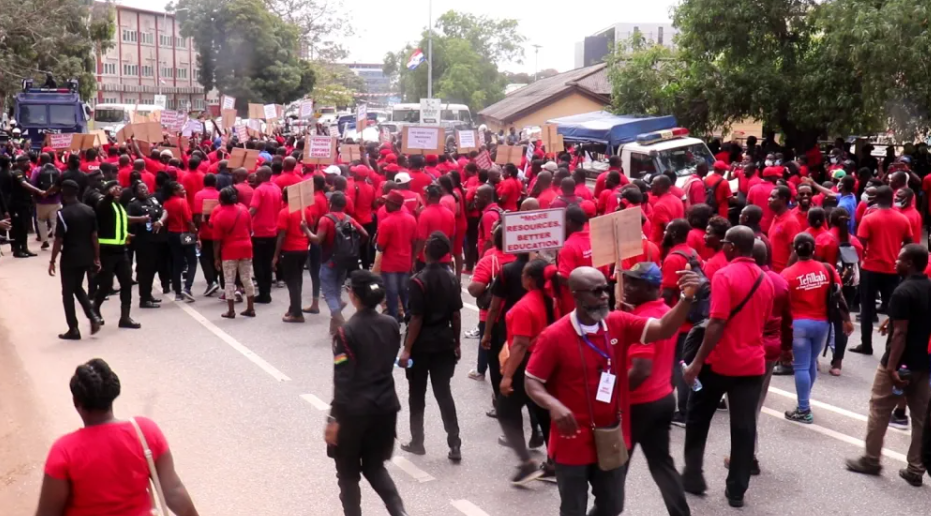
The Controlled Food Suppliers Association, known as the CFSA, announced on 17 November 2026 that its members would stage peaceful protests at two state-linked institutions on 24 November: the Ghana Commodity Exchange, situated on Tumu Avenue in Kanda, Accra, and the National Food Buffer Stock Company Limited, located at No. 18, 4th Circular Road, Cantonments. The picketing, conducted in accordance with the Public Order Act, 1994 (Act 491), is directed at recovering outstanding payments for food items supplied to both the GCX and NAFCO under the Free SHS programme during 2024. The CFSA’s action is not spontaneous; it is the organised response of a supplier community that has exhausted quieter channels and now turns to public demonstration as its instrument of last resort.
The Free SHS programme, launched under President Nana Akufo-Addo’s administration and retained as a political cornerstone across successive governments, represents one of Ghana’s most ambitious social expenditure commitments, enrolling over one million students annually and requiring sustained procurement of food, materials, and services from the private sector. Its operational viability depends entirely on the reliability of the payment chain connecting the Ministry of Finance, implementing agencies like NAFCO, commodity intermediaries like the GCX, and the private suppliers who actually deliver goods to school feeding points. When that chain fractures, the consequences are not merely financial; they threaten the programme’s operational continuity and signal to the broader supplier market that state contracts carry unacceptable settlement risk.
NAFCO’s role in this architecture is instructive. Established as a government-owned enterprise to manage strategic food reserves and buffer stock operations, NAFCO has historically served as a procurement intermediary between smallholder farmers, commodity aggregators, and institutional buyers including the school feeding and Free SHS programmes. The Ghana Commodity Exchange, a more recent institutional addition to Ghana’s agricultural market infrastructure, was designed to bring price transparency, standardised grading, and warehouse receipt financing to commodity trade, reducing the friction and opacity that historically disadvantaged both farmers and buyers. That both institutions now face public picketing over unpaid supplier debts suggests that their operational mandates have outpaced their fiscal underpinning, a pattern familiar across West African state-owned enterprises where political ambition and budgetary reality diverge.
From a regional governance perspective, Ghana’s difficulty in honouring procurement obligations to private food suppliers mirrors broader tensions across ECOWAS member states between expansive social programme design and the payment discipline required to sustain private sector participation. Côte d’Ivoire’s school feeding infrastructure, partly anchored in commodity board procurement, has faced analogous arrears issues, while Nigeria’s Anchor Borrowers Programme generated widespread complaints from agricultural input suppliers over delayed reimbursements. These are not isolated national failures; they reflect a regional pattern in which social programmes are designed with political visibility in mind but without the treasury management systems, escrow mechanisms, or independent payment verification frameworks that would make supplier confidence durable. The CFSA’s protest, viewed through this lens, is less a local grievance and more a symptom of a governance gap that ECOWAS’s regional integration agenda has yet to meaningfully address in the domain of public procurement standards.
The implications for investor and supplier confidence in Ghana’s agricultural commodity sector are concrete. The GCX was positioned, at its founding, as a vehicle for attracting institutional investment into Ghanaian commodity markets, offering structured trading, warehouse receipts, and a rules-based settlement environment that would differentiate Ghana from less formalised regional markets. If one of the exchange’s most visible counterparties, the state itself operating through Free SHS procurement, accumulates unpaid debts to suppliers, it corrodes the institutional credibility the exchange was built to project. Private aggregators and commodity traders assessing whether to route business through the GCX will weigh this reputational signal heavily, and the damage is not easily repaired by assurances alone.
For NAFCO, the stakes are similarly structural. A buffer stock company that cannot settle its procurement obligations on schedule loses its capacity to attract reliable suppliers in subsequent procurement cycles, creating a selection effect where only the most financially resilient or desperate suppliers bid for state contracts, while better-capitalised operators redirect their production toward more creditworthy buyers. Over time, this degrades the quality and competitiveness of the supplier pool available to the state, raising costs and reducing programme effectiveness in ways that never appear in official programme assessments but are acutely felt by school administrators managing food shortages on the ground.
What the CFSA’s action ultimately demands is not merely the settlement of 2024 arrears, though that is the immediate and legitimate claim. It demands that Ghana’s Ministry of Finance, in coordination with the Ghana Revenue Authority and the Controller and Accountant-General’s Department, establish a payment assurance framework for social programme procurement that includes ring-fenced appropriations, mandatory settlement timelines, and independent audit of payment flows from treasury to end suppliers. Several WAEMU countries, operating under the West African Economic and Monetary Union’s convergence criteria and fiscal surveillance mechanisms, have developed more structured approaches to arrears management precisely because monetary union membership imposes external accountability that national political cycles alone do not. Ghana, outside the franc zone but subject to its own IMF programme conditionalities, has the institutional leverage to implement comparable reforms if the political will to protect supplier relationships is treated as a governance priority rather than a budgetary afterthought. The suppliers picketing on Tumu Avenue on 24 November are, in their own way, making exactly that argument.