A mining giant has embedded a high-performance computing and robotics facility inside Ghana’s premier mining university. The question worth asking is not whether the investment is welcome — it plainly is — but what institutional architecture surrounds it, and whether this model of corporate-academic partnership can generate the kind of durable, transferable capacity that Ghana’s extractive sector, and West Africa’s broader industrial ambitions, actually require.
What exactly was commissioned, and by whom?
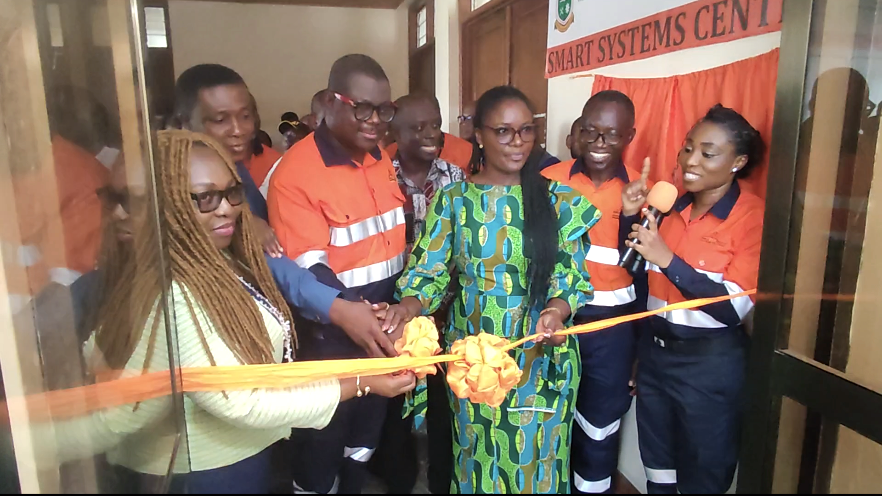
AngloGold Ashanti Iduapriem Mine, the South African gold major’s Ghanaian operation, commissioned a Smart Systems Centre at the University of Mines and Technology (UMaT) in Tarkwa on a capital outlay of US$750,000. The facility houses high-performance computing infrastructure, robotics units and advanced digital software platforms designed to train students and researchers in artificial intelligence, machine learning, big data analytics and real-time mining operations management.
UMaT sits at the heart of Ghana’s Western Region, the country’s primary gold-producing corridor and home to several large-scale mining operations. Placing the centre there is not incidental — it positions the facility within the operational geography of Ghana’s mining industry, shortening the distance between academic output and industrial application. During a pilot phase, students used the centre’s resources to design two functional drones built from locally fabricated materials and to develop a prototype sanitary pad vending machine, early signals that the facility’s scope extends beyond narrow extractive applications.
AngloGold Ashanti Iduapriem’s Managing Director, Daniel Boadi, framed the investment in terms of technological sovereignty: “Our responsibility goes beyond adopting these technologies; we must invest in the minds that will build, advance and master them.” He added that the centre’s computing capacity can process complex mining data generated across Ghana, with the explicit goal of reducing dependence on foreign technology platforms.
Why does this matter for Ghana’s governance of its extractive sector?
Ghana’s mining sector contributed approximately 6 percent of GDP and over 30 percent of export revenues in recent years, yet the country has historically captured limited value from the technological and knowledge dimensions of extraction. Decisions on ore processing, equipment maintenance, environmental monitoring and operational optimization have largely been mediated through proprietary foreign systems, with Ghanaian engineers functioning as operators rather than architects of those systems.
The Smart Systems Centre directly addresses this structural gap. By training engineers in AI-driven mine planning and real-time data analytics within a Ghanaian institutional context, the facility creates conditions for what economists call “technological internalization” — the process by which host countries move from passive technology recipients to active contributors. The Bank of Ghana and the Minerals Commission have both signalled, in separate policy frameworks, that local content in mining must extend beyond employment quotas to encompass skills, procurement and intellectual contribution. This centre operationalizes that ambition in a concrete, measurable way.
UMaT’s Pro Vice-Chancellor, Professor Grace Ofori-Sarpong, described the centre as a partnership that “empowers Ghanaian talent to solve Ghanaian problems.” That framing carries governance weight: it positions the university not as a passive beneficiary of corporate philanthropy but as an institutional co-owner of a national capability-building agenda. AngloGold Ashanti’s parallel disclosure that it invested GH¢17.2 million in education and youth development in the preceding year — including scholarships for 224 students, 77 of them at UMaT — reinforces that this is a structured programmatic commitment rather than a one-off capital donation.
How does this fit within West Africa’s regional technology and industrial agenda?
Ghana’s investment in mining-sector digitalization does not occur in isolation. Across West Africa, the race to build technical capacity in resource extraction is accelerating, driven by three converging pressures: the energy transition reducing long-term demand for fossil fuels while increasing demand for critical minerals; the African Continental Free Trade Area (AfCFTA) creating incentives for value-added processing over raw commodity export; and intensifying competition from Ivory Coast, Senegal and Guinea for foreign direct investment in the mining and technology sectors.
Within ECOWAS, Ghana currently holds a comparative institutional advantage in mining governance. Its regulatory framework, anchored by the Minerals and Mining Act and administered through the Minerals Commission, is among the more transparent in the sub-region. Côte d’Ivoire has expanded gold production significantly, but its technical training infrastructure for mining lags behind UMaT’s established capacity. Senegal, emerging as a new hydrocarbon and mineral producer, is building its own technical institutions from a lower base. The Smart Systems Centre reinforces Ghana’s position as the sub-regional reference point for mining sector governance and human capital development.
The AfCFTA framework, which entered its operational phase in 2021 and now covers 54 African Union member states, explicitly prioritizes industrial development and technology transfer as mechanisms for structural economic transformation. A facility that trains engineers to design and operate AI-driven mining systems within Ghana creates exportable expertise — graduates who can work across ECOWAS member states, reducing the sub-region’s collective dependence on non-African technology providers. That dynamic has direct implications for ECOWAS’s broader agenda of building integrated industrial value chains rather than a collection of competing commodity exporters.
What are the structural limitations of this model?
Corporate-funded academic infrastructure, however well-designed, carries inherent governance risks that require institutional management. The most significant is alignment risk: a facility funded by a single mining company may, over time, orient its research agenda toward that company’s operational priorities rather than broader public or regulatory interests. Ghana’s Minerals Commission and the Ministry of Lands and Natural Resources should establish clear protocols governing intellectual property generated at the centre, research independence and access for students not affiliated with AngloGold Ashanti’s scholarship programmes.
A second structural question concerns sustainability. UMaT’s ability to maintain high-performance computing infrastructure, license advanced software platforms and attract faculty with AI and robotics expertise depends on recurrent funding that a one-time US$750,000 capital investment does not guarantee. The Ghanaian government’s Mineral Development Fund, which channels a portion of mining royalties into community and sector development, represents a natural financing mechanism for operational continuity. Formalizing that linkage would transform the centre from a corporate CSR asset into a durable public institution.
Finally, the centre’s impact on reducing foreign technology dependence will be measured not by the number of students trained but by the number of Ghanaian-designed systems adopted by the mining industry. That requires deliberate procurement policy from both the Minerals Commission and mining operators — a preference for locally developed analytical tools and monitoring systems where they meet technical standards. Without demand-side policy to match the supply-side investment, the centre risks producing technically skilled graduates who export their capabilities to foreign firms rather than building Ghanaian institutional knowledge.
What should institutions do next?
Three policy actions would convert this facility from a promising corporate investment into a structural pillar of Ghana’s mining governance architecture. The Minerals Commission should develop a national digital mining strategy that designates UMaT’s Smart Systems Centre as a certified research and testing environment for AI and automation systems deployed in Ghanaian mines — creating both a regulatory function and a revenue stream for the centre. The Ministry of Education, working with UMaT, should negotiate open-access terms ensuring that students from across West Africa can access the centre’s facilities, positioning Ghana as a sub-regional training hub consistent with ECOWAS’s human capital integration objectives. AngloGold Ashanti, for its part, should publish annual performance metrics for the centre — graduate placement rates, research outputs, technology adoption outcomes — to maintain accountability and demonstrate that the investment generates measurable public value beyond reputational benefit to the company.
Ghana has built something real in Tarkwa. The institutional question now is whether the country’s governance frameworks are strong enough to scale it.