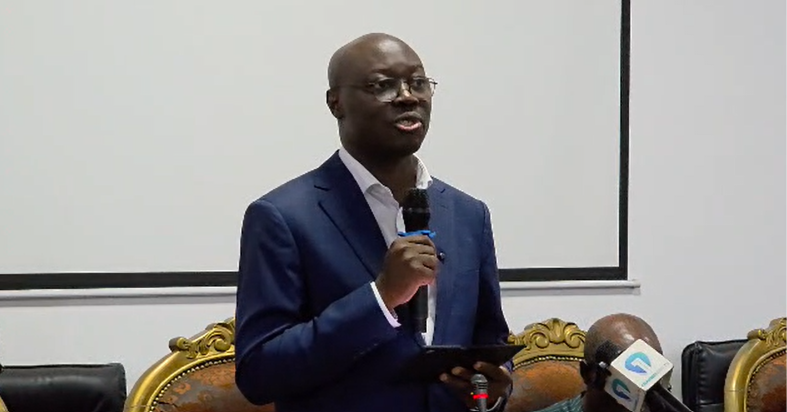
When Ghana’s Finance Minister Dr Cassiel Ato Forson stood before students and faculty at the Kwame Nkrumah University of Science and Technology in Kumasi to defend the government’s proposed New Economy Programme, the central question in the room was both simple and structurally significant: where does the money come from? His answer, that the programme would draw entirely from domestic revenue and fiscal savings rather than new sovereign borrowing, carries implications that extend well beyond Ghana’s borders into the architecture of West African fiscal governance.
Ghana is not alone in navigating the tension between debt sustainability commitments and the political imperative to invest in structural economic transformation. Across ECOWAS, governments that underwent debt restructuring in the aftermath of the COVID-19 fiscal shock, compounded by commodity price volatility and currency depreciation, face the same fundamental constraint: how to generate fiscal space without triggering the alarm of creditors, rating agencies, and the IMF. Forson’s framing of the New Economy Programme as a reallocation exercise, not an expansion of liabilities, is a direct response to that constraint.
The mechanics of the funding model are specific and, on their face, internally consistent. The government plans to commit 1.5 per cent of GDP annually to the programme between 2027 and 2030, sourced from two distinct fiscal levers. The first is a direct revenue allocation of 0.5 per cent of GDP drawn from government receipts. The second, and arguably more consequential, is a deliberate reduction in the primary surplus target, from 1.5 per cent of GDP down to 0.5 per cent. That one-percentage-point adjustment effectively frees up fiscal resources that had previously been earmarked for accelerated debt reduction, redirecting them toward productive investment. The combined annual envelope, Forson indicated, could generate at least US$13 billion over the four-year programme window.
The legitimacy of this approach rests on Ghana’s demonstrated fiscal performance in the preceding years. The country recorded a primary surplus of 2.5 per cent of GDP in 2025, with a further surplus of 1.5 per cent projected for 2026. Those two consecutive surpluses, totalling approximately 4 per cent of GDP in cumulative debt reduction, provide the credibility buffer that makes a deliberate slowdown in fiscal consolidation from 2027 onward defensible. Forson’s argument, in effect, is that Ghana has earned the right to ease off the accelerator, having already built meaningful momentum toward the 45 per cent of GDP public debt target set for 2028.
That target, embedded in Ghana’s post-restructuring debt sustainability framework, functions as a binding governance benchmark rather than an aspirational figure. ECOWAS’s own secondary convergence criteria require member states to maintain debt-to-GDP ratios within manageable thresholds, and the West African Monetary Zone’s push toward a common currency makes fiscal discipline among anchor economies like Ghana a regional, not merely national, concern. If Accra can demonstrate that a primary surplus reduction need not translate into debt trajectory reversal, it offers a replicable model for peer economies, including Senegal, which is managing its own fiscal correction following revelations of underreported deficits, and Côte d’Ivoire, which has pursued infrastructure investment while maintaining Eurobond market access.
Forson also addressed a specific misconception circulating in public discourse around the Ghana Gold Board, known as GoldBod. He clarified that GoldBod does not channel revenue to the Ministry of Finance or the consolidated fund; the state’s fiscal receipts remain anchored to direct taxes, indirect taxes, and non-tax revenue streams. This distinction matters institutionally. In the broader West African context, where commodity revenue management has frequently been a source of opacity and governance failure, from Nigeria’s oil federation account disputes to artisanal mining revenue leakages in Mali and Burkina Faso, Ghana’s explicit delineation of GoldBod’s fiscal role is a small but meaningful act of institutional transparency.
The New Economy Programme itself has not yet been subjected to independent technical scrutiny in the public domain, and that gap is worth naming. The US$13 billion figure is a projection built on GDP growth assumptions, revenue performance forecasts, and a primary surplus trajectory that has not yet been stress-tested against external shocks, including commodity price reversals or a deterioration in Ghana’s access to concessional financing. The IMF’s Extended Credit Facility programme, which has underpinned Ghana’s fiscal stabilisation since 2023, imposes its own conditionalities, and any material deviation from agreed fiscal targets would require renegotiation, a process that carries both time costs and reputational risks for the sovereign.
Investors and regional policymakers watching Ghana’s fiscal evolution will note that the credibility of this programme ultimately depends less on the arithmetic of the funding model and more on the institutional mechanisms that govern its execution. Ghana’s history with earmarked funds and off-budget expenditure, including the Ghana Infrastructure Investment Fund and various statutory funds, illustrates the gap that can open between fiscal design and fiscal reality. Parliamentary oversight, independent audit, and transparent reporting to the Bank of Ghana and the Ministry of Finance will determine whether the New Economy Programme’s funding model holds under pressure.
There is also a regional integration dimension that deserves attention. AfCFTA’s effective operationalisation depends on member states investing in productive capacity, logistics infrastructure, and human capital, precisely the kinds of structural transformation a well-executed New Economy Programme could accelerate. Ghana’s position as a regional trade and services hub, with the AfCFTA Secretariat headquartered in Accra, gives it both a reputational stake and a practical incentive to demonstrate that fiscal discipline and developmental investment are not mutually exclusive. A credible programme, transparently financed and institutionally anchored, would reinforce Ghana’s claim to regional economic leadership at a moment when that leadership is being contested by a resurgent Côte d’Ivoire and a Nigeria still navigating its own structural reform turbulence.
What Forson articulated at KNUST was, at its core, a governance argument: that the state can shift fiscal resources from debt service acceleration toward productive investment without abandoning the rules-based framework that restored market confidence after Ghana’s 2022 default. Whether that argument holds will be tested not in lecture halls but in the quarterly fiscal data releases, the IMF review reports, and the bond market spreads that serve as the real-time verdict on sovereign credibility in West Africa.