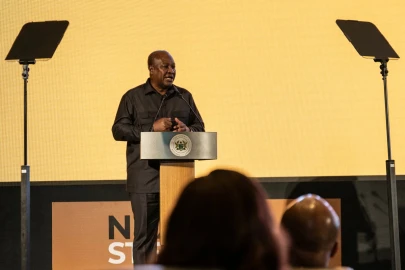
The report landed on President John Dramani Mahama’s desk on a Thursday, and within hours, Justice Minister Dominic Ayine was before journalists confirming what Ghana’s political class had debated for months: the government would accept the Constitution Review Committee’s recommendation to extend the presidential term from four years to five.
It was a quiet announcement for a consequential shift. Ghana, which has sustained an unbroken democratic record since its 1992 constitution came into force, is now weighing a structural redesign of executive power that will reverberate well beyond its borders. The country’s institutional credibility, built painstakingly through successive peaceful transfers of power, gives it an outsized influence on governance norms across West Africa. What Accra does with its constitution, Abuja, Dakar and Abidjan watch closely.
The committee’s central argument is procedural rather than political. A four-year presidential cycle, it concluded, leaves an administration with “a little over two years” of effective governing time. The first six months are consumed by cabinet appointments, agency confirmations and the machinery of transition. The final year belongs, functionally, to electoral campaigning. The math, the committee argued, produces chronic short-termism: infrastructure projects stall, fiscal consolidation is deferred, and reform agendas are sacrificed to electoral calendars. A five-year term, in this framing, is not an expansion of executive privilege but a correction of a structural inefficiency embedded in the constitutional architecture itself.
The committee also proposed that parliament’s term be extended to five years in parallel, aligning the legislative cycle with the executive and reducing the friction of mid-term political realignments. On the question of candidate eligibility, the committee recommended lowering the minimum age for presidential candidates from 40 to 30 years. The government accepted the principle but drew the line at 35, a compromise that signals openness to generational renewal without fully abandoning the experience threshold that older political establishments tend to defend.
Whether these proposals survive Ghana’s referendum process is far from certain. Constitutional amendments of this nature require a national vote, scheduled for 2027, with strict thresholds on both voter turnout and approval margins. Ghana’s referendum architecture was deliberately designed to make fundamental changes difficult, a safeguard against executive overreach. The 2027 vote will test whether the public shares the committee’s diagnosis of democratic inefficiency, or whether it reads the extension of presidential power with the suspicion that West African constitutional history has, in many cases, earned.
That history matters. Across the region, term-limit manipulation has been the preferred instrument of democratic backsliding. Togo’s Faure Gnassingbé used constitutional revision to reset his term count. Guinea’s Alpha Condé triggered a coup by pushing through a new constitution that effectively restarted his tenure. Burkina Faso and Mali have seen constitutional orders collapse entirely. Ghana’s proposal is structurally distinct: it does not reset existing terms, does not remove term limits, and will be subject to popular ratification. But the optics of any government recommending an extension of its own potential tenure carry inherent credibility costs, and the government of President Mahama, himself a returning figure in Ghanaian politics, will need to manage that perception with particular care.
Regional governance frameworks offer some comparative anchor. Within ECOWAS, the protocol on democracy and good governance establishes that constitutional changes affecting the terms and conditions of the exercise of power should not be made to benefit incumbents. Ghana’s proposal does not violate this protocol on its face, since it applies prospectively and requires referendum approval. But ECOWAS’s institutional credibility has been strained by its handling of the Sahelian coups, and the community’s ability to enforce democratic norms is under active contestation. A clean, transparent referendum process in Ghana would, paradoxically, serve a regional governance function: demonstrating that constitutional change through legitimate popular consent remains viable in West Africa.
For investors and development partners operating across the region, Ghana’s constitutional stability has long been a pricing variable. The country’s ability to attract foreign direct investment, access international capital markets, and negotiate trade terms under the African Continental Free Trade Area (AfCFTA) framework rests substantially on perceptions of institutional predictability. A credible, well-administered referendum that produces a clear democratic mandate would likely reinforce that stability premium. A contested or low-turnout vote, by contrast, could introduce precisely the kind of political uncertainty that erodes investor confidence and complicates Ghana’s positioning as a regional hub for services, finance and agro-industrial value chains.
The Governance Calculus Behind the Five-Year Argument
The committee’s efficiency argument deserves serious engagement rather than reflexive dismissal. Comparative governance data from across sub-Saharan Africa suggests that policy implementation timelines for major infrastructure and institutional reform programmes routinely exceed four years. The World Bank’s own project completion data shows average implementation periods for complex governance reforms in the region running between five and seven years. A four-year electoral cycle, in that context, does create structural pressure to prioritise visible, short-cycle spending over durable institutional investment. Senegal, operating under a seven-year presidential term before its 2016 constitutional revision reduced it to five years, experienced precisely this debate in reverse: critics argued the longer term insulated the executive from accountability, while defenders pointed to the policy continuity it enabled.
Ghana’s peer group in West Africa now largely operates on five-year cycles. Nigeria’s constitution provides for four-year terms, but its federal architecture and the sheer scale of its political economy create different dynamics. Ivory Coast, Ghana’s most direct regional competitor for investment and institutional credibility, operates on five-year presidential terms. The alignment question is not trivial: in a region where ECOWAS is attempting to deepen political and economic integration, divergent electoral calendars create coordination costs for regional institutions, joint programmes and cross-border policy alignment.
The age threshold debate, while receiving less attention than the term extension, carries its own governance weight. West Africa has one of the youngest populations on the planet, with median ages across the region sitting below 20 years in several countries. A constitutional minimum of 35 for presidential candidates, down from 40, signals a formal acknowledgment that leadership pipelines need to open. Whether that signal translates into substantive political change depends on party structures, access to campaign finance, and the informal gatekeeping that constitutional text cannot reach.
What Ghana does next will be watched. The 2027 referendum is not merely a domestic event. It is a test of whether West Africa’s most stable democracy can reform its own institutions through transparent popular consent, and whether the region’s governance architecture can absorb constitutional change without the instability that has consumed its neighbours. The committee has submitted its report. The government has signalled its position. The citizens of Ghana will have the final word, and the weight of that word extends far beyond Accra.