When Ghana’s Tema–Mpakadan railway line was commissioned, it was presented as a milestone in the country’s long-deferred infrastructure modernisation. What a forensic audit later revealed was something considerably less triumphant: a corridor put into service without functional signalling, without operational level crossing controls, without point machines, and without a working public address system. The Ghana Railway Development Authority (GRDA) has now confirmed that the current administration inherited, in effect, a railway that was not ready to run.
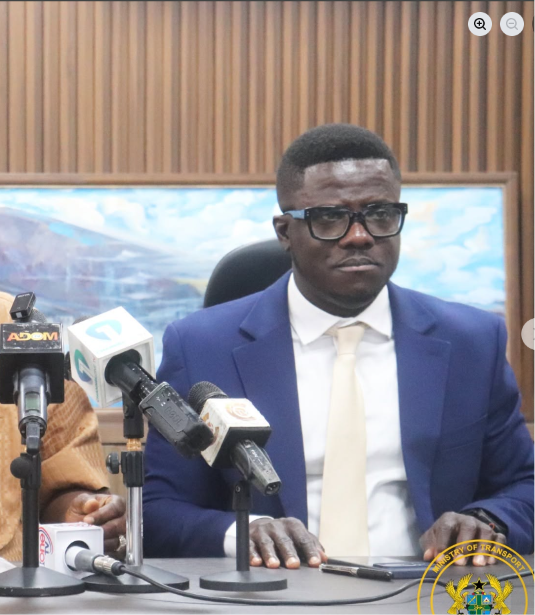
The disclosure, made by GRDA Chief Executive Officer Dr Frederick Appoh at a press briefing, carries implications that extend well beyond the technical. It surfaces a recurring governance question in West African infrastructure delivery: the gap between ribbon-cutting and operational readiness, and the institutional mechanisms, or absence thereof, that allow that gap to persist.
The immediate financial response is a US$21 million grant secured from the European Union Commission under the EU Sustainability and Interoperability Grant Scheme for Africa. Ghana competed for the funding through a formal process, and the award will finance the installation of an ETCS Level 1 signalling system — the European Train Control System standard widely used across rail networks that prioritise safety and interoperability. Dr Appoh confirmed the grant was secured under the directive of Transport Minister Joseph Bukari Nikpe, with the GRDA’s technical team leading the application.
The ETCS Level 1 standard is not an arbitrary technical choice. It is the baseline signalling architecture used across European rail corridors and increasingly mandated in infrastructure agreements involving EU financing. Its adoption on the Tema–Mpakadan line would position Ghana’s railway within a recognised international framework, a consideration that matters both for future financing and for any ambition to integrate the corridor into broader West African freight logistics.
The Tema–Mpakadan line runs approximately 97 kilometres from Ghana’s principal port city to the Volta River town of Mpakadan, where it connects to the Boankra Inland Port project and, in strategic terms, to trade routes reaching into landlocked countries to the north. Burkina Faso, Mali, and Niger have historically depended on Ghanaian port infrastructure for a significant share of their import and export flows. A functioning, safe, and commercially reliable rail corridor on this axis would reduce road freight costs, cut transit times, and relieve pressure on the Tema–Accra highway, which bears a disproportionate share of regional cargo movement.
That regional dimension is precisely what makes the commissioning failures consequential beyond Ghana’s borders. ECOWAS has maintained a long-standing framework for transport corridor development, and the Authority of Heads of State has repeatedly endorsed the interconnection of national rail networks as a strategic priority. When a member state commissions infrastructure that cannot operate safely, it delays not just domestic service but the regional integration calculus that depends on each national link functioning as designed.
Ghana’s situation also invites comparison with Côte d’Ivoire, its most direct regional competitor for port transit traffic. The Abidjan–Ouagadougou rail corridor, operated under the SITARAIL concession, has faced its own operational difficulties, but Côte d’Ivoire has maintained a more consistent institutional framework for railway regulation and concession oversight. Senegal’s integration of the Dakar regional express rail into an urban mobility strategy offers a different model: phased commissioning with independent technical validation before commercial operation. Ghana’s experience with Tema–Mpakadan suggests that independent pre-commissioning audits, rather than politically timed inaugurations, should become a non-negotiable governance standard.
The forensic audit that uncovered the deficiencies was itself a governance instrument. Conducted under the current administration, it produced the evidentiary basis on which the EU grant application was built. That sequence, audit, documentation, competitive grant application, technical remediation, represents a more accountable infrastructure management cycle than the one that produced the original commissioning. The question is whether this cycle becomes institutionalised or remains an ad hoc correction to a specific political inheritance.
For investors and development finance institutions watching Ghana’s infrastructure sector, the episode carries a dual signal. On one hand, it confirms that procurement and commissioning oversight in large infrastructure projects requires structural reinforcement, whether through the GRDA’s own technical capacity, independent engineering certification, or parliamentary infrastructure committees with genuine review authority. On the other hand, Ghana’s successful navigation of a competitive EU grant process demonstrates institutional competence and credibility with multilateral partners, a non-trivial asset in a financing environment where African governments increasingly compete for concessional and grant capital.
The AfCFTA framework, which Ghana hosts through the AfCFTA Secretariat in Accra, assigns particular importance to trade facilitation infrastructure. Rail connectivity between coastal ports and landlocked member states is among the most direct physical expressions of the agreement’s ambition. A Tema–Mpakadan corridor operating at full commercial capacity, with certified safety systems and reliable scheduling, would strengthen Ghana’s position as a trade facilitation hub, and give concrete meaning to AfCFTA commitments that too often remain aspirational on paper.
What the GRDA and the Ministry of Transport now face is a delivery test. The US$21 million is secured; the ETCS Level 1 specification is defined. The governance challenge shifts to procurement integrity in the signalling contract, construction supervision, and a commissioning process that does not repeat the errors of its predecessor. Dr Appoh’s public announcement sets a political accountability marker: the funding is on record, the technical scope is stated, and the expectation of full operationalisation is now a measurable commitment rather than an aspirational timeline. Ghana’s railway governance will be judged, in part, by whether this corridor reaches commercial service on the terms that have now been publicly declared.