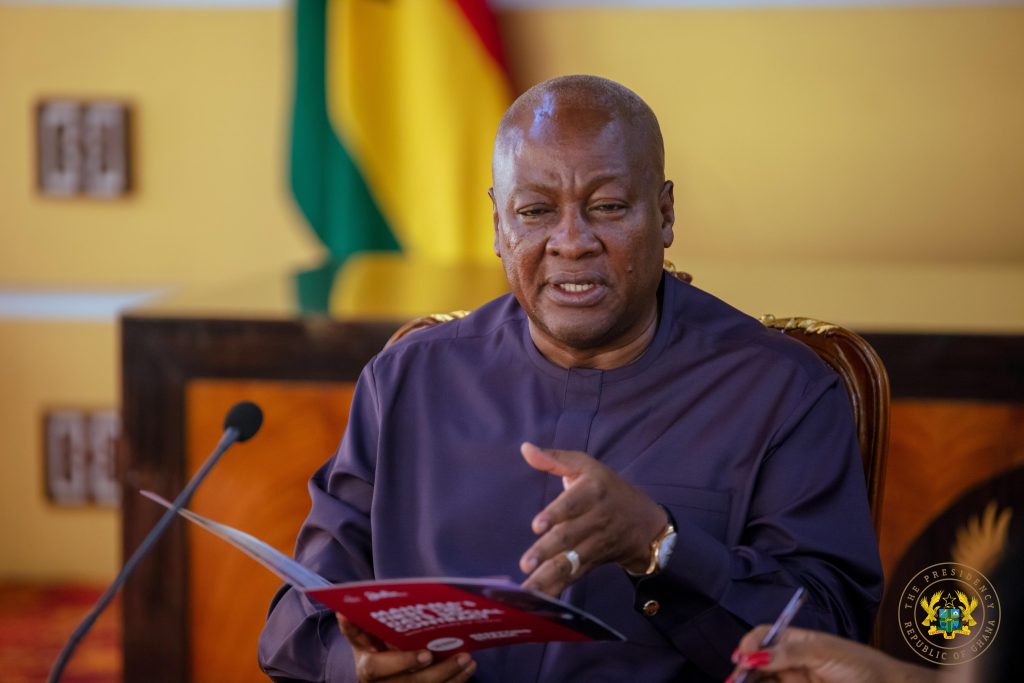
The corridors of Ghana’s National Security Council Secretariat carry a particular weight. They connect intelligence units, logistics departments, and special investigations arms whose coordination, or lack thereof, determines how effectively the state protects its borders, its citizens, and ultimately, the institutional stability that underpins investor confidence across the sub-region. On Tuesday, 11 August, President John Dramani Mahama moved to reshape those corridors decisively, approving a sweeping reorganisation that places retired Major General William Ayamdo, former Chief of Army Staff, at the operational heart of the country’s security apparatus.
Ayamdo’s appointment as Deputy National Security Coordinator in charge of Operations is not a ceremonial posting. It signals a deliberate institutional choice: to anchor Ghana’s security operations in military professionalism at a moment when West Africa’s security environment has grown measurably more volatile. From the Sahel’s cascading governance failures to the persistent threat of maritime insecurity in the Gulf of Guinea, Ghana occupies a strategic position that demands a security secretariat functioning with both coherence and command clarity. Mahama’s reshuffle appears designed to deliver exactly that.
The reorganisation extends well beyond a single headline appointment. Former National Security Coordinator Yaw Donkor has been reassigned to the Office of the National Security Advisor, where he will serve as Director of Intelligence and Research, a role that repositions rather than sidelines his institutional knowledge. Adam Saaka moves into the directorship of Logistics and Transport, a function whose operational significance is often underestimated but which determines whether security directives translate into field-level action. Faustina Effah-Boadi takes charge of the Human Security Department, a portfolio whose mandate encompasses civilian protection frameworks that align with ECOWAS’s own human security protocols. Retired DCOP Peter Ndekugri assumes command of the Special Investigations Unit, while ACP Alhassan Osman has been returned to the Ghana Police Service for further deployment, closing his chapter at the Secretariat with immediate effect.
What makes this restructuring analytically significant is not merely the personnel changes themselves, but the institutional logic they reveal. Ghana’s National Security Council Secretariat has historically struggled with coordination gaps between its intelligence, operations, and logistics functions, a structural weakness that external assessments have noted in the context of ECOWAS’s regional security frameworks. By installing a former army chief in the operations role and repositioning intelligence expertise within the advisory office, the Mahama administration appears to be drawing a cleaner institutional boundary between strategic intelligence analysis and operational execution. That distinction matters enormously in governance terms: conflating the two functions has been a documented source of accountability failures in peer institutions across the region.
Security Governance and the Regional Stakes
Ghana’s security architecture does not operate in isolation. As a non-WAEMU member that nonetheless anchors ECOWAS’s democratic credentials in a bloc increasingly destabilised by military coups in Mali, Burkina Faso, Niger, and Guinea, Accra carries disproportionate institutional weight. The credibility of Ghana’s governance institutions, including its security services, directly affects the sub-region’s capacity to present a coherent democratic front within the African Union’s Peace and Security Council frameworks. A well-functioning, professionally led National Security Secretariat in Accra reinforces the argument that civilian-led security governance remains viable in West Africa, an argument that has lost considerable ground since 2020.
There is also a direct economic dimension that analysts and investors track closely. Ghana’s ongoing engagement with the International Monetary Fund, its AfCFTA trade facilitation commitments, and its ambitions to position Accra as a regional financial hub all depend on a stable security environment managed through transparent, accountable institutions. Foreign direct investment decisions in extractive sectors, particularly in the northern regions where Ayamdo’s military career gave him operational familiarity, are sensitive to perceptions of state security capacity. A secretariat that functions with clear lines of authority and professional leadership sends a signal that governance infrastructure is being maintained even as the country navigates fiscal consolidation.
The inclusion of a Human Security Department under Effah-Boadi’s leadership is worth particular attention. Human security as a governance concept, encompassing food security, displacement, and civilian protection, sits at the intersection of Ghana’s domestic policy obligations and its ECOWAS commitments under the 1999 Protocol Relating to the Mechanism for Conflict Prevention, Management, Resolution, Peacekeeping and Security. Ghana has historically been a net contributor to ECOWAS peacekeeping operations, and embedding human security as a distinct institutional function within the Secretariat reflects an understanding that security governance in the 21st century cannot be reduced to hard-power operations alone. It is a structural acknowledgment that displacement pressures from the Sahel, including cross-border movement into Ghana’s northern territories, require a dedicated institutional response.
What remains to be seen is whether the reorganisation produces the coordination gains it implies on paper. Institutional reshuffles of this scale carry inherent transition risks: knowledge gaps open, informal networks that sustained operational continuity are disrupted, and new leadership teams require time to establish working relationships with field units and partner agencies. Ghana’s security services have navigated political transitions before, and the professional corps within the Secretariat carries institutional memory that transcends any single administration. The test of this reorganisation will come not in its announcement, but in the months that follow, when operational demands reveal whether the new architecture holds under pressure.
For now, the Mahama administration has made a clear institutional bet: that placing a career military commander with Ayamdo’s seniority and operational record at the centre of security coordination will sharpen Ghana’s response capacity while maintaining the civilian oversight framework that distinguishes Accra’s governance model from those of its neighbours who have fallen to the coup cycle. Whether that bet pays dividends will be measured not in press releases, but in the quiet, unglamorous work of institutional coherence that security governance demands.