A contractual breach dating back years finally reached its breaking point in October 2026, when the University of Ghana branch of the University Teachers Association of Ghana (UTAG-UG) formally notified the National Labour Commission that it would withdraw all teaching and related services unless the government settled outstanding payments within days.
The roots of the dispute trace to 9 October 2026, when UTAG-UG President Dr. Jerry Joe Harrison signed and dispatched a strike notice addressed to the National Labour Commission, setting a hard deadline of 16 October for the government to pay the 2026 Book and Research Allowance. The notice made clear that if payment was not received by that date, members would cease teaching and all related academic services from Monday, 19 October 2026.
What gave the threat its institutional weight was not merely the frustration of individual academics, but the existence of a binding legal framework that the government had already agreed to honour. In 2020, UTAG and the government signed a Memorandum of Agreement stipulating that the Book and Research Allowance must be disbursed by the end of August each year. By the time Dr. Harrison’s notice reached the National Labour Commission, the government was already more than six weeks past that contractual deadline, with no payment made and no credible public explanation offered.
The notice was copied to a notably broad set of institutions: the Fair Wages and Salaries Commission, the Ministers of Employment and Labour Relations, Finance, and Education, the Ghana Tertiary Education Commission, and UTAG’s national leadership. That distribution was deliberate. By formally notifying each body, UTAG-UG created an accountability trail that would be difficult for any single ministry to deflect, while simultaneously signalling that the association viewed this as a systemic governance failure rather than an administrative oversight.
A Governance Failure With Structural Roots
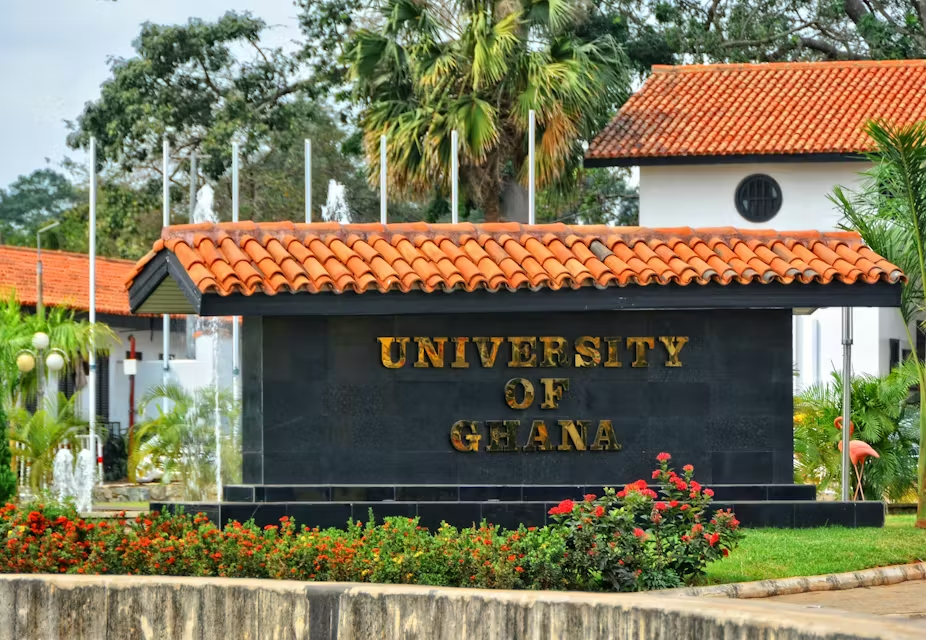
The Book and Research Allowance is not a discretionary benefit. It is a negotiated entitlement designed to sustain the research capacity of university academics at Ghana’s premier public institution, the University of Ghana in Legon. Its annual disbursement is meant to support library acquisitions, journal subscriptions, fieldwork, and scholarly publication, activities that underpin the university’s standing as a regional centre of knowledge production. When the government delays or withholds the allowance, it does not merely inconvenience individual lecturers; it erodes the institutional infrastructure that makes the University of Ghana competitive within West Africa’s higher education landscape.
This is not the first time UTAG has been forced to escalate over the same issue. The pattern of late or incomplete payment of the Book and Research Allowance has recurred across multiple budget cycles, suggesting that the problem is not one of administrative oversight but of fiscal prioritisation. Ghana’s public wage bill has been a persistent source of tension with the International Monetary Fund under successive adjustment programmes, and tertiary education allowances have often been caught in the crossfire of mid-year expenditure controls. The 2020 Memorandum of Agreement was itself a product of earlier disputes, intended to lock in a payment schedule that would prevent exactly this kind of recurring standoff.
By October 2026, that agreement had evidently failed to produce the institutional compliance it was designed to secure. The Ministry of Finance had not released the funds by the August deadline, and weeks passed without a formal response to UTAG-UG’s internal communications. Only when the association moved to engage the National Labour Commission, the statutory body responsible for mediating industrial disputes in Ghana, did the matter acquire the urgency of a potential strike.
The implications for students at the University of Ghana were immediate and concrete. A withdrawal of teaching services from 19 October would have disrupted end-of-semester lectures, tutorials, and assessments for thousands of undergraduate and postgraduate students. The University of Ghana serves as a feeder institution for Ghana’s professional and public service class, and academic disruptions at Legon carry reputational and economic costs that extend well beyond the campus.
Within the West African higher education space, the episode also carried a cautionary signal. Peer institutions in Côte d’Ivoire, Senegal, and Nigeria have each grappled with cycles of academic labour disputes rooted in delayed government payments, and the region has not yet developed a robust framework for insulating university financing from short-term fiscal pressures. Ghana’s own experience with the 2020 Memorandum of Agreement represented an attempt to institutionalise payment discipline through a contractual mechanism, but without enforcement provisions and with fiscal space remaining constrained, such agreements have limited coercive power.
For investors and development partners monitoring Ghana’s governance environment, the UTAG-UG notice added another data point to an already complex picture. Ghana completed a staff-level agreement with the IMF in 2023 as part of its debt restructuring process, and fiscal consolidation has since required difficult trade-offs across the public sector. But the consistent failure to honour a negotiated allowance schedule for university teachers points to a prioritisation problem within the Ministry of Finance’s expenditure management, one that risks compounding human capital deficits at precisely the moment Ghana needs its research institutions to support economic diversification.
The Fair Wages and Salaries Commission, copied on the notice, holds a specific mandate to ensure that public sector compensation agreements are implemented equitably and on schedule. Its silence in the weeks preceding the October deadline raised questions about whether the Commission was exercising that mandate with sufficient rigour, or whether it lacked the institutional leverage to compel timely disbursement when the Ministry of Finance chose to delay.
What the UTAG-UG notice ultimately exposed was a gap between contractual obligation and fiscal execution that no memorandum of agreement alone can close. Sustainable resolution requires the Ministry of Finance to ring-fence the Book and Research Allowance within the annual budget appropriation, giving it protected status that insulates it from mid-year expenditure freezes. The Ghana Tertiary Education Commission, which oversees public universities, should in turn develop a monitoring mechanism that triggers formal escalation when allowance payments breach their contractual deadlines, without requiring UTAG branches to initiate the process themselves. Until those institutional fixes are in place, the cycle of threatened strikes, last-minute negotiations, and deferred payments will continue to drain academic morale and institutional credibility at Ghana’s public universities.