When a Kenyan industrial energy firm scores 87.5 points on B Lab’s rigorous B Impact Assessment, clearing the 80-point certification threshold, the result is more than a badge of corporate virtue. It is a data point in a live experiment: can a Build-Own-Operate biomass energy model, anchored in local agricultural waste streams, replace imported fossil fuels for African manufacturers without sacrificing commercial viability?
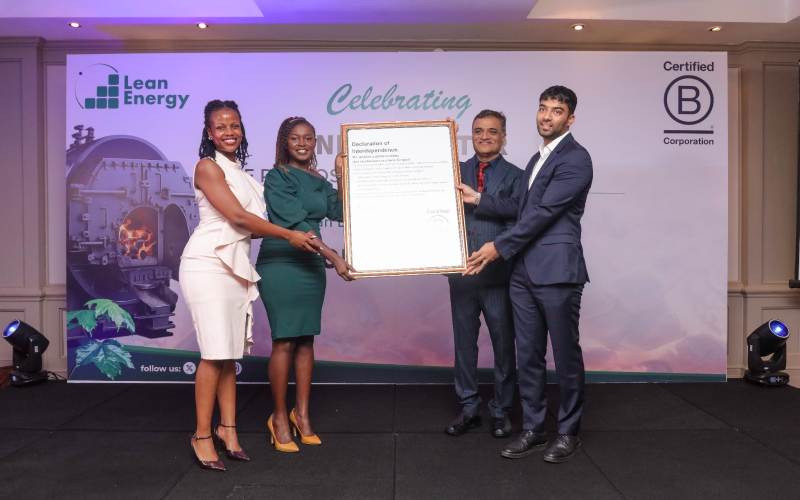
Lean Energy Solutions, founded by Dinesh Tembhekar and headquartered in Nairobi, received its B Corp Certification from B Lab in mid-2025, becoming one of a still-small cohort of East African industrial firms to meet the standard. B Lab’s assessment methodology examines governance structures, worker welfare, community value creation and environmental management, not merely the sustainability credentials of a company’s end product. That breadth matters: it distinguishes certified firms from those that greenwash at the product level while maintaining extractive internal practices.
Elizabeth Mutwiri, Communications and Engagement Senior Associate at B Lab Africa, was direct about what the certification signals. “The assessment looks beyond a company’s products to how it is governed, how it supports its workers, creates value for communities and customers, and manages its environmental impact. Lean Energy’s certification demonstrates that responsible business practices can be embedded in how an industrial company operates, competes and grows,” she said. The emphasis on governance and embeddedness, rather than peripheral corporate social responsibility programming, reflects a maturing conversation about what accountable business actually looks like in African industrial contexts.
Lean Energy’s core model is structurally interesting from a development-finance perspective. The company finances, installs, operates and maintains biomass boiler systems under a Build-Own-Operate arrangement, meaning manufacturers pay only for the steam they consume rather than carrying upfront capital expenditure for energy infrastructure. This shifts the investment risk onto the operator, lowers the barrier to entry for manufacturers and creates a recurring-revenue structure that, in principle, aligns Lean Energy’s commercial incentives with its clients’ long-term energy cost reduction. The fuel source, agricultural residues including maize cobs and coffee husks, is sourced locally, which simultaneously reduces foreign exchange exposure for manufacturers and creates demand-side value for smallholder farmers who would otherwise treat these residues as waste.
The foreign exchange dimension deserves particular attention in the current macroeconomic environment. Across East and West Africa, manufacturers have absorbed severe input cost inflation driven partly by currency depreciation against the US dollar, through which most fossil fuel imports are priced. Kenya’s shilling lost significant ground against the dollar between 2022 and 2024 before a partial recovery. Ghana’s cedi experienced one of its most acute depreciations on record in 2022, compressing industrial margins sharply. Nigeria’s naira has undergone a managed float that dramatically repriced energy imports. In each case, manufacturers with exposure to imported diesel or heavy fuel oil absorbed costs that a locally sourced biomass model would have partially insulated against. Lean Energy’s pitch, that its model reduces dependence on imported fuels while delivering reliable, lower-carbon steam, addresses a genuine structural vulnerability.
Tembhekar framed the ambition in continental terms. “Africa’s industrial growth should not come at the expense of competitiveness or the environment. This certification strengthens our ambition to scale a model that gives manufacturers reliable, lower-carbon energy while building local value chains and reducing dependence on imported fuels,” he said. The language of local value chains is not incidental. Under the African Continental Free Trade Area framework, member states have committed to deepening intra-African trade and reducing the continent’s dependence on extra-African commodity imports. Industrial energy models that substitute local agricultural residues for imported fossil fuels are, in a narrow but real sense, structurally aligned with AfCFTA’s localization objectives, even if the formal trade architecture and the energy-services sector rarely speak to each other directly.
The ECOWAS region presents a particularly compelling expansion context. West Africa’s industrial base, concentrated in Ghana, Côte d’Ivoire, Nigeria and Senegal, is energy-intensive and disproportionately dependent on fossil fuels, with electricity reliability remaining a persistent constraint on manufacturing competitiveness. Ghana’s industrial sector has long operated against a backdrop of erratic grid power and expensive backup generation. Côte d’Ivoire, the region’s most dynamic manufacturing hub, has invested heavily in gas-fired power but remains exposed to gas supply disruptions from Nigeria through the West African Gas Pipeline. Senegal, now an emerging hydrocarbon producer, faces the governance challenge of ensuring oil and gas revenues finance productive diversification rather than entrenching fossil-fuel dependency. A biomass steam model that decouples industrial heat generation from grid electricity and imported liquid fuels could find commercial traction across all four markets, provided the agricultural residue supply chains can be organized at sufficient scale.
That supply-chain question is where the model’s replicability will ultimately be tested. Kenya’s agricultural geography, with its dense smallholder coffee and maize cultivation, provides a relatively accessible feedstock base. West African analogues exist: cocoa husks in Ghana and Côte d’Ivoire, groundnut shells in Senegal, rice husks across the Sahel. But aggregating these residues into reliable industrial fuel streams requires logistics infrastructure, quality standardization and offtake agreements that do not yet exist at meaningful scale in most markets. The governance environment matters here too. Where land tenure is insecure, where smallholder cooperatives lack legal standing, or where local government licensing processes are opaque, the transaction costs of building biomass supply chains rise sharply, eroding the commercial case.
B Corp certification does not resolve those structural challenges, but it performs a specific function in the capital-raising environment Lean Energy will need to navigate as it pursues continental expansion. Impact investors, development finance institutions including the IFC, the British International Investment, and Proparco, and increasingly mainstream institutional investors apply environmental, social and governance screens to industrial investments. A certified score of 87.5 on the B Impact Assessment provides a third-party-verified governance and impact baseline that reduces due-diligence friction and signals credible accountability mechanisms to prospective capital partners. In a continent where impact-washing remains a documented risk, that verification carries real informational value.
What Lean Energy’s certification ultimately illustrates is a governance proposition as much as an environmental one: that industrial firms operating in African markets can structure their ownership, labor, community and environmental practices to meet internationally recognized accountability standards, and that doing so is compatible with, rather than antagonistic to, commercial growth. Whether that proposition scales from one certified Kenyan firm to a regional industrial-energy model depends less on the certification itself than on the regulatory frameworks, agricultural logistics and development-finance architectures that African governments and regional institutions build around it. The model exists. The institutional scaffolding that would allow it to replicate is still being constructed.