Kenya’s President William Ruto announced on Sunday that his government will reduce the cost of fertiliser and seeds for farmers hit by below-average rainfall, framing the intervention as an emergency measure to protect food production ahead of the anticipated September-October planting season, with longer-term infrastructure commitments suggesting a structural shift in how Nairobi intends to manage agricultural vulnerability.
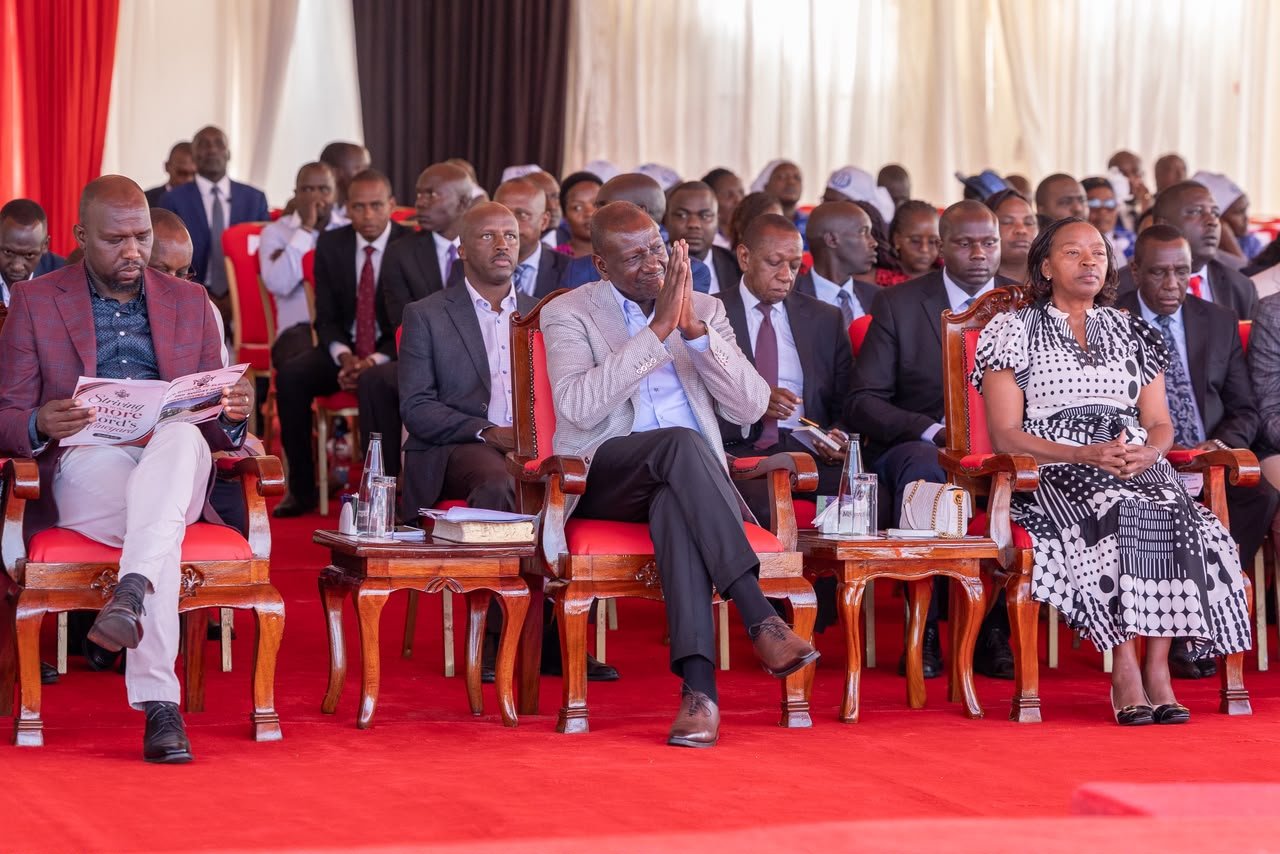
Speaking at the Anglican Church of Kenya’s St Stephen’s Chepkoilel in Moiben Constituency, Uasin Gishu County, Ruto acknowledged that crop failure resulting from poor rains had placed significant pressure on farming communities across the country’s food basket regions, and that subsidised inputs were the government’s immediate instrument of response. The announcement, delivered from a church pulpit rather than a policy forum, nonetheless carried concrete programmatic weight, pointing to the National Infrastructure Fund as the financial vehicle for a sweeping water harvesting agenda.
That agenda, as Ruto described it, involves the construction of 50 mega dams, 200 medium dams, and 1,000 micro dams intended to expand irrigation farming, particularly across Kenya’s arid and semi-arid lands. The scale of the proposal is considerable, and the institutional mechanism, channelling capital through a recently established national fund, reflects an approach increasingly common among East African governments seeking to reduce dependence on erratic rainfall without waiting for regional climate financing frameworks to mature. Whether Kenya’s procurement and implementation capacity can absorb such an ambitious build-out remains an open governance question, one that past infrastructure cycles in the region have not always answered favourably.
A Development Charter and the Question of Constitutional Alignment
Ruto also used the occasion to elaborate on his proposed National Development Charter, a framework he first floated the previous week as a successor to Vision 2030, the long-range development blueprint formulated under former President Mwai Kibaki. His argument for a new plan rested on a specific institutional logic: Vision 2030 predates Kenya’s 2010 Constitution, and the country’s development architecture must now be brought into alignment with the constitutional order that has since been fully operationalised. “We have operationalised all sections of the Constitution,” Ruto said. “Now we must operationalise the development chapter, and it cannot be done in darkness. People must come out and give their suggestions.”
The framing positions the charter as a participatory exercise in democratic planning rather than a top-down executive blueprint, a distinction that matters for institutional credibility. Whether the national conversation Ruto envisions will be structured through formal legislative or consultative mechanisms, or remain a looser political mobilisation, carries significant implications for how the resulting framework would command legitimacy across Kenya’s devolved governance architecture.
On the social infrastructure front, Ruto disclosed that his administration is directing KSh1.2 trillion toward affordable housing, modern markets, and student hostels for college and university students nationwide. In Uasin Gishu County alone, KSh35 billion has been allocated, including hostel capacity for 9,000 students. The government also reported that more than 800,000 young people have benefited from the NYOTA programme, an entrepreneurship and artisan support scheme that Ruto said would be expanded. Interior Cabinet Secretary Kipchumba Murkomen, also present, underscored the government’s investment in security modernisation, while taking pointed aim at former Deputy President Rigathi Gachagua over what he characterised as irresponsible commentary about the security sector.
The political register of the gathering was unmistakable: attending MPs declared their support for Ruto’s re-election in the 2025 general election, and Uasin Gishu Senator Jackson Mandago issued a pointed warning against leaders who might use campaign visits to the Rift Valley to stoke ethnic tensions, drawing a line between legitimate political competition and incitement. The convergence of policy announcements and electoral positioning in a single Sunday church service reflects a well-established pattern in Kenyan political communication, where the boundary between governance and campaigning is rarely enforced with institutional rigour.
For regional observers and investors tracking Kenya’s agricultural and infrastructure trajectory, the fertiliser subsidy and dam construction commitments represent a government betting that supply-side interventions, rather than market liberalisation alone, can stabilise food prices and rural incomes in a climate-stressed environment. The credibility of that bet will depend less on the announcements themselves than on the procurement transparency, fiscal discipline, and implementation oversight that follow.