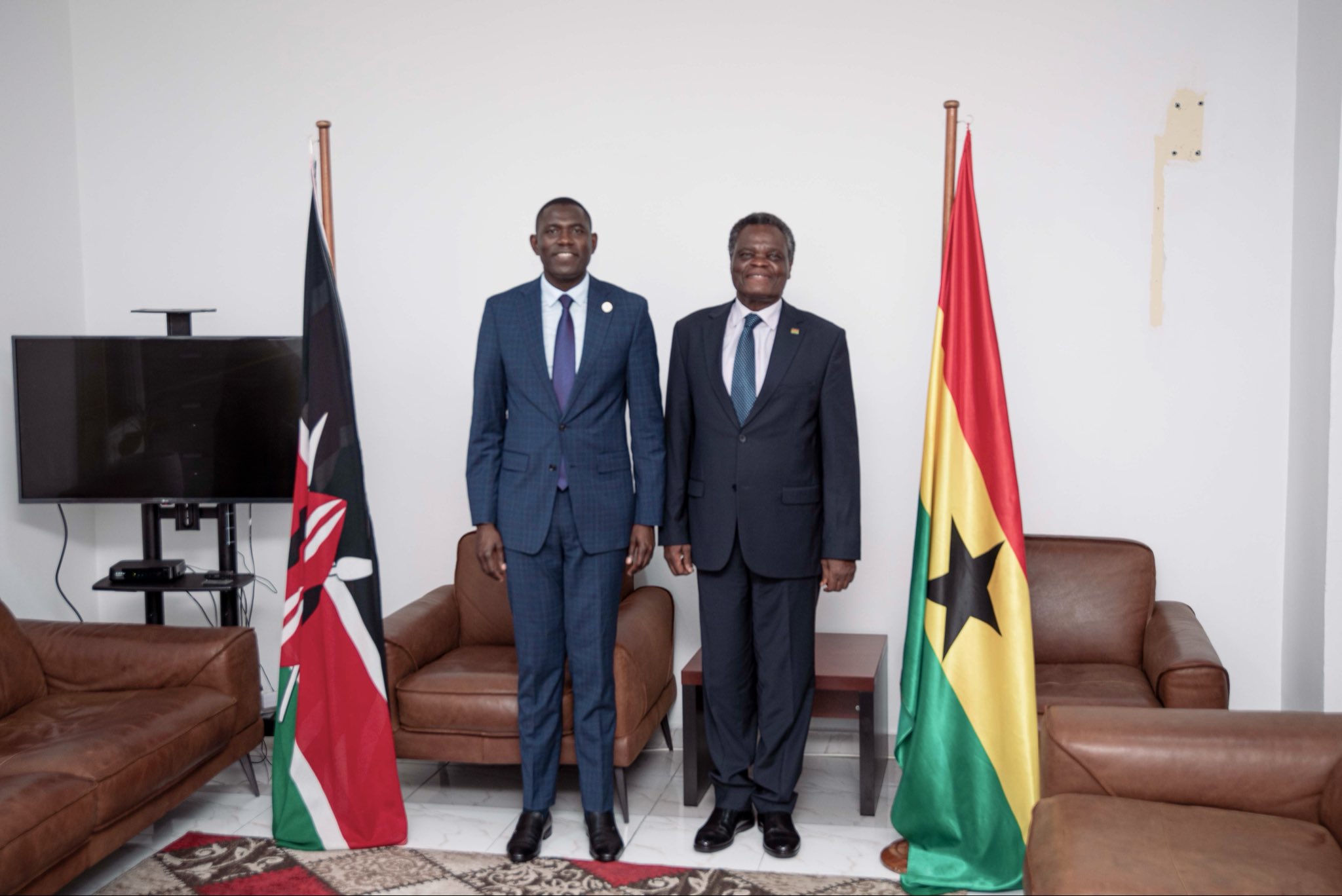
Kenya and Ghana have opened formal discussions on a bilateral health partnership covering Universal Health Coverage architecture, pharmaceutical manufacturing, and digital health infrastructure, with both governments signaling intent to translate diplomatic engagement into concrete institutional programmes. The talks took place on the sidelines of the African Union Extraordinary Session in Accra, where Kenya’s Medical Services Principal Secretary, Dr. Ouma Oluga, met with Kenya’s Ambassador to Ghana, Col. (Rtd) Shem Ishahilidza Amadi, at the Kenyan Embassy.
The timing is significant. Both Kenya and Ghana are navigating structural reforms in their health financing systems while confronting persistent vulnerabilities in pharmaceutical supply chains that the COVID-19 pandemic exposed with particular severity across the continent.
UHC Financing and Institutional Architecture Under the Microscope
At the centre of the discussions was a comparative exchange on health financing models, with Kenya explicitly seeking to learn from Ghana’s longer track record in UHC implementation. Ghana’s National Health Insurance Scheme (NHIS), established in 2003, remains one of West Africa’s most studied public health financing instruments, having extended formal coverage to millions of low-income households, even as fiscal pressures and claims management challenges have repeatedly tested its sustainability.
Kenya, by contrast, is in an earlier and more turbulent phase of UHC consolidation. Dr. Oluga outlined the country’s implementation of the Social Health Authority (SHA), a reformed institutional framework designed to replace the National Hospital Insurance Fund (NHIF) and broaden coverage under President William Ruto’s flagship health agenda. The SHA has faced significant rollout friction, including provider payment delays and public trust deficits, making Ghana’s institutional experience a potentially instructive reference point.
The two sides discussed the mechanics of peer learning, including technical exchanges between health ministries, joint programme design, and the establishment of stronger institutional linkages between regulatory and financing bodies in both countries. These are not merely diplomatic pleasantries. Structured South-South knowledge transfer, when properly resourced and governed, has produced measurable gains in health system capacity across comparable middle-income economies.
Pharmaceutical Manufacturing: The Structural Dependency Problem
Perhaps the most strategically consequential dimension of the talks was the focus on local pharmaceutical manufacturing. Africa imports an estimated 70 to 90 percent of its pharmaceutical products, a structural dependency that inflates procurement costs, creates supply disruption risks, and transfers significant economic value outside the continent. Both Kenya and Ghana have articulated national ambitions to build domestic manufacturing capacity, but neither has yet achieved the scale necessary to meaningfully alter regional supply dynamics.
The discussions in Accra explored opportunities for bilateral cooperation across the full pharmaceutical value chain, specifically:
Ghana’s pharmaceutical sector, anchored by the Food and Drugs Authority (FDA) and a small but growing domestic manufacturing base, has made incremental progress in local production. Kenya’s pharmaceutical industry, concentrated around Nairobi’s industrial corridor, is comparatively more developed, with several firms already producing generics for East African markets. A structured bilateral arrangement could allow Kenya’s manufacturing expertise to complement Ghana’s regulatory frameworks and market access within ECOWAS.
The AU Framework and Continental Health Security
The bilateral talks were explicitly situated within the African Union’s broader health agenda, a framing that carries both political and institutional weight. Dr. Oluga reaffirmed Kenya’s commitment to AU-level priorities, including sustainable health financing, pandemic preparedness, and the construction of resilient health systems capable of absorbing future shocks without collapsing into external dependency.
The AU’s Africa CDC, headquartered in Addis Ababa, has been central to coordinating continental pandemic response since its operational expansion during COVID-19, and its Partnerships for African Vaccine Manufacturing (PAVM) initiative provides a direct institutional home for the kind of manufacturing ambitions Kenya and Ghana are discussing. The PAVM framework targets the production of 60 percent of Africa’s vaccine needs on the continent by 2040, a goal that requires precisely the kind of bilateral industrial and regulatory cooperation now being explored.
For West Africa specifically, ECOWAS maintains a health policy framework through its Social Affairs and Health Department, and the ECOWAS Regional Centre for Surveillance and Disease Control (RCSDC) provides a regional coordination layer for health security. Ghana’s participation in these structures gives any Kenya-Ghana pharmaceutical partnership a potential conduit into West African regulatory harmonisation processes, which could amplify the impact of bilateral agreements beyond the two countries themselves.
Governance Conditions for a Functional Partnership
Bilateral health diplomacy between African states has a mixed record. Declarations of intent are common; durable institutional programmes are rarer. The Kenya-Ghana discussions will need to clear several governance hurdles to produce outcomes commensurate with the ambition on display in Accra.
Regulatory alignment is the most technically demanding requirement. For pharmaceutical products manufactured in Kenya to be recognised and traded in Ghana, and vice versa, the two countries’ regulatory authorities must establish mutual recognition agreements or adopt common standards. This process typically requires years of technical negotiation and is most efficiently pursued through multilateral frameworks rather than purely bilateral channels. AfCFTA’s pharmaceutical annex negotiations offer one such vehicle, though progress has been uneven.
Financing is the second critical variable. Local pharmaceutical manufacturing in Africa has repeatedly stalled not for lack of political will but for lack of patient, long-term capital willing to absorb the high fixed costs and regulatory uncertainty of building production facilities. Development finance institutions, including the African Development Bank and the International Finance Corporation, have expanded health-sector lending in recent years, but deployment at the project level remains constrained by bankability gaps that neither Kenya nor Ghana can resolve through diplomacy alone.
What the Accra meeting does establish is a formal bilateral channel, grounded in a shared AU agenda, through which Kenya and Ghana can coordinate positions in multilateral negotiations, share regulatory intelligence, and design pilot programmes that demonstrate proof of concept for broader continental replication. The institutional architecture for that channel now needs to be built, with clear mandates, accountable leads in both health ministries, and a monitoring framework that moves the partnership beyond communiqués.