Mali’s Governance Vacuum Empowers Armed Groups as Junta Consolidates Control
The killing of Mali’s Defence Minister, General Sadio Camara, during coordinated jihadist and separatist attacks in late April 2026 exposed a structural failure that no military intervention has yet resolved: the Malian state’s inability to deliver governance where it matters most, at the local level. Thirteen years after the country’s first coup fractured its institutional architecture, armed non-state actors have filled that void with a durability that conventional counter-terrorism frameworks have consistently underestimated.
A State Absent in Its Own Territory
Mali’s governance crisis did not begin with extremism. It began with institutional collapse. The 2012 military coup and the subsequent seizure of northern regions by armed groups triggered a cycle of transitional failures that culminated in the military junta’s dissolution and banning of all political parties in May 2025, removing the last formal mechanisms of civilian accountability.
In central and northern Mali, bordering Algeria, state institutions, courts, administrative services, and security forces, are either absent or actively distrusted. Into that vacuum have moved groups such as Jamaat Nusrat al-Islam wal-Muslimin (JNIM), a coalition of five organisations claiming over 10,000 fighters, and the Islamic State in the Greater Sahara (ISGS). Both have expanded their territorial influence consistently despite over a decade of foreign military engagement.
A peer-reviewed study by political scientists specialising in Sahelian security dynamics found that these groups function as de facto local authorities, settling disputes, enforcing rules, collecting taxes, and providing basic order in areas where the Malian state has no operational presence. Their legitimacy, such as it is, derives not from ideology but from function.
What Foreign Interventions Consistently Missed
France’s Operation Serval in 2013 successfully halted the southward advance of Islamist forces toward Bamako. It did not end the conflict. Displaced fighters relocated to rural areas with weak state presence and rebuilt community ties by exploiting existing grievances: land disputes between Fulani herders and Dogon farming communities in central Mali, corruption in local administration, and competition over natural resources.
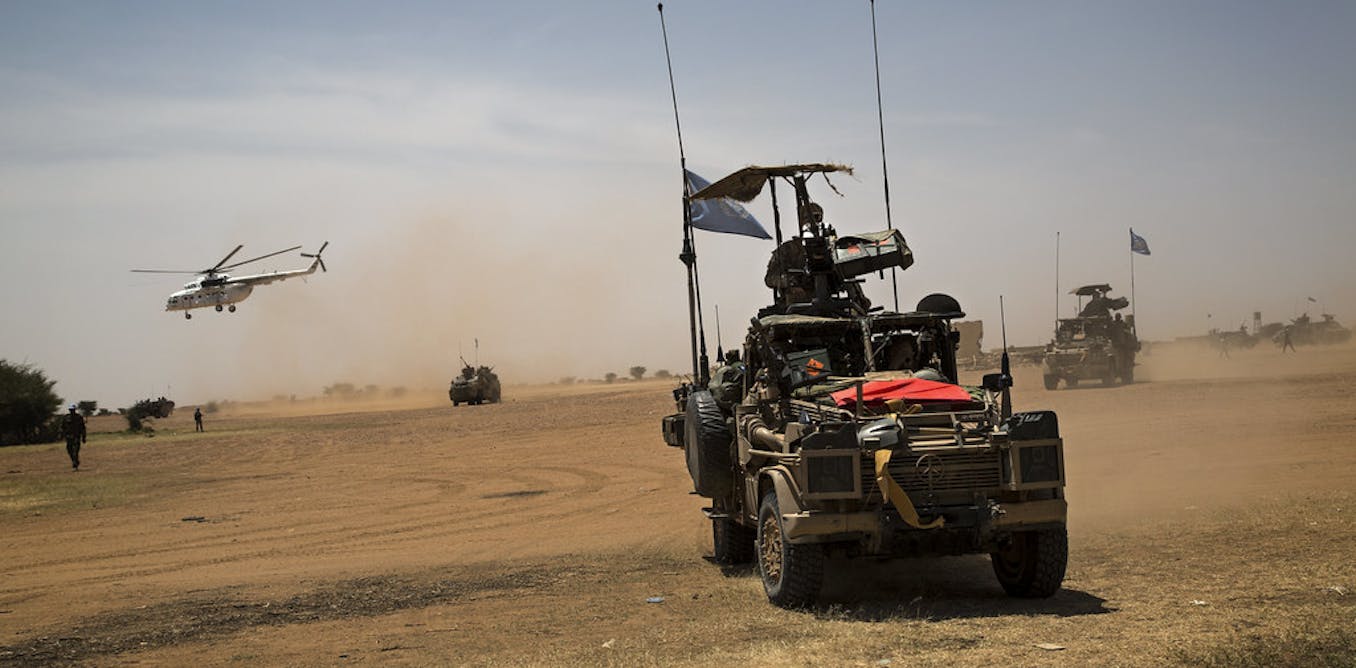
France’s subsequent decade-long Barkhane operation, the US military footprint, and now the deployment of Russian-linked Wagner Group forces have each prioritised counter-terrorism and centralised state-building. None adequately addressed what the research identifies as the core dynamic: armed groups derive staying power not primarily from weapons but from their embeddedness in local governance realities.
The fragmentation of external involvement has compounded the problem. France’s 2022 withdrawal, intensifying anti-Western sentiment, and the arrival of Russian-linked forces created competing intervention agendas with no coherent governance strategy. In several documented cases, the presence of external actors reinforced community tensions and weakened trust in already fragile Malian institutions.
Civilian populations, caught between an absent state, abusive security forces, and armed groups offering predictable if coercive order, make choices driven by survival rather than ideology. That distinction is analytically critical and has been operationally ignored.
The Regional Governance Dimension: ECOWAS and the Sahel Architecture
Mali’s institutional deterioration carries direct consequences for West African regional governance. Mali’s suspension from ECOWAS following the 2021 coup, and its subsequent withdrawal alongside Burkina Faso and Niger to form the Alliance of Sahel States (AES) in 2023, has fractured the bloc’s security architecture at a moment when coherent regional response is most needed.
JNIM and ISGS do not respect national borders. Their operational zones span Mali, Burkina Faso, Niger, and increasingly northern Côte d’Ivoire and western Senegal. The G5 Sahel Joint Force, already weakened by the withdrawal of its founding members, has lost the institutional framework needed to coordinate cross-border responses.
For ECOWAS member states, the governance vacuum in Mali is not a distant bilateral problem. It is a direct threat to the bloc’s free movement protocols, its border security arrangements, and its credibility as a regional governance institution. Ghana, Senegal, and Côte d’Ivoire have all registered increased jihadist activity in their northern border regions, directly traceable to the displacement of armed group networks from Mali’s conflict zones.
The African Union’s Peace and Security Council has repeatedly called for negotiated political transitions in the AES states, with limited effect. The AU’s normative framework on unconstitutional changes of government, codified in the Lomé Declaration of 2000, has not been enforced with sufficient institutional weight to alter junta behaviour.
Governance Functions of Non-State Actors: A Comparative Framework
The phenomenon of armed groups assuming governance roles is not unique to Mali. In Colombia, FARC administered taxation, dispute resolution, and social services across large rural territories for decades. In South Sudan, armed factions structured local economies and security arrangements in the absence of central state authority. In Syria, multiple non-state actors built parallel administrative systems that outlasted military campaigns against them.
The common analytical thread, confirmed by the Mali-focused research, is that military displacement of armed groups without simultaneous governance substitution does not produce security. It produces displacement of the conflict to less monitored areas, as Operation Serval demonstrated in 2013.
In Mali specifically, the research establishes that community interaction with armed groups is driven by the absence of viable alternatives, not by ideological alignment. This matters for policy design: programmes targeting “hearts and minds” through ideological counter-narratives address a secondary variable while the primary driver, governance absence, remains unresolved.
Institutional Pathways: What Credible Policy Requires
The research advocates for a governance-centred framework that begins with honest assessment of which institutions, state or non-state, formal or informal, currently hold functional legitimacy in specific territories. That assessment must precede any intervention design.
Concretely, this means several things. Access to justice mechanisms, including customary and local dispute resolution structures, must be supported and connected to formal legal institutions rather than displaced by them. Local administrative capacity, particularly in central and northern Mali, requires investment that is decoupled from junta political objectives. Grievance structures around land tenure, pastoral rights, and resource competition require dedicated policy responses, not military suppression.
For ECOWAS, re-engagement with the AES states on governance benchmarks rather than purely on coup condemnation offers a more productive institutional pathway. The bloc’s 2015 Supplementary Act on Democracy and Good Governance provides a framework; applying it selectively based on geopolitical alignment undermines its credibility.
For international partners, including the European Union’s Sahel strategy and bilateral actors, the evidence from Mali argues against security-first sequencing when governance infrastructure does not exist to consolidate military gains. The US$2.4 billion spent on security assistance to Mali between 2001 and 2021, according to Security Assistance Monitor data, produced no measurable reduction in armed group territorial control.
Mali’s trajectory since 2012 constitutes one of West Africa’s most consequential governance failures. Armed groups have not succeeded because they are militarily superior. They have succeeded because they perform functions the state does not. Until that structural reality drives intervention design, in Bamako, in Abuja, in Brussels, and in Washington, the violence will remain structurally embedded rather than episodically managed.