A 179% jump in pre-tax profit at Letshego Ghana Savings and Loans PLC reveals more than a single company’s strong half-year performance. It exposes a structural question at the heart of Ghana’s non-bank financial sector: whether the Bank of Ghana’s regulatory framework can keep pace with the rapid scaling of digital and mobile credit institutions operating below the commercial banking threshold.
The Numbers Behind the Surge
Letshego Ghana recorded profit before tax of GH¢67 million for the six months ended 30 June 2026, compared with GH¢24 million in the same period in 2025. Return on equity climbed to 33%, up from 23% a year earlier. Lending income rose 35% to GH¢308 million, driven by higher loan disbursements and a compression in funding costs that widened net interest margins.
Mobile lending disbursements reached GH¢5 billion during the period, a figure that dwarfs the company’s gross loan book of GH¢1.2 billion and signals the velocity at which funds are cycling through the portfolio. Total assets expanded to GH¢1.9 billion, customer deposits reached GH¢834 million, and the capital adequacy ratio held at 20.2%, well above the Bank of Ghana’s regulatory minimum for savings and loans institutions.
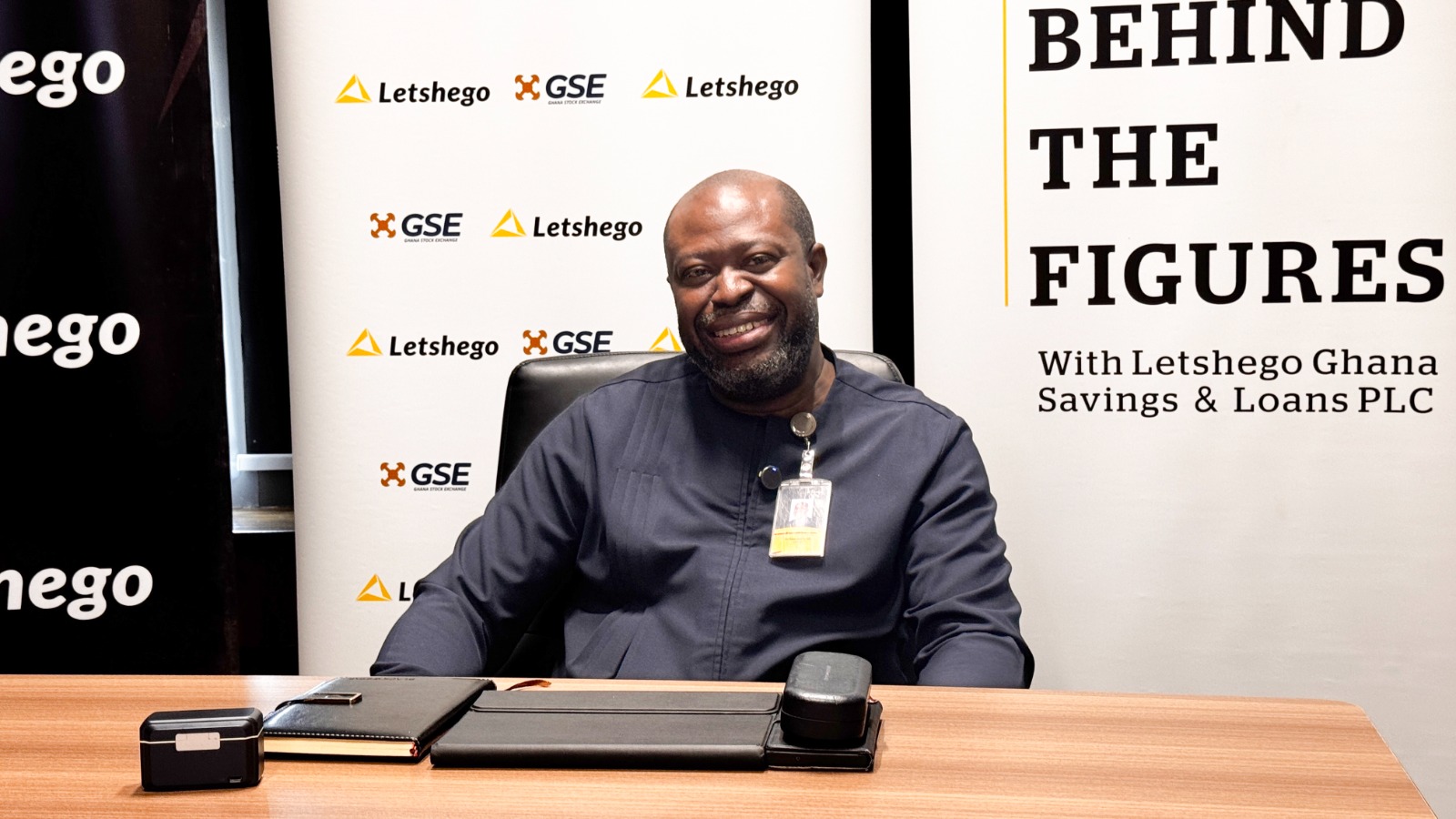
These metrics, disclosed at the Ghana Stock Exchange’s “Facts Behind the Figures” engagement, position Letshego Ghana as one of the most profitable non-bank lenders in the country. Chief Finance Officer Daisy O. Adjei-Boadi attributed the results to disciplined cost management, portfolio diversification, and a lending model anchored in mobile delivery channels.
Mobile Credit Infrastructure and Financial Inclusion Governance
The scale of mobile disbursements raises substantive governance questions about credit infrastructure, consumer protection, and data sovereignty in Ghana’s digital financial services ecosystem.
Letshego Ghana’s model relies on mobile channels to originate, disburse, and collect loans, reducing branch overhead while extending reach into underserved segments. This architecture has enabled the company to serve individuals, women entrepreneurs, and micro and small enterprises that commercial banks systematically exclude. The company also piloted group lending programmes targeting women and continued financing clean energy and green mobility projects under its environmental, social and governance framework.
Yet rapid mobile credit expansion in West Africa has repeatedly produced consumer harm where regulatory oversight lags. Ghana’s experience with the 2017-2019 microfinance sector collapse, which wiped out savings for hundreds of thousands of depositors and required a GHS 21 billion Bank of Ghana-led resolution, established a painful institutional reference point. The question is not whether Letshego Ghana’s current metrics are sound. They are. The question is whether Ghana’s supervisory architecture is calibrated for institutions operating at this velocity and scale.
Consumer Protection and Responsible Lending Standards
Ghana’s Borrowers and Lenders Act, 2020 (Act 1052) established disclosure requirements and debt recovery standards, but enforcement remains uneven across non-bank financial institutions. As mobile lending volumes grow, the gap between regulatory intent and supervisory capacity becomes operationally significant. Comparable West African jurisdictions have addressed this through tiered licensing and real-time portfolio reporting requirements. Senegal, operating within the WAEMU regulatory framework under the Banque Centrale des États de l’Afrique de l’Ouest (BCEAO), mandates quarterly stress-testing for microfinance institutions above defined asset thresholds. Ghana’s Bank of Ghana has not yet published equivalent thresholds for savings and loans companies operating at Letshego Ghana’s balance sheet size.
The Microfinance Bank Transition: Institutional Mechanics
Letshego Ghana’s management confirmed the company is preparing for a potential transition to a microfinance bank, contingent on Bank of Ghana regulatory reforms and formal approval. This transition is institutionally significant and deserves precise analysis.
A microfinance bank license in Ghana confers deposit-taking authority under a distinct prudential regime, with higher minimum capital requirements, stricter governance mandates, and expanded supervisory reporting obligations. For Letshego Ghana, with customer deposits already at GH¢834 million and a capital adequacy ratio of 20.2%, the capital threshold is not the primary constraint. The governance architecture, particularly board composition, fit-and-proper standards for directors, and internal audit independence, will determine regulatory readiness.
Bank of Ghana’s Reform Timeline and Institutional Credibility
The transition also depends on the Bank of Ghana completing its own reform process for the microfinance bank licensing framework, which has been under review since the sector cleanup of 2017-2019. Delays in that reform process have created uncertainty for several non-bank financial institutions planning similar upgrades. The Bank of Ghana’s credibility as a regulatory institution, partially restored following its IMF-supported recapitalization under Ghana’s 2023 Extended Credit Facility program, is directly implicated in how transparently and consistently it processes these transitions.
For investors on the Ghana Stock Exchange, the transition timeline represents both an upside catalyst and a governance risk variable. A microfinance bank license would expand Letshego Ghana’s funding base, reduce reliance on domestic bond market issuance, and potentially lower funding costs further. The company has maintained an active presence in Ghana’s domestic bond market for over a decade. Transitioning away from that dependency would structurally improve the cost of capital.
Regional Positioning and AfCFTA Financial Services Implications
Letshego Ghana is a subsidiary of Letshego Holdings Limited, a Botswana-headquartered pan-African financial services group operating across 11 African markets. This regional structure gives the Ghana operation access to group capital, risk management frameworks, and technology infrastructure that purely domestic competitors cannot easily replicate.
Within the West African context, this positions Letshego Ghana differently from local microfinance institutions. Its parent company’s multi-market presence aligns structurally with the African Continental Free Trade Area’s financial services liberalization agenda, which envisions cross-border financial service provision under harmonized regulatory standards. ECOWAS has been developing a regional financial integration framework, but progress on harmonizing non-bank financial institution standards across member states remains slow relative to the pace of market development.
Competitive Dynamics: Ghana vs. Regional Peers
Ghana’s non-bank financial sector competes directly with Ivory Coast’s microfinance market, which operates under BCEAO supervision and benefits from WAEMU’s more integrated monetary framework. Ivory Coast’s microfinance sector recorded total outstanding credit of approximately CFA 1.2 trillion (roughly US$ 2 billion) as of 2024, supported by a clearer tiered licensing structure. Nigeria’s non-bank lending market, dominated by fintech-driven digital lenders, operates under a fragmented regulatory environment that has produced rapid growth alongside significant consumer harm episodes. Ghana, sitting between these two models, has an opportunity to establish a more coherent supervisory framework that could serve as a regional benchmark.
Letshego Ghana’s performance data provides a concrete reference point for that ambition. A capital adequacy ratio of 20.2%, disciplined non-performing loan management, and a diversified funding base combining deposits and bond market issuance represent a governance model that regulators across the sub-region could study.
Policy Pathways: What Institutions Must Deliver
Letshego Ghana’s H1 2026 results crystallize three specific institutional actions that Ghana’s financial sector governance requires.
Letshego Ghana’s trajectory from a modest savings and loans company to a GH¢1.9 billion balance sheet institution disbursing GH¢5 billion in mobile loans per half-year is a governance stress test in real time. The company’s own metrics suggest it is managing that growth responsibly. Whether Ghana’s regulatory institutions can supervise that scale with equivalent rigor is the more consequential question for depositors, investors, and the integrity of West Africa’s broader financial integration project.