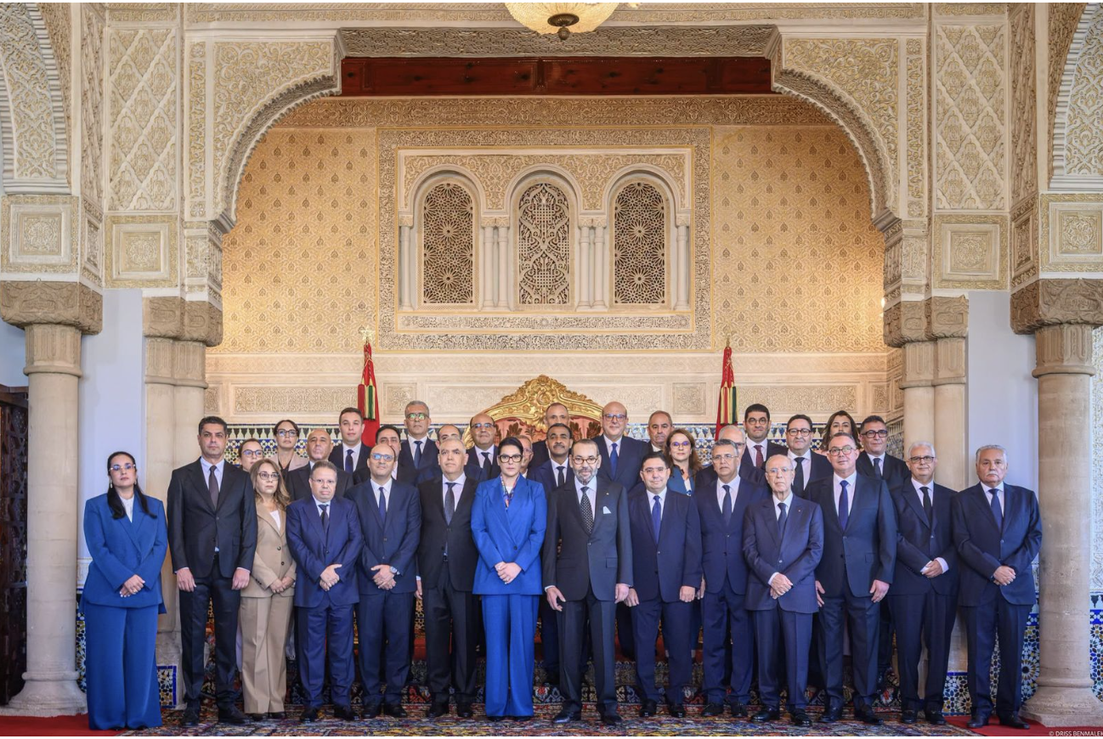
When King Mohammed VI presided over the swearing-in of Morocco’s restructured cabinet at the Royal Palace in Rabat on Friday, the ceremony carried weight beyond its ceremonial form. At its centre stood Fatima Ezzahra El Mansouri, appointed Head of Government and tasked with steering a reform agenda that spans digital infrastructure, social protection, and economic acceleration. The appointment of a woman to lead Morocco’s executive machinery is not incidental symbolism. It signals a deliberate recalibration of how the monarchy projects governance legitimacy in an era of mounting regional competition and continental integration pressure.
Morocco occupies a peculiar position in African geopolitics. It is simultaneously a North African state, an Atlantic economy, and since 2017, a returning member of the African Union after a 33-year absence. That return was never merely diplomatic. It was a strategic repositioning, one that placed Rabat in direct institutional dialogue with ECOWAS, the African Continental Free Trade Area (AfCFTA), and the broader architecture of pan-African economic governance. The cabinet reshuffled this week must be read against that backdrop.
The continuity bloc within the new government is deliberate and telling. Abdelouafi Laftit retains Interior, Nasser Bourita holds Foreign Affairs, Abdellatif Ouahbi keeps Justice, and Ahmed Toufiq maintains Endowments and Islamic Affairs. These are not ceremonial retentions. They reflect a monarchy that treats sovereignty portfolios as instruments of long-term institutional coherence, insulating core state functions from the volatility of electoral cycles. For foreign investors and regional partners assessing Morocco’s governance risk profile, that continuity carries a specific signal: the rules of engagement will not shift arbitrarily.
What shifts, and shifts sharply, is the economic and technological architecture of the cabinet. Fouzi Lekjaa moves to Economy and Finance, a portfolio that will carry the weight of Morocco’s fiscal consolidation ambitions and its role as a gateway economy linking West African markets to European capital. Nizar Baraka takes Water and Infrastructure, a portfolio of existential urgency given Morocco’s documented water stress and its infrastructure development commitments under the AfCFTA framework. The appointment of Ahmed Rahhou to a newly prominent Artificial Intelligence and Digital Transformation portfolio is the most structurally significant signal of all.
Morocco has spent the better part of a decade positioning Casablanca as a financial and digital hub for the continent. The Casablanca Finance City hosts over 200 multinational and regional firms, many using Morocco as their operational base for sub-Saharan and West African markets. A dedicated AI and digital portfolio at cabinet level formalises that ambition within the state’s governing machinery. It also places Morocco in direct competition with Senegal’s emerging digital governance agenda, Ivory Coast’s tech investment corridor, and Nigeria’s fintech regulatory push. The race for continental digital leadership is institutional, not merely commercial.
Samir Belfkih’s dual role as Minister of Territorial Planning and Government Spokesperson reflects a governance model that treats communication as a policy instrument. Territorial planning in Morocco carries specific AfCFTA relevance: the kingdom’s northern ports, Atlantic logistics corridors, and trans-Saharan connectivity infrastructure are central to its pitch as a continental trade hub. Belfkih’s mandate effectively ties spatial governance to narrative management, a combination that matters enormously when Rabat is simultaneously courting Gulf sovereign wealth funds, European development finance, and African institutional investors.
The education cluster deserves scrutiny. Nabil Benabdallah and Azzeddine El Midaoui share responsibility for a sector that has historically underperformed relative to Morocco’s economic ambitions. The World Bank’s 2023 Human Capital Index placed Morocco at 0.50, below the MENA regional average and well behind peer economies like Tunisia. If the new government is serious about digital transformation, the human capital pipeline feeding that transformation requires structural reform in curriculum, teacher training, and tertiary technical education. Two ministers sharing an already fragmented portfolio raises legitimate questions about coordination mechanisms and accountability lines.
On agriculture, Khalid Hatimy inherits a sector that contributes roughly 14 percent of GDP and employs over 40 percent of the rural labour force, according to Morocco’s High Planning Commission. Climate stress, groundwater depletion, and shifting export demand from European markets all bear on this portfolio. Morocco’s agricultural trade with West African ECOWAS members, particularly Senegal, Ivory Coast, and Ghana, has grown under bilateral frameworks, but remains constrained by non-tariff barriers and logistics gaps that AfCFTA is designed to address. Hatimy’s mandate will test whether Rabat can align domestic agricultural policy with its continental trade commitments.
Najwa Koukouss at Family Affairs and Younes Bjijou at Health and Social Protection together hold the social contract dimension of this government’s legitimacy. Morocco’s urban-rural inequality gap, its youth unemployment rate hovering near 35 percent among urban graduates according to the High Commission for Planning, and its informal economy burden all concentrate pressure on these portfolios. A government that leads with digital transformation rhetoric while failing to deliver measurable improvements in social protection will face credibility deficits, both domestically and in the eyes of multilateral partners conditioning budget support on governance benchmarks.
What emerges from this cabinet’s architecture is a government organised around two distinct logics operating in parallel. The first is institutional consolidation: experienced technocrats and loyalty figures holding the sovereignty core, providing the predictability that investors and regional partners require. The second is transformative ambition: a cluster of reform-oriented portfolios in digital technology, infrastructure, education, and social protection, designed to shift Morocco’s development trajectory within a single mandate cycle. Whether those two logics reinforce or undermine each other depends almost entirely on the quality of inter-ministerial coordination and the degree to which El Mansouri is granted genuine executive authority rather than ceremonial leadership.
For West Africa, Morocco’s governance evolution matters in concrete terms. Moroccan banks, particularly Attijariwafa and Banque Populaire, hold significant assets across ECOWAS economies. Moroccan construction and infrastructure firms operate across the region. OCP Group’s phosphate and fertiliser exports are embedded in West African agricultural supply chains. A more capable, reform-oriented Moroccan state is a more effective regional economic partner. A cabinet that performs its mandate will strengthen the institutional credibility of Morocco’s AU re-engagement and its AfCFTA commitments. The swearing-in in Rabat was, in that sense, a regional governance event, not merely a national one.