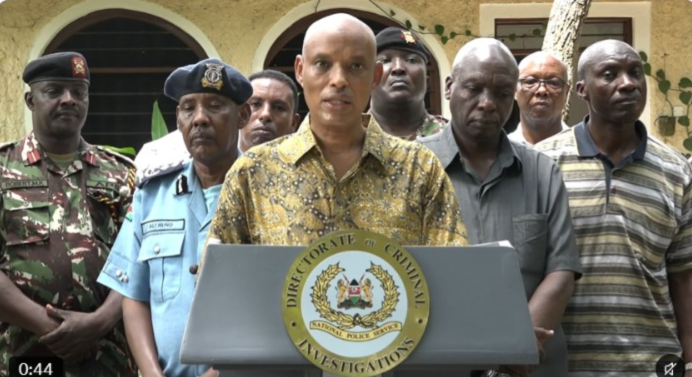
Kenya’s Director of Criminal Investigations, Mohamed Amin, issued a formal warning in early 2025 that narcotics trafficking proceeds represent a concrete threat to the integrity of the country’s 2027 General Election, calling on security agencies to monitor illicit financial flows with renewed discipline and institutional rigour.
The alert did not emerge from a vacuum. Across West and East Africa, the penetration of drug money into electoral cycles has become a documented governance failure, with the United Nations Office on Drugs and Crime estimating that illicit financial flows drain hundreds of billions of dollars annually from African economies, a portion of which finds its way into political financing. Kenya, positioned as a regional hub for trade and transit, carries particular exposure to this dynamic.
Amin’s briefing was precise in its framing. He described how narcotics profits, once laundered, can be converted into protection networks, deployed to corrupt public officials, or funnelled directly into campaign financing structures that are difficult to trace under existing electoral finance disclosure rules. “Any credible links between known traffickers, suspicious financial flows and electoral financing must be properly documented, verified and investigated through the appropriate channels,” he stated, setting a procedural standard for how such cases should be handled within the DCI’s investigative mandate.
The DCI chief was equally deliberate in drawing a boundary around the scope of any investigation. He stressed that inquiries into narco-financing must proceed without political profiling and must not interfere with legitimate political activities, a distinction that reflects both constitutional obligation and the institutional credibility of the Directorate itself. In a political environment where security agencies have historically been accused of partisan deployment, that framing carries weight beyond procedural caution.
Illicit Finance and the Governance Architecture
Kenya’s electoral finance framework, governed by the Elections Act and overseen by the Independent Electoral and Boundaries Commission, requires political parties and candidates to disclose campaign contributions above specified thresholds. In practice, enforcement has been inconsistent, and the gap between declared and actual campaign expenditure has been widely noted by civil society monitors. Narcotics proceeds, typically layered through real estate, informal trade networks, or shell companies, are well-suited to exploit those disclosure gaps.
The Financial Reporting Centre, Kenya’s anti-money laundering authority, has a legal mandate to flag suspicious transactions and share intelligence with law enforcement. Whether the coordination between the FRC, the DCI, and the IEBC is sufficiently structured to catch narco-financing in real time, before it shapes electoral outcomes rather than after, is a governance question that Amin’s warning implicitly raises without fully answering.
Comparative experience from the region is instructive. Nigeria’s 2023 general election drew scrutiny from observers who documented the role of undisclosed cash in ward-level vote mobilisation, a pattern that ECOWAS electoral observer missions have repeatedly flagged across member states. Ghana’s 2024 election cycle similarly prompted domestic debate about the sources of campaign funding, particularly at the constituency level where formal financial reporting is least robust. Kenya’s situation, while distinct in its legal architecture, sits within the same regional governance challenge.
Amin reminded police officers of their constitutional duty to enforce the law without fear or favour, a phrase that carries specific resonance in Kenya’s post-2007 institutional memory, when security forces were implicated in politically motivated violence. The reminder signals that the DCI is positioning itself, at least rhetorically, as an institution that will not be instrumentalised by any political actor in the lead-up to 2027.
Whether that institutional posture holds under the pressures of an active campaign environment will depend on factors beyond any single official’s public statement, including the independence of prosecutorial decisions, the robustness of inter-agency coordination, and the willingness of Kenya’s judiciary to process financial crime cases at the pace electoral timelines demand.
The 2027 election is still two years away, but the governance infrastructure required to detect, investigate, and prosecute narco-financing of political campaigns takes time to build. Amin’s warning, if it translates into concrete investigative protocols and inter-agency data-sharing agreements, could represent the beginning of that institutional groundwork. If it remains at the level of public caution, the risk he described will persist, documented but unaddressed.