Phala Phala’s Transatlantic Dimension: Mkhwebane Foundation Files US Complaint Against Ramaphosa, Exposing Governance Accountability Gaps
A foundation linked to former South African Public Protector Busisiwe Mkhwebane formally submitted a complaint on 19 May 2026 to four United States federal agencies, requesting an investigation into whether millions of undeclared US dollars stored at President Cyril Ramaphosa’s Phala Phala game farm violated American anti-money laundering and currency-smuggling statutes. The move signals a deliberate strategy to internationalise an accountability dispute that domestic institutions have, so far, failed to resolve conclusively.
The Complaint: Legal Architecture and Jurisdictional Claims
The Advocate Busisiwe Mkhwebane Foundation directed its submission to the Federal Bureau of Investigation (FBI), the United States Department of Justice (DOJ), the Financial Crimes Enforcement Network (FinCEN), and the US Treasury Department. The complaint rests on three specific provisions of American federal law.
The first is 31 U.S.C. § 5332, the bulk cash smuggling statute, which targets the transport of amounts exceeding US$10,000 with intent to evade reporting requirements. The second is 18 U.S.C. § 1956, the primary US money laundering statute, which criminalises the cross-border movement of funds to conceal ownership, source, or reporting obligations. The third is 18 U.S.C. § 1957, which prohibits financial transactions involving allegedly unlawful proceeds exceeding US$10,000.
The foundation’s jurisdictional argument centres on the status of the US dollar as the global reserve currency, asserting that American authorities hold a sovereign interest in determining whether their currency was implicated in violations of federal law. This framing mirrors legal strategies used in prior international asset-forfeiture and anti-corruption cases pursued by US authorities, including actions under the Kleptocracy Asset Recovery Initiative.
Shirley Willemse, chairperson of the foundation, confirmed the complaint’s authenticity but acknowledged that no formal acknowledgement had been received from US agencies. She indicated the organisation hoped South African institutions would facilitate a referral to the FBI, given the absence of a direct jurisdictional link from South Africa to the United States.
What the Phala Phala Record Shows: Unresolved Compliance Questions
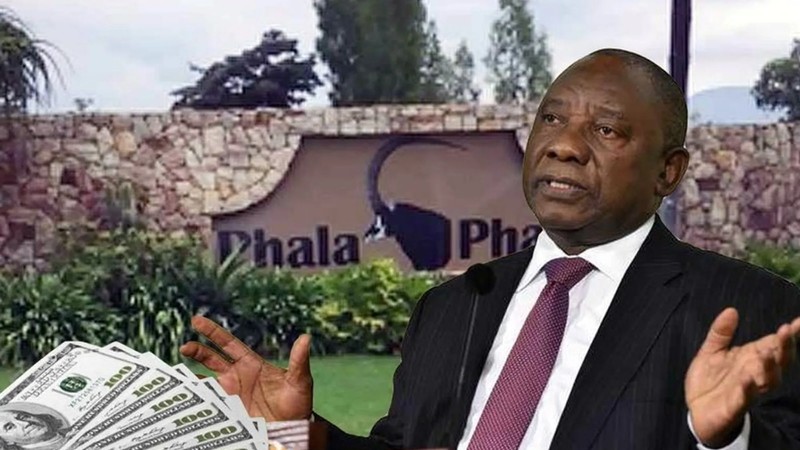
At the core of the complaint is foreign currency that Ramaphosa has publicly acknowledged was stored at his Phala Phala farm in Bela-Bela, Limpopo, before a February 2020 burglary. Ramaphosa has maintained consistently that the funds represented legitimate proceeds from a buffalo sale to Sudanese businessman Mustafa Mohamed Ibrahim Hazim, and has denied any wrongdoing.
Ramaphosa’s own account places the stolen amount at approximately US$580,000. The foundation’s submission references reports suggesting the figure may have been substantially higher, though no verified independent figure has been established through formal legal proceedings.
The foundation argues that, despite former Public Protector Mkhwebane’s 2023 report, questions of foreign exchange compliance, tax treatment, and potential criminality were deferred to other bodies. Those processes have not produced a definitive public accounting. “To date, no lawful account of the origin, transportation, or tax treatment of the US dollars has been provided,” the foundation stated in its submission.
South Africa’s South African Reserve Bank (SARB) and the South African Revenue Service (SARS) both have regulatory mandates covering the precise questions the foundation raises, including foreign currency declaration obligations and income tax treatment of proceeds from asset sales. Neither institution has publicly confirmed the closure of any related inquiry.
Constitutional Court Ruling Reopens Parliamentary Accountability Question
The foundation’s US filing comes shortly after the Constitutional Court of South Africa ruled that Parliament acted unlawfully in 2022 when it halted an impeachment inquiry linked to the Phala Phala scandal. That ruling reaffirms that the matter carries unresolved constitutional weight, not merely political controversy.
The Constitutional Court’s intervention establishes that South Africa’s highest judicial authority has found a procedural accountability failure at the legislative level. This is significant for institutional analysis: it demonstrates that the accountability gap is not simply a product of political opposition pressure, but has been formally recognised within the country’s constitutional framework.
For governance analysts, the pattern is notable. A sitting head of state acknowledged storing a substantial sum of undeclared foreign currency on private property. Domestic oversight bodies, including Parliament, have not produced a definitive resolution after more than six years. The Constitutional Court has now confirmed that at least one institutional response, the halting of the impeachment inquiry, was itself unlawful.
Political Context: MK Party, Opposition Strategy, and Institutional Credibility
The foundation is linked to Mkhwebane, who now serves as a Member of Parliament for the uMkhonto weSizwe (MK) Party, a formation that has positioned itself in sharp opposition to Ramaphosa’s African National Congress (ANC). This political alignment is relevant context for assessing the complaint’s motivations, though it does not, in itself, determine the legal merit of the underlying questions the foundation raises.
The decision to approach US federal agencies reflects a broader opposition strategy of escalating the Phala Phala matter beyond domestic forums where, critics argue, political considerations have constrained accountability. Whether US agencies will find sufficient jurisdictional basis to act remains genuinely uncertain. FinCEN and the DOJ have historically been selective in pursuing international cases, typically requiring a demonstrable US nexus beyond currency denomination alone.
Willemse acknowledged this constraint directly, noting that the foundation hopes South African agencies will facilitate a referral, precisely because a direct jurisdictional link has not been independently established. The complaint’s legal viability in the US system therefore depends substantially on cooperation from the very South African institutions that have not yet resolved the matter domestically.
Governance Implications: Accountability Architecture Under Scrutiny
The Phala Phala matter, now in its sixth year without definitive institutional resolution, raises structural questions about South Africa’s accountability architecture that extend beyond partisan politics.
South Africa’s Chapter 9 institutions, including the Public Protector’s office and the Independent Electoral Commission, were designed under the 1996 Constitution to provide non-partisan oversight of executive conduct. The Phala Phala record suggests those mechanisms, combined with parliamentary oversight and law enforcement, have not produced the transparent public accounting that governance standards require when a head of state is implicated in questions of undeclared foreign currency and potential financial compliance failures.
For investors and regional partners, the signal matters. South Africa is the continent’s most industrialised economy and a central node in African Union governance frameworks. Its capacity to hold executive power accountable through domestic institutions, without requiring external escalation, is a direct indicator of institutional quality. The foundation’s decision to approach US federal agencies, whatever its political motivation, reflects a judgment that domestic channels have been exhausted without resolution.
The AU’s African Peer Review Mechanism (APRM), to which South Africa is a founding signatory, explicitly benchmarks member states on transparency, accountability, and the rule of law in governance. A six-year unresolved accountability question involving a sitting president, culminating in a Constitutional Court finding of parliamentary unlawfulness, is precisely the category of governance deficit the APRM was designed to flag.
Whether US authorities act on the foundation’s complaint or not, the more consequential question is whether South Africa’s own institutions, its prosecutorial services, its revenue authority, its reserve bank, and its reconstituted Parliament, will now use the Constitutional Court’s ruling as the basis for a definitive, transparent resolution of the compliance and accountability questions that have remained open since 2020.