A Recurring Institutional Failure
Picture a road project in the Bono Region, freshly commissioned after years of construction and public borrowing. The ribbon is cut, the photographs are taken, and then — nothing. No complementary investment in the logistics corridors that would move agricultural produce to market. No processing facilities to capture value along the supply chain. No follow-through assessment of whether the infrastructure is generating the economic activity it was designed to support. This is not an isolated oversight. It is, according to Johnson Asiedu Nketiah, National Chairman of the governing National Democratic Congress, a structural habit embedded in how Ghana transitions political power — and one that measurably slows the country’s development trajectory.
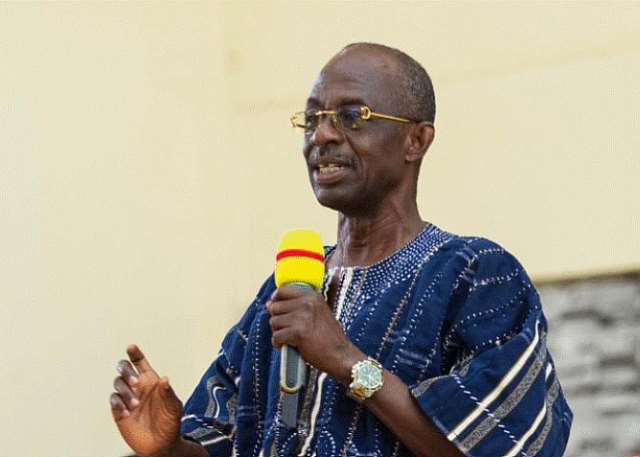
Speaking at the fourth Bono Regional Ghana Journalists Association Awards in Sunyani on 19 September 2026, Asiedu Nketiah articulated a governance critique that cuts across party lines: Ghana’s four-year electoral cycle has become an institutional reset button, erasing institutional memory, wasting sunk public investment, and preventing the compounding returns that sustained policy implementation would otherwise deliver. “A serious country cannot start every four years afresh,” he said, in a formulation that carries weight precisely because it comes from a senior figure within the ruling party — not from opposition benches.
The Mechanics of Policy Discontinuity
The pattern Asiedu Nketiah described is structurally familiar across West African democracies, but Ghana’s version has particular characteristics worth examining. When a new administration assumes office, programmes associated with the previous government face a political credibility problem: continuing them risks appearing to validate the outgoing party’s record. The incentive, therefore, is to rebrand, restructure, or quietly shelve — even when the underlying programme is functional. “We change the name, change the structure, change the people and occasionally spend more money arriving at almost the same place,” Asiedu Nketiah said, with a candour that implicitly acknowledges his own party’s participation in this cycle.
The fiscal cost of this pattern is rarely quantified but is almost certainly significant. Procurement processes must be restarted. New personnel require onboarding. Institutional knowledge built by programme staff disperses. In some cases, donor co-financing arrangements, which are often tied to specific programme frameworks and implementation timelines, are disrupted entirely, triggering renegotiation costs and reputational friction with multilateral partners. Ghana’s record with the International Monetary Fund — the country has entered IMF programmes nine times since independence — reflects in part this chronic difficulty sustaining medium-term fiscal and policy frameworks across electoral transitions.
Asiedu Nketiah was careful to distinguish between programmes that deserve discontinuation and those that are abandoned for purely political reasons. “Of course, a government must change policies that are failing, and nobody should continue a bad programme for the sake of continuity,” he said. The governance question he raised is not about blind continuity — it is about institutional capacity to evaluate programmes on merit rather than political provenance, and to protect public investment from the volatility of partisan competition.
Regional Benchmarks and the Competitiveness Gap
Ghana’s policy discontinuity problem does not exist in isolation. It plays out against a regional backdrop in which its immediate competitors are consolidating institutional frameworks with greater durability. Côte d’Ivoire, which overtook Ghana in GDP per capita terms around 2019, has maintained the National Development Plan architecture across successive administrations with relative consistency, enabling longer investment cycles in agro-industrial corridors and infrastructure. Senegal’s Plan Sénégal Émergent, now transitioning into a successor framework under President Faye, has demonstrated that even under political change, medium-term planning instruments can retain structural coherence — though Dakar’s own experience with programme continuity is not without friction.
Within the ECOWAS framework, the Community’s supplementary acts on macroeconomic convergence require member states to maintain fiscal deficit targets, debt sustainability thresholds, and inflation ceilings across electoral cycles. Ghana has repeatedly struggled to meet these criteria, and the political economy of programme discontinuity is one reason why: when incoming governments reject the fiscal architecture of predecessors, convergence benchmarks become moving targets rather than binding institutional constraints. The ECOWAS convergence framework is only as strong as the domestic political commitment of its members to honour it between elections, not merely at the point of signing.
Nigeria, West Africa’s dominant economy, faces its own version of this challenge at a larger scale, with federal-state programme incoherence compounding the electoral cycle problem. But Ghana, with its more manageable institutional footprint and historically stronger rule-of-law credentials, is better positioned to implement the kind of cross-party policy compacts that would make programme continuity structurally enforceable rather than dependent on political goodwill.
Infrastructure Investment and the Value-Chain Deficit
Asiedu Nketiah’s specific example — the Bono Region’s agricultural economy — illuminates a broader structural weakness in how Ghana conceptualises public investment. The region is one of Ghana’s most productive agricultural zones, with significant output in cashew, yam, and other commodities. Yet the value captured by Bono Region farmers remains constrained by the absence of complementary infrastructure: cold storage, processing facilities, feeder road connectivity, and reliable market access. “If we borrow money to construct a road, our interest should continue after the road has been commissioned,” he said, pointing to the gap between infrastructure delivery and infrastructure utilisation as an economic development instrument.
This observation connects directly to Ghana’s obligations under the African Continental Free Trade Area. AfCFTA’s value proposition for Ghana rests on the country’s ability to move up agricultural and industrial value chains — exporting processed goods rather than raw commodities, capturing margin domestically rather than ceding it to processing economies elsewhere on the continent or beyond. That transition requires not just physical infrastructure but the sustained policy environment in which private investment in processing and logistics can be planned over five-to-ten-year horizons. When the policy environment resets every four years, those investment horizons collapse, and the structural transformation that AfCFTA is designed to accelerate stalls at the point of commodity export.
Toward Institutional Mechanisms for Policy Continuity
Asiedu Nketiah’s remarks were framed as a call for political maturity, but the governance architecture required to operationalise that maturity is more specific than goodwill alone can deliver. Ghana has the institutional raw material: a functioning Parliament, an independent Bank of Ghana, a constitutional framework that includes the National Development Planning Commission, and a civil society sector capable of monitoring programme implementation. What has been missing is the political compact — across the NDC-NPP duopoly that has governed Ghana since the return to multiparty democracy in 1992 — to treat certain development programmes as national assets rather than partisan property.
Comparative experience from within Africa suggests that statutory long-term planning frameworks, insulated from annual budget cycles and protected by parliamentary super-majorities, offer one mechanism for achieving this. Rwanda’s Vision 2050 and its predecessor frameworks have demonstrated that ambitious long-term targets can survive political transitions when they are embedded in law and monitored by independent institutions with genuine reporting authority. Ghana’s National Development Planning Commission exists in statute but has rarely functioned as the non-partisan anchor it was designed to be. Strengthening its mandate, resourcing it adequately, and requiring incoming governments to formally respond to its programme evaluations before restructuring existing initiatives would represent a concrete institutional reform rather than an aspirational one.
The broader signal from Asiedu Nketiah’s remarks — delivered, notably, at a journalism awards ceremony, in front of an audience whose professional function is accountability — is that the governance conversation in Ghana is maturing. Acknowledging, from within the ruling party, that the country’s own political culture contributes to its development constraints is not a minor admission. Whether that acknowledgement translates into institutional reform, or remains a conference observation, will depend on whether Ghana’s political class is willing to bind itself to mechanisms that constrain its own future discretion. That is the harder question — and the more consequential one.