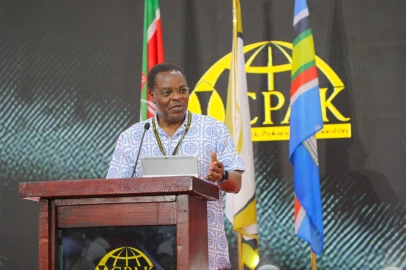
Kenya’s Ethics and Anti-Corruption Commission (EACC) has issued a direct warning to the country’s certified public accountants: professional expertise deployed in service of corruption is not a mitigating factor, it is an aggravating one. The warning, delivered at the Institute of Certified Public Accountants of Kenya (ICPAK) Annual Seminar in Mombasa, signals a sharper institutional focus on the role that financial professionals play in enabling, concealing, and sustaining corrupt networks within both public and private sectors.
EACC Chairperson Dr. David Oginde addressed the seminar, held from 9 to 13 November in Mombasa, with language that cut through the usual platitudes of anti-corruption discourse. “The wickedness that’s done by professionals is professionally done,” he told the assembled accountants. “It’s not an easy crime for the Commission to crack.” That admission is significant: it acknowledges that Kenya’s anti-corruption architecture faces a structural challenge when the very professionals who design financial systems are the ones exploiting their opacity.
The EACC’s concern reflects a documented pattern across West and East Africa where skilled financial intermediaries, auditors, tax advisors, and corporate accountants, provide the technical scaffolding for illicit financial flows. The African Union’s own assessments have consistently identified professional facilitation as a critical gap in continental anti-corruption frameworks, a gap that governance bodies from Nairobi to Abuja have struggled to close through regulation alone.
Oginde’s framing of integrity as a personal, unchosen disposition rather than a compliance output was deliberate. “Integrity is not enforceable, it is a personal choice,” he said, challenging the notion that tighter regulation alone can solve a problem rooted in individual professional judgment. He was specific about what that judgment looks like in practice: the accountant who refuses to manipulate figures, the auditor who stands by uncomfortable findings, the professional who declines to subordinate independent analysis to client pressure. These are not abstract virtues; they describe concrete decisions that financial professionals make under institutional and commercial pressure every day.
The ICPAK seminar brought together accounting professionals and governance stakeholders at a moment when Kenya’s public financial management credibility is under scrutiny. Successive auditor-general reports have flagged billions of Kenya Shillings in unaccounted public expenditure, and civil society organisations have repeatedly pointed to the role of compliant or compromised accountants in allowing those figures to persist without consequence. Against that backdrop, the EACC’s engagement with ICPAK is less a courtesy call than a governance intervention.
ICPAK Chairperson CPA Prof. Elizabeth Kalunda matched the tone. She reaffirmed that the professional body would not serve as a refuge for members implicated in corrupt conduct, and committed ICPAK to deepening its institutional collaboration with the EACC on integrity promotion and accountability standards. Kalunda further pledged that ICPAK would present a formal progress report at the next summit, detailing measurable steps taken by its membership to embed ethical practice. That commitment to reporting and accountability, if honoured, would mark a meaningful shift from declarative anti-corruption positioning toward verifiable institutional action.
The regional dimension of this challenge cannot be separated from Kenya’s domestic governance record. As a signatory to the African Continental Free Trade Area (AfCFTA) and a key node in East African Community (EAC) economic integration, Kenya’s financial governance standards carry weight beyond its borders. Investors assessing cross-border transactions, regional development banks structuring infrastructure financing, and ECOWAS-adjacent trade corridors linking East and West African markets all depend on the credibility of national financial reporting systems. When those systems are manipulated by professionals who understand exactly which controls to circumvent, the damage extends to the regional investment climate.
Oginde pressed the point about silence as complicity. “If we keep silent about wrongdoings, then evil will perpetuate,” he said, framing inaction as an active choice with measurable consequences. This is a governance argument, not a moral sermon: whistleblower protection frameworks, internal audit independence, and professional disciplinary mechanisms only function when individuals within institutions are willing to activate them. Kenya’s Public Officer Ethics Act and the Bribery Act provide legal scaffolding, but enforcement depends on professionals prepared to use it.
The EACC chairperson also posed a question that reframes the national development conversation. “If Americans built their country to the extent we want to go there, why can’t we build Kenya so that the Americans, Singaporeans and other foreigners would want to come and live here?” The question is pointed because it links professional integrity directly to the conditions that generate investment, talent retention, and institutional confidence. Countries that attract capital and skilled migration do so partly because their financial governance systems are trusted, and that trust is built or broken at the level of individual professional decisions.
What the EACC’s Mombasa intervention ultimately demands is that professional bodies like ICPAK move beyond ethical declarations and operationalise accountability through enforceable disciplinary processes, mandatory reporting obligations for suspected financial crimes, and transparent member sanction records. The commitment by ICPAK’s leadership to report progress at the next summit is a start, but the credibility of that commitment will be tested by whether members found to have facilitated corruption face professional consequences proportionate to the institutional damage they caused. Kenya’s anti-corruption institutions have the mandate; the question is whether the professional bodies that train, certify, and govern financial experts will exercise theirs with equal resolve.