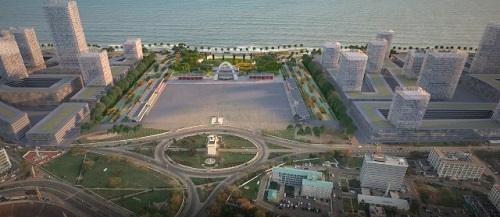
A 241-acre waterfront redevelopment project in Accra, stalled for years by institutional inertia, funding gaps, and governance lapses, has become the clearest test yet of Ghana’s capacity to structure credible public-private partnerships for large-scale infrastructure. The Marine Drive Project, led by the Ministry of Tourism, Culture and Creative Arts, now sits at the centre of a broader question: whether Ghanaian institutions can convert political ambition into bankable, transparently governed development frameworks that attract serious capital.
The project’s origins predate the current administration. Conceived as a transformation of Accra’s Atlantic waterfront into a mixed-use tourism, cultural, and commercial hub, Marine Drive was designed to reposition Ghana’s capital as a regional destination economy, generating foreign exchange, employment, and creative-industry infrastructure. On paper, the vision aligned with Ghana’s obligations under the African Continental Free Trade Area (AfCFTA), which requires member states to develop competitive services sectors, including tourism and creative industries, capable of regional and continental trade.
A Governance Audit Before a Revival
When Tourism Minister Abla Dzifa Gomashie convened a stakeholders’ meeting in June 2025, the exercise was less a launch event than a forensic review. The Ministry assembled relevant parties to assess the project’s status, revisit decisions taken by previous administrations, and identify the specific institutional and regulatory bottlenecks that had prevented implementation. That kind of structured diagnostic, rare in Ghanaian infrastructure governance, produced a clearer picture of what had gone wrong: fragmented oversight, absent accountability structures, and no binding investor commitments.
The response was institutional. The Ministry reconstituted the project’s board and established a dedicated steering committee, with the Minister explicitly tasking the new board to prioritise transparency, discipline, and measurable results. These are not decorative mandates. In the context of West African infrastructure governance, where project boards frequently function as patronage instruments rather than accountability mechanisms, the framing matters. Whether the mandate holds will depend on whether the board operates with genuine independence from political interference, and whether its deliberations are subject to public scrutiny.
Ms Gomashie has also begun investor engagement directly, joining President John Mahama at London Business Week to pitch Marine Drive to the international business community. The diplomatic framing, presenting the project as “ready,” carries risk. Investors experienced in West African markets will conduct their own due diligence on land tenure security, regulatory approval timelines, and dispute resolution mechanisms before committing capital. A ministerial pitch is a necessary first step, not a substitute for the legal and regulatory architecture that makes projects financeable.
The PPP Structural Question
Ghana’s public-private partnership framework, governed by the Public Financial Management Act and the Ghana Infrastructure Investment Fund, has produced mixed results. Landmark PPP projects, particularly in energy and road infrastructure, have struggled with renegotiation disputes, cost overruns, and inadequate risk allocation. Marine Drive, as a tourism and cultural infrastructure project rather than a utility, presents a different risk profile: revenue streams are demand-dependent, construction timelines are long, and the public-good components, promenades, cultural spaces, civic infrastructure, are unlikely to generate returns that attract purely commercial capital.
The Ministry’s stated approach, phased implementation beginning with public promenades and cultural precincts before moving to mixed-use commercial zones, reflects a sensible sequencing logic. By demonstrating visible, tangible progress on the civic dimensions of the project, the government can build the credibility necessary to bring in private developers for higher-value parcels. This mirrors the development model used in Dakar’s Corniche redevelopment and elements of Abidjan’s Plateau district urban renewal, both of which combined public investment in civic infrastructure with structured private development rights.
Ivory Coast’s experience is instructive. Abidjan has attracted sustained FDI into commercial real estate and hospitality precisely because the regulatory environment, anchored within the WAEMU monetary union’s convergence framework, offers investors currency predictability and a functioning arbitration system. Ghana, operating outside WAEMU but engaged in ECOWAS-level monetary cooperation discussions, cannot offer the same currency assurances. The cedi’s depreciation trajectory remains a structural deterrent for long-horizon real estate and tourism investors, and no amount of ministerial enthusiasm resolves that underlying exposure without hedging mechanisms or concessional financing structures.
Regional Positioning and AfCFTA Alignment
Marine Drive’s strategic rationale extends beyond Accra’s skyline. Ghana has positioned itself as a cultural hub for the African diaspora, most visibly through the “Year of Return” and “Beyond the Return” campaigns, which generated measurable increases in diaspora tourism and creative-economy investment between 2019 and 2022. Marine Drive, if implemented, would provide the physical infrastructure to sustain and deepen that positioning, offering world-class venue capacity for continental cultural events, film production facilities, and hospitality assets capable of competing with Nairobi, Lagos, and Cape Town.
Within the AfCFTA services trade protocol, which Ghana has signed, tourism and cultural services represent high-value sectors where comparative advantage is achievable without the industrial base required for manufactured goods trade. A credibly governed Marine Drive project could anchor Ghana’s services export strategy in a way that aligns with continental integration objectives. The African Union’s Agenda 2063 explicitly identifies cultural industries as a driver of intra-African trade and identity, and infrastructure investment in this space carries both economic and diplomatic weight.
ECOWAS, for its part, has not developed a coherent regional tourism infrastructure framework, leaving member states to compete individually for continental and international tourism flows. Ghana’s Marine Drive, if it reaches implementation, would set a precedent for how West African governments structure large-scale cultural infrastructure PPPs, with implications for how regional development finance institutions, including Ecowas Bank for Investment and Development (EBID), engage with similar projects across the bloc.
What Credible Implementation Requires
The Ministry’s current trajectory addresses some of the governance failures that stalled Marine Drive, but several structural gaps remain unresolved. Land tenure documentation for the 241-acre site must be unambiguous and legally defensible, a non-trivial requirement in Accra’s contested coastal land market. Regulatory approval timelines, spanning environmental impact assessments, building permits, and coastal zone management authorisations, must be streamlined and publicly tracked. And the co-financing arrangements the Ministry is pursuing with financial institutions must be structured with clear risk-sharing terms, not simply as government guarantees that transfer downside risk to the public balance sheet.
Investor confidence, the stated objective of the phased approach, is a function of institutional credibility, not narrative. The new board’s composition, its operating mandate, and the frequency and transparency of its reporting will determine whether Marine Drive attracts the quality of capital the project requires, or whether it cycles through another round of feasibility studies and ministerial announcements without breaking ground. Ghana’s Parliament, as the oversight institution with constitutional authority over public expenditure and PPP commitments, has a direct role to play in ensuring that the project’s governance structures are subject to legislative scrutiny before financial commitments are locked in.
For West African observers and investors, Marine Drive represents something larger than a single infrastructure project. It is a stress test of whether Ghana’s governance institutions, after years of fiscal strain and implementation failures, can deliver a complex, multi-stakeholder development at the scale the country’s regional ambitions demand.