
For generations, rural women across Kenya have cultivated land registered in someone else’s name, raised children without authority over household resources, and watched decisions that shaped their daily lives emerge from rooms they were never invited to enter. That arrangement, long normalised by custom and reinforced by legal ambiguity, is now under organised, deliberate challenge.
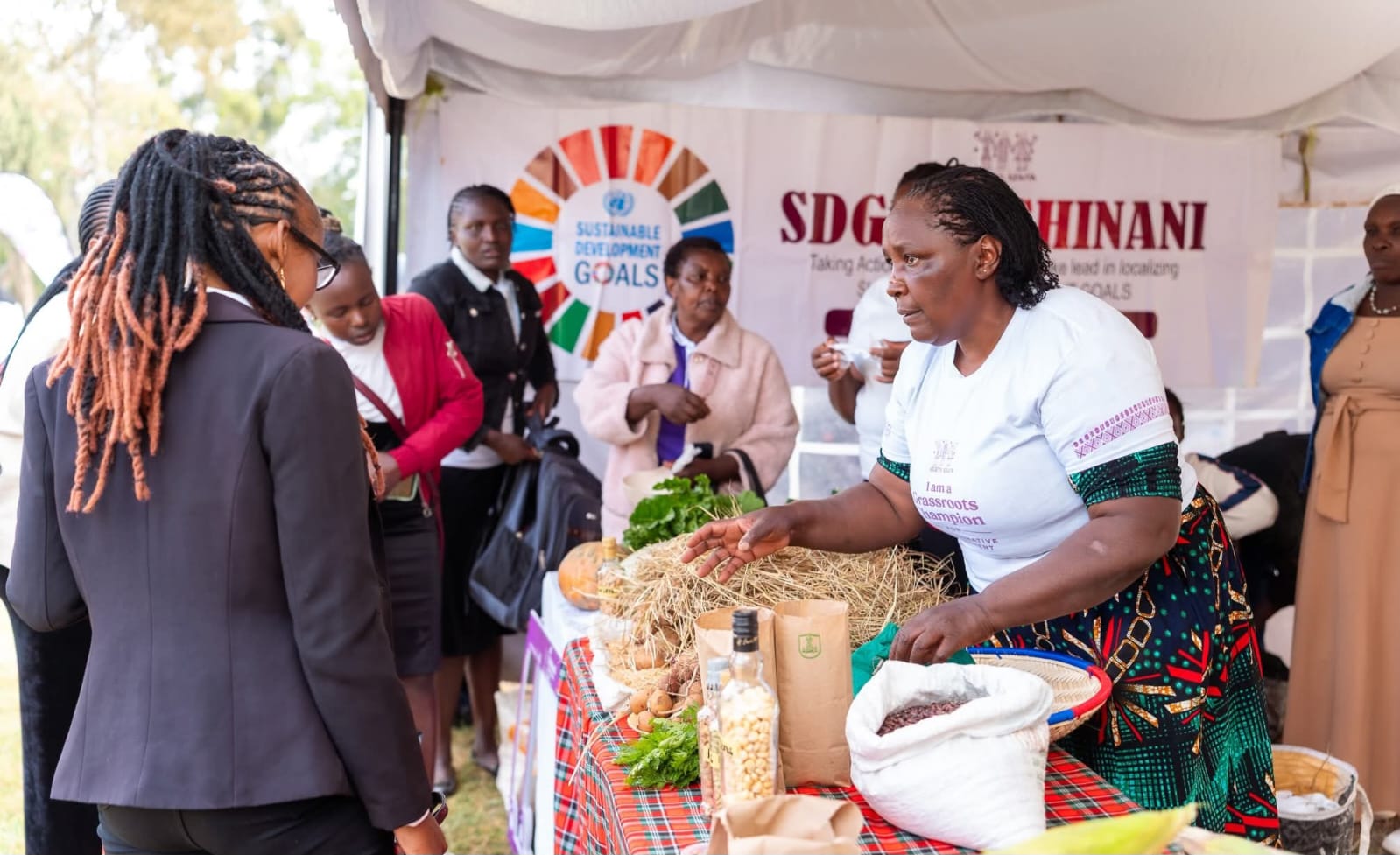
In Ol Kalou, a highland town in Nyandarua County, grassroots women leaders drawn from 30 of Kenya’s 47 counties converged at the National Rural Women’s Forum convened by GROOTS Kenya, a movement that coordinates more than 5,000 grassroots groups representing an estimated 100,000 women. The forum was not a consultation exercise in the conventional sense. It was a structured policy deliberation, built on prior community consultations conducted at the village, ward, sub-county and county levels, designed to channel lived experience into actionable demands on land tenure, political representation, food security and climate resilience.
What made the gathering significant was not its size but its method. GROOTS Kenya Executive Director Eunice Mwangi described the forum’s architecture with precision: “We are here to listen to them and to share and learn from each other.” That framing, modest in tone but consequential in design, reflects a governance philosophy that positions rural women not as programme recipients but as primary knowledge holders whose analysis should drive policy. The distinction matters enormously when evaluating why so many rural development interventions in sub-Saharan Africa produce short-term outputs without durable institutional change.
The land question dominated the forum’s proceedings, and rightly so. Kenya operates under a plural land tenure system governed by the Land Act of 2012, the National Land Commission Act and constitutional provisions that formally guarantee equality in property rights. Yet the gap between statute and practice remains wide, particularly in communities where customary inheritance norms exclude women from owning or inheriting land. Mwangi was direct about the mechanism: “You find that in some cultures, women are not supposed to own land,” she said, noting that widows and daughters are frequently dispossessed following the death of a male household head. The legal framework exists. The enforcement architecture, and the community-level awareness required to activate it, does not consistently reach rural women.
This is not a problem unique to Kenya. Across the ECOWAS region, women account for the majority of agricultural labour while controlling a fraction of registered land. In Ghana, women constitute roughly 52 percent of the agricultural workforce yet hold title to less than 20 percent of registered farmland, a structural imbalance that suppresses their ability to access credit, invest in inputs or participate in formal commodity markets under the AfCFTA framework. In Senegal and Côte d’Ivoire, similar dynamics play out under different statutory regimes but comparable customary pressures. Kenya’s experience, and the institutional responses being tested through forums like this one, therefore carries lessons that extend well beyond its borders.
Mwangi acknowledged that legal awareness alone is insufficient. GROOTS Kenya has deliberately integrated men into its programming through a Men for Women Champions initiative, a design choice that reflects hard-won understanding of how gender-based violence can intensify when women gain economic agency without corresponding shifts in household power dynamics. “We don’t want to solve one problem of empowering women and then bring another problem of gender-based violence into the home,” she said. Cultural leaders, as custodians of community traditions, are also engaged, recognising that durable norm change requires working within existing authority structures rather than simply against them.
The government’s presence at the forum carried institutional weight. Representing the Nyandarua County Commissioner, Administrative Officer Lentete Saitemo confirmed that local administrators are using public barazas to educate communities on women’s land and inheritance rights. “Gone are those days when people used to discriminate against women, that maybe they don’t need to own land or to inherit land from their parents,” Saitemo said. That language, coming from a state representative at a grassroots forum, signals a degree of institutional alignment between civil society advocacy and administrative practice that is worth noting, even if implementation remains uneven across counties.
The economic transformation testimony offered by Monica Keben, a rural women’s representative from Tiaty in Baringo County, illustrated how organised collective action produces measurable outcomes. Since GROOTS Kenya began working in the area in 2021, women who had previously been confined to domestic roles were organised into groups and trained in income-generating activities. Keben described widows who had struggled to protect property and educate children now sending those children to university. “An older man at home now knows that when the woman comes home in the evening, she comes with something,” she said. That shift in household perception, grounded in demonstrated economic contribution, represents a more sustainable basis for norm change than awareness campaigns alone.
Dorcus Kigera, a GROOTS Sacco leader, pushed the governance argument further. Economic empowerment, she argued, must translate into institutional representation if it is to produce lasting policy change. She called for women to seek positions on school boards, hospital management boards and county decision-making bodies, and to pursue elective office at the parliamentary and county levels. “We are pushing women to join these boards so that they can understand and fight for their rights,” Kigera said. The logic is institutional: women who participate in resource allocation decisions at the local level build the competencies, networks and visibility that support entry into formal political structures.
Esther Kuria, a GROOTS Kenya Champion Movement member from Nyandarua, connected land ownership directly to productive economic agency. Her framing went beyond title registration: “Women should not merely have land in their names but should also have the freedom and knowledge to determine how to use it to generate income and improve their livelihoods.” That distinction between nominal ownership and substantive economic control is analytically important. Land titling programmes that do not accompany registration with access to extension services, credit facilities and market linkages frequently fail to translate property rights into income growth, a pattern documented across multiple World Bank and IFAD evaluations of smallholder programmes in East and West Africa.
Food security featured prominently in the forum’s proceedings, with women from Nakuru County describing a household food mapping exercise that involves visiting families to assess food stores and identify households at risk of hunger. Wairimu Kanyiri, a farmer from Turi Ward in Molo, described how collaboration with the Ministry of Agriculture had supported production increases. “Now we can say our families have food,” Kanyiri said. The mapping methodology, simple in design but systematic in application, represents the kind of community-level data infrastructure that national food security planning in Kenya and across the region frequently lacks.
What the Ol Kalou forum ultimately demonstrated is that the governance deficit facing rural women in Kenya is not primarily a resource deficit. It is an institutional deficit: a gap between rights formally enshrined in law and the administrative, cultural and economic mechanisms required to make those rights operative. GROOTS Kenya’s model, which combines legal awareness with economic organisation, male engagement, cultural leadership involvement and structured political advocacy, addresses multiple dimensions of that deficit simultaneously. The 100,000 women it reaches represent a constituency with the scale and organisation to exert real pressure on county and national institutions. Whether that pressure translates into legislative amendments, county budget allocations or changes in land administration practice will depend on whether Kenya’s governance institutions respond to organised rural women as legitimate policy interlocutors rather than development beneficiaries awaiting assistance.