A Self-Imposed Deadline Exposes Institutional Fault Lines
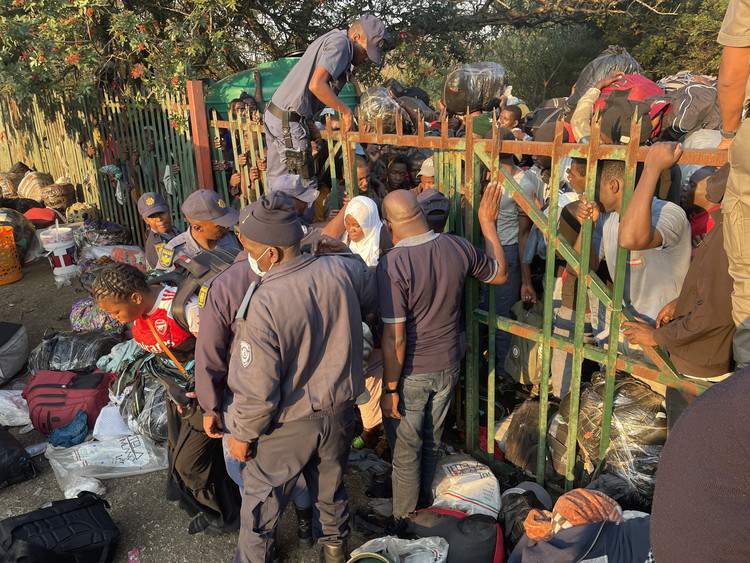
On 30 June 2026, a date manufactured by anti-immigration groups rather than any legislative or judicial process, South Africa confronted a stress test of its constitutional order. Organised movements, most prominently March and March, had spent weeks mobilising demonstrations against undocumented migrants, framing the date as a deadline by which foreign nationals should leave the country. The government held no such position. Immigration enforcement, as both national and provincial authorities repeatedly clarified, remains an exclusive state function under South African law.
The gap between that legal reality and the street-level mobilisation it failed to prevent is precisely the governance question at stake. When non-state actors successfully impose extrajudicial timelines on vulnerable populations, the credibility of constitutional protections is not merely tested in theory. It is tested in practice, in clinics, in markets, and in the streets of Johannesburg, Cape Town, and Durban.
More than 400 public health professionals, academics, and healthcare workers crystallised that challenge in a joint statement released on 29 June 2026. Prepared by Professor Hassan Mahomed of the Western Cape Department of Health and Wellness and Dr Rebecca Walker, a senior research consultant in migration, health, and human rights, the statement drew signatures from some of South Africa’s most credentialed scientists, including Professors Glenda Gray, Shabir Madhi, Francois Venter, Leslie London, and Crick Lund. Their message was direct: anti-migrant rhetoric constitutes a measurable public health risk, and the institutional response to date has been inadequate.
The Misinformation Architecture Driving Xenophobic Mobilisation
The signatories identified misinformation as the primary accelerant of the current climate. Specific, verifiable claims about migrants overloading public health facilities have circulated widely and shaped political discourse, yet the evidence base for those claims does not exist.
“There is no available evidence that migrants place a disproportionate burden on public health facilities,” the statement reads. Research by Médecins Sans Frontières and data from the National Department of Health point in the opposite direction: undocumented migrants systematically avoid healthcare facilities out of fear of arrest or deportation. They delay treatment, often presenting with advanced illness at significantly greater cost to both themselves and the health system.
This is not a minor empirical correction. It inverts the dominant political narrative. If migrants are net avoiders of public services rather than net consumers of them, then the entire policy framing that positions migrants as a fiscal burden on municipalities and hospitals collapses.
The professionals also flagged a subtler but consequential concern: President Cyril Ramaphosa’s national address on migration, while explicitly condemning vigilantism and affirming that immigration enforcement “rests with the state and the state alone,” simultaneously framed undocumented immigration as a significant driver of South Africa’s economic difficulties. The signatories were precise in their critique: “a framing not supported by available evidence, and one that risks reinforcing the narrative that is fueling the current climate of fear.”
When executive communication validates the premise of a misinformation campaign, even while rejecting its methods, the institutional message becomes contradictory. That contradiction has operational consequences for law enforcement, healthcare workers, and vulnerable communities navigating the gap between stated policy and street reality.
Constitutional Rights, Healthcare Access, and the Limits of State Enforcement
What the Law Requires
South Africa’s constitutional framework is unambiguous. Section 27 of the Constitution guarantees access to healthcare services, and the Constitutional Court has consistently interpreted this to apply to all persons within the country’s borders, regardless of documentation status. South Africa’s international obligations under the 1951 Refugee Convention and the African Charter on Human and Peoples’ Rights reinforce this framework.
The public health statement documented specific violations of that framework already underway:
The Enforcement Gap
Court orders exist. The problem is implementation. When judicial instructions protecting migrant access to services are not enforced with speed and visible consequence, the message transmitted to organised vigilante groups is that extrajudicial pressure produces results that legal processes do not punish. That feedback loop is institutionally corrosive.
The signatories called explicitly on government to enforce existing court orders, implement clear healthcare access policies across all health departments, and guarantee that migrants are treated with dignity regardless of documentation status. These are not aspirational demands. They are legal obligations the state has already accepted.
Regional Integration Dimensions: SADC, ECOWAS, and the Continent’s Free Movement Architecture
South Africa’s current xenophobic mobilisation does not occur in an institutional vacuum. It unfolds against the backdrop of continent-wide efforts to build the legal and practical infrastructure for African free movement, anchored by the African Union’s Free Movement of Persons Protocol and operationalised through regional economic communities including ECOWAS and SADC.
ECOWAS, covering fifteen West African states, has maintained one of Africa’s most functional free movement regimes since 1979. Citizens of member states hold the right to enter, reside, and work across the bloc without a visa for up to ninety days, with pathways to longer-term residence. That framework has survived coups, currency crises, and political turbulence because member states have consistently treated it as a structural asset rather than a negotiable concession.
The contrast with the current South African situation is instructive. When anti-migrant sentiment in any ECOWAS member state escalates toward organised exclusion, the bloc’s legal architecture provides a reference point for diplomatic engagement and, where necessary, institutional pushback. The ECOWAS Community Court of Justice has jurisdiction over human rights violations, including those affecting free movement rights. That institutional layer matters.
SADC’s free movement commitments are less advanced, and South Africa’s domestic politics have historically complicated regional integration ambitions. But the reputational and diplomatic costs of state-tolerated xenophobic violence extend beyond bilateral relationships. For the AfCFTA to function as a genuine continental trade framework, the principle that African nationals can move, work, and do business across borders without facing organised violence must be credible. South Africa, as the continent’s most industrialised economy, carries disproportionate weight in that credibility calculus.
Investors assessing regional supply chains, logistics infrastructure, and labour mobility under AfCFTA watch how states treat mobile African workers. A South Africa that cannot protect documented and undocumented migrants from organised violence sends a signal about the reliability of its institutional environment that extends well beyond immigration policy.
Governance Failures at the Root: Unemployment, Service Delivery, and Scapegoating
The public health professionals were explicit about the structural drivers of South Africa’s social crisis. “The cause of this crisis is not foreign nationals but instead lies in state failure, corruption, and compounding inequality,” their statement reads. Unemployment, struggling municipalities, and widespread service delivery failures are real and severe. They are also the product of decades of governance deficits that predate any measurable increase in migration flows.
Scapegoating migrants for those failures is not simply morally wrong. It is analytically counterproductive. It displaces political accountability from the institutions and actors responsible for service delivery onto a population that has no electoral voice and limited legal recourse. That displacement protects the governance failures it should be exposing.
South Africa’s municipal infrastructure crisis, its electricity generation deficit, its unemployment rate exceeding 32% by narrow definition, its public hospital underfunding: none of these are migrant-produced phenomena. Treating them as such does not produce policy solutions. It produces violence.
Policy Pathways: What Institutions Must Do Now
The public health community’s demands translate into a concrete institutional agenda. Government at national and provincial level must act on several fronts simultaneously.
Police and prosecutorial services need to enforce existing court orders protecting migrant access to healthcare and public spaces with the speed and visibility that deters repeat violations. Slow enforcement is not neutral. It signals permissiveness.
Provincial health departments must publish and communicate clear policies on healthcare access for migrants and refugees, removing the administrative ambiguity that allows individual facilities and staff to apply inconsistent standards under pressure.
The national government must audit its own communication on migration. Framing undocumented immigration as a significant economic driver without evidentiary support, even within a message that condemns vigilantism, produces mixed signals that organised anti-migrant groups exploit. Precision in executive communication is a governance tool.
Combating the specific misinformation claims circulating about migrants and public services requires a proactive information strategy, not reactive denial. The National Department of Health holds data that directly contradicts the dominant narrative. Publishing it prominently and repeatedly is both a public health intervention and an institutional responsibility.
Finally, South Africa’s engagement with SADC and AU frameworks on migration governance needs to become more substantive. The country’s capacity to lead continental integration processes, including AfCFTA implementation, depends on demonstrating that its domestic institutions can uphold the rights its international commitments guarantee. That demonstration begins with protecting the people already within its borders.