Ghana’s AU Gambit Exposes Cracks in South Africa’s Migration Governance as Africa Day Tensions Flare
Ghana’s formal request for the African Union to convene a debate on xenophobia in South Africa has transformed a domestic migration dispute into a continental governance question, testing whether the AU’s human rights architecture can hold a member state accountable for the treatment of foreign nationals on its soil.
A Diplomatic Rupture on Africa Day
South Africa’s Africa Day celebrations on 26 May 2025 at Moruleng Stadium in North West Province became the focal point of a widening diplomatic rift. African ambassadors, citing security concerns over large expected crowds and the safety of African migrants, collectively opted not to attend the event. André Nzapayeke, ambassador of the Central African Republic and dean of the African ambassadorial corps, confirmed the decision, though ambassadors later clarified they were postponing their own Africa Day observances rather than formally boycotting the South African government’s event.
The distinction is procedurally significant but politically thin. The symbolic withdrawal of the continent’s diplomatic corps from a celebration of African unity sent an unambiguous message about the state of South Africa’s standing among its continental peers.
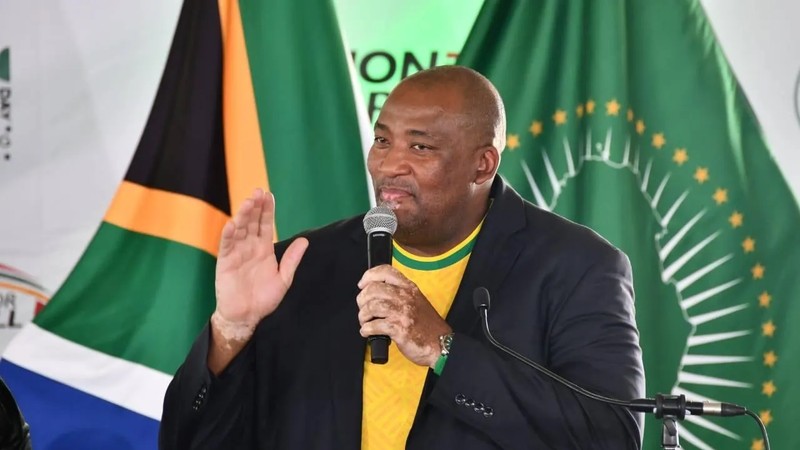
At the centre of the controversy stood Minister of Sport, Arts and Culture Gayton McKenzie, whose remarks at Moruleng crystallised the tension between South Africa’s constitutional obligations and a growing political current that frames undocumented migration as an economic threat. “African leaders keep sending their people to take the jobs of our young people,” McKenzie said. “If you don’t have papers for this country, you must go home.”
McKenzie rejected the xenophobia characterisation outright: “How does asking for people to be documented and to follow the law make me xenophobic?” His framing positions immigration enforcement as a rule-of-law question, deflecting responsibility onto origin-country governments. The argument has domestic political traction but sits uneasily with South Africa’s obligations under the AU’s Constitutive Act, the 1969 OAU Convention Governing the Specific Aspects of Refugee Problems in Africa, and SADC’s Protocol on the Facilitation of Movement of Persons.
Ghana’s AU Referral: Testing Continental Accountability Mechanisms
Ghana’s response has been the most institutionally consequential. Accra announced it was evacuating 300 Ghanaian nationals from South Africa and formally requested the African Union to place xenophobia in South Africa on the agenda of the AU’s mid-year coordination summit in Cairo. South Africa’s Department of International Relations and Cooperation (Dirco) described the request as “regrettable,” a response that itself signals the limits of peer accountability within the continental body.
Ghana’s High Commissioner to South Africa, Benjamin Quashie, framed the stakes plainly: sustained tensions over undocumented migration risk structural damage to South Africa’s bilateral relationships across the continent. That assessment carries weight in the context of the African Continental Free Trade Area (AfCFTA), whose secretariat is headquartered in Accra. AfCFTA’s Protocol on the Free Movement of Persons, still under negotiation, depends on a baseline of political trust between member states. Episodes of anti-migrant violence, and the political rhetoric that accompanies them, erode that foundation.
South Africa is AfCFTA’s largest economy by GDP and a critical node in the agreement’s implementation. Its domestic political posture on migration directly shapes the credibility of continental free movement commitments. If Pretoria’s government cannot publicly defend the dignity of African nationals on its territory, the normative architecture of continental integration weakens.
Cabinet Divisions and the Limits of Executive Coherence
The South African government’s response has been internally fractured. Minister of International Relations and Cooperation Ronald Lamola distanced the cabinet from McKenzie’s framing, stating that migration concerns “must be handled in a constitutional way with human dignity.” President Cyril Ramaphosa, speaking at the South Africa-Botswana binational commission summit, attributed anti-immigrant attacks to “opportunists” and affirmed that the violence did not reflect government policy or South African values.
Minister in the Presidency Khumbudzo Ntshavheni went further, condemning “opportunistic attempts to hijack the concerns of genuine South Africans” and confirming that cabinet had instructed law enforcement agencies to prosecute perpetrators of xenophobic violence.
Yet McKenzie, a cabinet minister, faced no public disciplinary consequence for remarks that Lamola acknowledged were “not in the spirit of the government.” That gap between stated policy and ministerial conduct is a governance failure. It signals to both domestic audiences and continental partners that accountability within the executive is selective, and that anti-migrant rhetoric carries political cost only when it attracts external diplomatic pressure.
Former President Thabo Mbeki, speaking ahead of Africa Day, argued that economic hardship and unemployment should not be instrumentalised to scapegoat migrants. His intervention reflects a longer-standing tension within South African political culture between the ANC’s pan-Africanist founding ideology and the electoral pressures generated by 33.5% unemployment among South African youth.
Migration Data and the Policy Gap
The political debate has consistently outpaced the empirical record. According to Statistics South Africa’s Report on Migration Statistics, drawn from the 2022/2023 Income and Expenditure Survey, the international migrant population stood at 3.1 million people, representing approximately 5.1% of South Africa’s total population. Of those, 56.2% are male and 43.8% are female.
That figure, while significant, does not support the scale of economic displacement implied by ministerial rhetoric. South Africa’s unemployment crisis is structurally rooted in skills mismatches, inadequate industrial policy, and energy infrastructure failure, not migrant labour competition at the aggregate level. The conflation of undocumented migration with youth unemployment is analytically weak but politically potent.
South Africa has no functional national migration management system capable of distinguishing between asylum seekers, documented workers, undocumented economic migrants, and long-term residents with lapsed documentation. The Department of Home Affairs has faced persistent capacity and corruption challenges that have made legal migration pathways slow, expensive, and unreliable. That institutional failure drives informality, which politicians then frame as a security threat.
Regional Integration Stakes and the Path Forward
The episode exposes a structural contradiction at the heart of South Africa’s continental role. Pretoria positions itself as a champion of African integration, hosting the AfCFTA secretariat negotiations, anchoring SADC, and projecting soft power through its development finance institutions. Simultaneously, its domestic political economy generates recurring cycles of anti-migrant sentiment that undermine the normative preconditions for the integration it claims to support.
Ghana’s AU referral, whatever its procedural outcome in Cairo, establishes a precedent: member states can and will use continental institutions to raise accountability questions about the treatment of their nationals abroad. That is precisely how regional governance architecture is supposed to function. The more consequential question is whether the AU’s human rights mechanisms, historically deferential to member state sovereignty, have the institutional will to follow through.
For South Africa, the governance imperative is concrete: Home Affairs reform to create functional, dignified, and efficient legal migration pathways; enforcement action against ministers whose public statements contradict cabinet policy; and sustained bilateral engagement with Ghana, Nigeria, and other affected states through the DIRCO framework that Lamola has indicated is already underway.
For West African states, the episode reinforces the case for accelerating the AfCFTA free movement protocol negotiations and building bilateral labour mobility agreements that reduce the vulnerability of their nationals to enforcement discretion in host countries. Migration governance, in the end, is a regional integration problem requiring regional institutional solutions, not a domestic law-and-order question amenable to unilateral enforcement rhetoric.