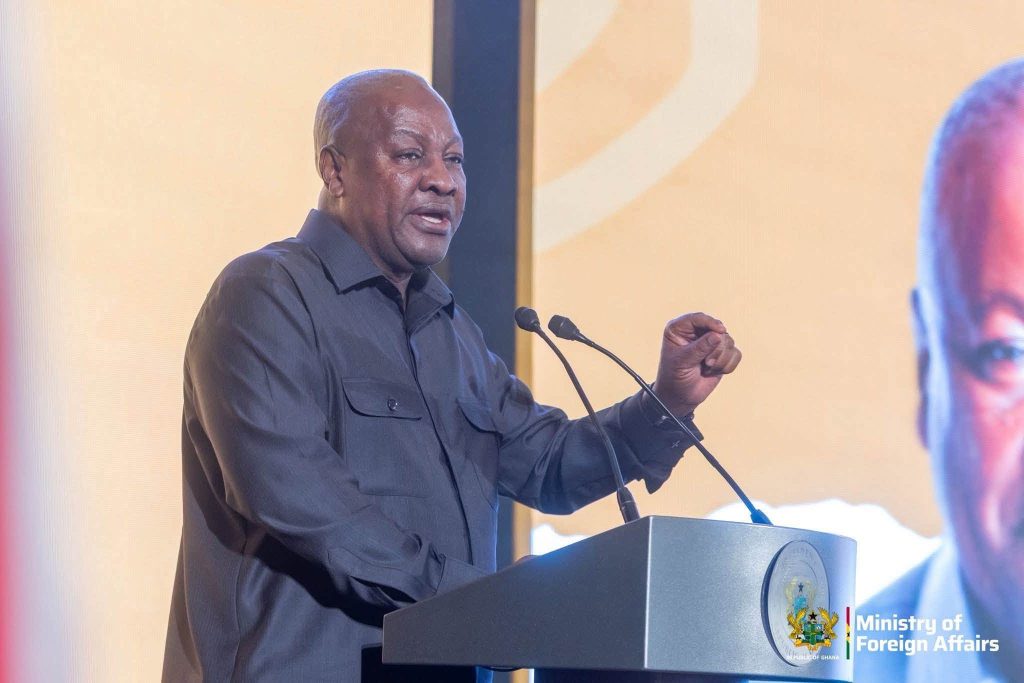
President John Dramani Mahama told an international audience in New York on the sidelines of the 81st United Nations General Assembly that his administration is actively restructuring Ghana’s public financial management systems, with a direct focus on curbing the diversion of statutory funds toward politically motivated spending. Speaking at the Accra Reset event held under the theme “Full Circle: Making Global Development Work Again,” Mahama identified the misallocation of ring-fenced public resources as a central governance failure his government inherited and is now working to reverse.
Statutory Funds at the Centre of Accountability Debate
The most pointed institutional disclosure Mahama offered concerned the National Health Insurance Scheme (NHIS), whose funding had been capped under the previous administration. He explained that once statutory fund allocations exceeded a defined percentage of the national budget, the surplus was automatically redirected into the Consolidated Fund, where it was deployed at executive discretion. “If they exceeded a certain percentage of the budget, the excess funds went into the Consolidated Fund and government used it mostly for programmes that would buy political patronage and put them in a better position to win the elections,” Mahama stated directly. His administration’s first corrective measure, he said, was to remove that cap, restoring the NHIS’s access to its constitutionally designated revenue streams. The NHIS is funded primarily through a 2.5 percent National Health Insurance Levy and a portion of Social Security and National Insurance Trust contributions, making the cap’s existence a significant structural constraint on the scheme’s operational capacity.
This disclosure carries weight beyond domestic politics. Ghana’s public financial management architecture has long been scrutinized by the International Monetary Fund, which has maintained an active program with Accra since 2023 following a sovereign debt default. The IMF’s Extended Credit Facility arrangement explicitly conditions disbursements on fiscal transparency benchmarks, including the integrity of earmarked fund management. Any systematic redirection of statutory allocations toward discretionary political spending would represent a structural breach of those commitments, raising questions about the depth of compliance under the prior fiscal regime.
Governance Reform Within a Regional Accountability Landscape
Ghana’s governance reset, as Mahama framed it, lands at a moment when West African institutional credibility is under acute strain. Three ECOWAS member states, Mali, Burkina Faso, and Niger, have exited the regional body’s political framework following military coups, citing governance failures and elite capture as justifications for their break with constitutional order. Against that backdrop, Ghana’s civilian government articulating a concrete anti-corruption and public finance reform agenda carries regional symbolic significance, particularly as ECOWAS attempts to reinforce democratic governance norms among its remaining members.
Peer comparisons sharpen the stakes. Senegal, under President Bassirou Diomaye Faye, has also launched a public audit of state finances following its 2024 transition, with a government commission revealing significant fiscal data discrepancies inherited from the previous administration. Ivory Coast, Ghana’s most direct economic competitor for foreign direct investment in the Gulf of Guinea, has maintained relatively stable public financial management institutions, giving it a structural advantage in sovereign credit markets. For Ghana to recover investor confidence and restore its access to international capital markets, institutional credibility on public finance is not peripheral; it is the central variable.
Public Finance Integrity and the AfCFTA Dimension
The governance reforms Mahama outlined also intersect with Ghana’s obligations and ambitions under the African Continental Free Trade Area. Accra hosts the AfCFTA Secretariat, a mandate that positions Ghana as a standard-bearer for continental economic governance. Investors and trade partners evaluating AfCFTA’s operational credibility assess member states’ domestic governance environments as proxies for contract enforceability, regulatory predictability, and institutional reliability. A Ghana that demonstrably strengthens its public financial management systems reinforces the institutional legitimacy of the Secretariat it hosts; a Ghana that continues to exhibit statutory fund diversion or opaque consolidated fund usage undermines it.
Mahama’s appearance at the Accra Reset event, a forum explicitly designed to reshape global development financing frameworks, also signals an intent to reposition Ghana as a credible interlocutor for concessional and blended finance. The event convened development finance institutions, multilateral agencies, and sovereign governments to discuss how development financing architectures can better serve recipient country needs. Ghana’s ability to attract restructured debt terms and new concessional flows depends materially on its governance track record, making the reform narrative Mahama advanced in New York a direct component of the country’s debt sustainability strategy.
Institutional Mechanisms and Outstanding Accountability Gaps
Several institutional mechanisms now carry the weight of delivering on Mahama’s reform commitments. Ghana’s Public Financial Management Act of 2016 provides the statutory framework for consolidated fund management and earmarked fund protection, but enforcement has historically been inconsistent. The Office of the Special Prosecutor, established in 2018 to pursue high-value corruption cases, has operated under persistent resource and jurisdictional constraints. The Ghana Audit Service and the Public Accounts Committee of Parliament remain the primary oversight instruments, though both have faced criticism for delayed reporting cycles and limited follow-through on audit findings.
The reform agenda Mahama outlined in New York is coherent in its diagnosis: statutory fund diversion, consolidated fund opacity, and politically driven resource allocation have eroded both public service delivery and institutional credibility. The NHIS uncapping is a concrete first step, but it remains a single corrective measure within a broader architecture that requires systematic legislative reinforcement, independent audit empowerment, and prosecutorial follow-through. Ghana’s regional standing, its AfCFTA convening authority, and its path back to capital market access all depend on whether these institutional commitments translate from speech to enforceable structural change.