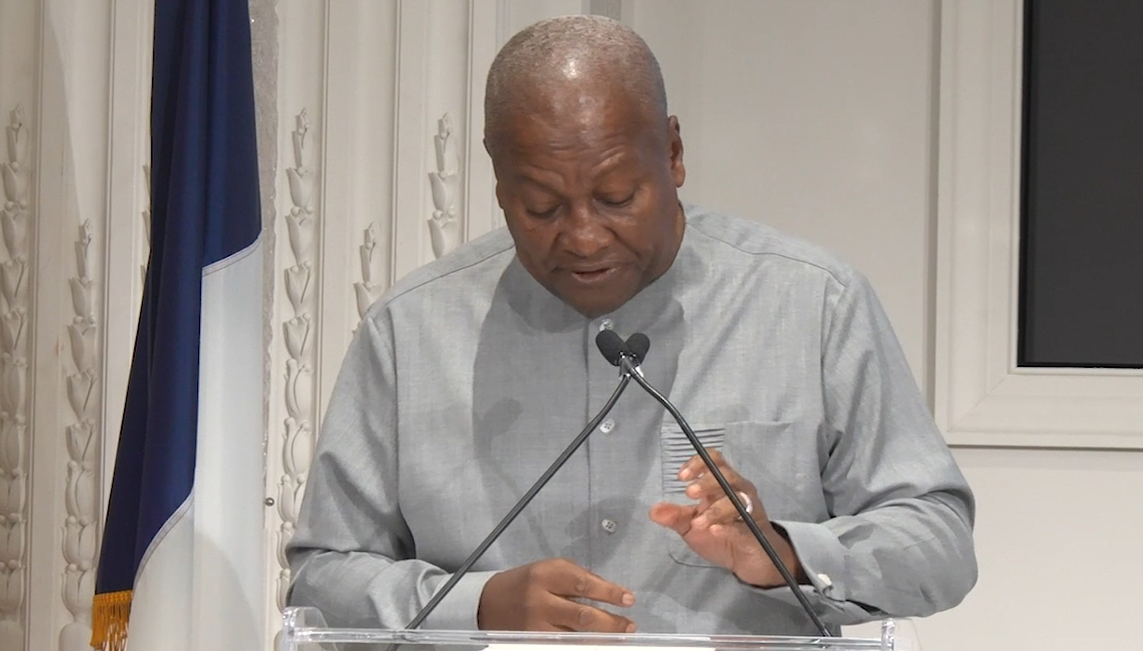
President John Dramani Mahama used a side event at the 81st United Nations General Assembly in New York to lay out a structured, three-part framework for operationalising the reparative justice commitments embedded in UN Resolution 80/250, the historic March 2025 declaration by 123 member states recognising the transatlantic slave trade as the gravest crime against humanity and calling for the prompt restitution of African cultural property.
The resolution marked a turning point in multilateral discourse on colonial redress. Mahama’s intervention moved the conversation firmly into institutional territory, demanding that goodwill give way to enforceable legal and diplomatic architecture.
From Symbolic Gestures to Standardised Legal Mechanisms
The first of Mahama’s three pillars targets what he described as the fundamental inadequacy of the current restitution landscape: a patchwork of unilateral, discretionary acts by holding states that produces uneven and conditional outcomes. He cited the Netherlands’ cataloguing of 2,000 Ghanaian artefacts for return, Germany’s engagement with the Kpando traditional area, France’s legislative frameworks, and the repatriation of the Djidji Ayokwe talking drum to Côte d’Ivoire as evidence of progress. But he was unequivocal about their structural limits.
“Moral justice cannot rely on piecemeal generosity or isolated acts of goodwill,” Mahama said. He called on the United Nations and holding states to establish “clear, standardised legal and diplomatic mechanisms” to streamline provenance research, improve access to archives, and eliminate legal barriers to unconditional restitution. He specified that the process should begin with the unconditional return of human remains, a demand that carries particular weight given that several European natural history institutions still hold skeletal remains acquired under colonial conditions.
The governance implication is direct. Without a binding multilateral framework, restitution remains a function of political will in holding states rather than a right exercisable by originating nations. For West African governments, which collectively hold claims to thousands of objects currently in European and North American institutions, the absence of standardised mechanisms translates into asymmetric negotiating power and indefinite delay.
The African Union’s existing mandate under Agenda 2063 provides a continental anchor for such demands. The AU has long identified cultural heritage recovery as integral to its development vision, and Resolution 80/250 now supplies the multilateral legitimacy to press for a formal UN instrument with real enforcement provisions.
Dismantling the Capacity Argument
Mahama’s second pillar addressed directly the most persistent counter-argument deployed by holding institutions: that African countries lack the conservation infrastructure to safely receive and preserve returned objects. He rejected this framing without equivocation.
“Capacity constraints must never be used as a justification for continued possession. Capacity must serve as a bridge to return, not a barrier to justice,” he said.
The argument matters beyond its rhetorical force. Framing capacity gaps as a prerequisite for restitution effectively conditions African sovereignty over cultural patrimony on a standard of institutional development that holding states themselves set and evaluate. It is a governance problem dressed as a technical one.
Mahama pointed to concrete investments already underway: Ghana’s construction of modern national and traditional institutions, the AU’s Great African Museum flagship project under Agenda 2063, and the AU-EU Museum Partnership as evidence that the continent is building the infrastructure to receive, research, and exhibit returning heritage. He argued that remaining technology, digitisation, and conservation gaps should be addressed through genuine multilateral partnerships, not used as a pretext for continued retention.
For regional peers, the model has direct relevance. Nigeria’s National Commission for Museums and Monuments has been engaged in protracted negotiations over Benin Bronzes held in European collections. Senegal and Mali have similarly active repatriation agendas. A coordinated West African position, channelled through ECOWAS and aligned with AU mechanisms, would carry substantially more institutional weight than bilateral negotiations conducted state by state.
ECOWAS has a cultural affairs mandate and has previously adopted declarations on heritage protection. Translating those declarations into a coordinated restitution negotiating bloc, backed by the legal authority of Resolution 80/250, represents an actionable next step for the regional body.
The economic dimension is not peripheral. West Africa’s creative economy and cultural tourism sectors remain underdeveloped relative to the continent’s heritage assets. Ghana’s tourism receipts, Senegal’s cultural economy, and Benin’s emerging museum sector all stand to benefit materially from the return of high-profile objects that anchor visitor interest and national identity narratives. The African Development Bank has identified cultural industries as a significant driver of GDP diversification; restitution is, in this framing, also an investment question.
Mahama’s third pillar made this case explicitly, rejecting the sequencing logic that places cultural heritage recovery after economic development. “Cultural heritage is not a luxury item to be addressed after economic development. Heritage is an engine of development,” he said, pointing to education, national identity, international tourism, and the creative economy as direct channels through which returned heritage generates tangible value.
The policy pathway Mahama sketched is ambitious but institutionally grounded. It asks the UN to move from declaratory resolution to binding instrument, holding states to replace discretionary repatriation with legally structured processes, and African governments to consolidate their negotiating positions within existing continental and regional frameworks. Whether the 81st General Assembly session translates Resolution 80/250’s moral authority into operational mechanisms will depend on how effectively Ghana and its continental partners press the institutional case in the months ahead.