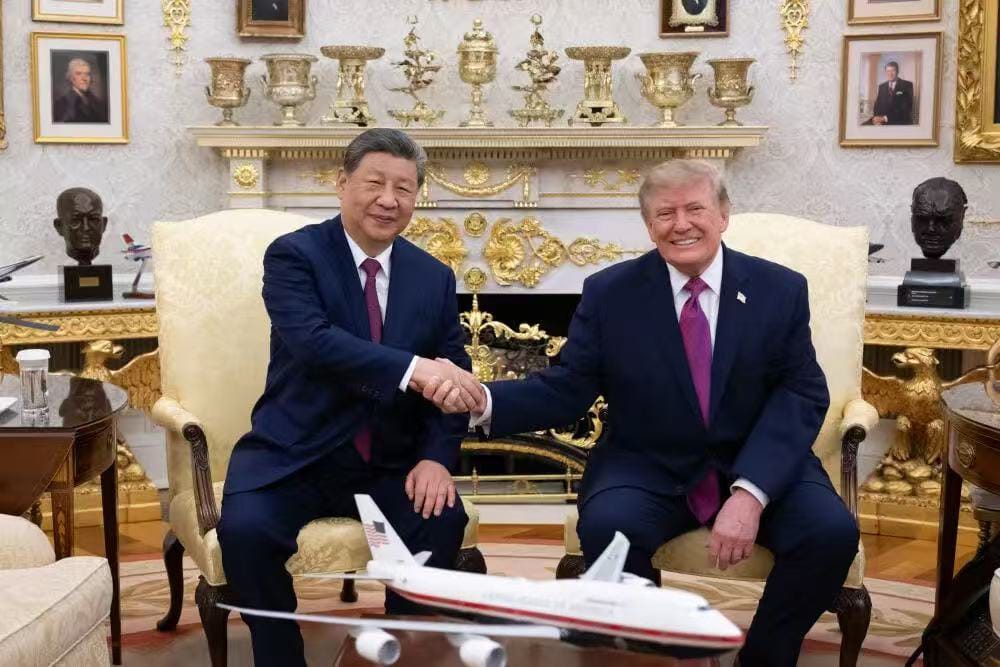
When Chinese President Xi Jinping and US President Donald Trump concluded their state-level talks and released an eight-point consensus framework covering trade tariffs, artificial intelligence governance, nuclear non-proliferation, and military crisis communication, the announcement reverberated well beyond Washington and Beijing. For West African governments navigating dual dependency on both superpowers, the framework recalibrates the external environment in which ECOWAS member states pursue regional integration, attract foreign direct investment, and manage their own governance reform agendas.
The consensus, released after Xi’s three-day state visit to the United States, commits both governments to a “constructive bilateral relationship founded on strategic stability, respect, fairness, and reciprocity.” That language, while diplomatic in register, carries concrete institutional weight: it signals a managed-competition posture rather than outright decoupling, a distinction that directly affects how African economies position themselves within global supply chains and development finance architectures.
At the core of the trade dimension sits a $30 billion reciprocal tariff reduction arrangement, the establishment of a formal trade council between the two economies, and the extension of understandings reached during prior consultations in Kuala Lumpur. Both presidents instructed their respective economic teams to implement these outcomes, lending the agreement an operational character beyond rhetorical commitment. For Ghana, Senegal, Côte d’Ivoire, and Nigeria, each of which runs significant trade relationships with both Washington and Beijing, the stabilisation of Sino-American commercial rules matters structurally. Tariff volatility between the world’s two largest economies has historically compressed commodity prices, disrupted export routing, and introduced currency pressure in West African markets that lack the reserve depth to absorb external shocks easily.
Ghana’s own economic trajectory illustrates this exposure with particular clarity. The country concluded an IMF Extended Credit Facility arrangement in 2023 following a debt restructuring process that exposed the degree to which external financing conditions, shaped partly by great-power monetary and trade policy, can destabilise even a structurally reforming economy. The Bank of Ghana’s monetary policy committee has repeatedly cited global risk sentiment, itself a function of US-China relations, as a variable shaping capital flows into Ghanaian sovereign instruments. A more predictable bilateral trade framework between Washington and Beijing reduces one source of that volatility, though it does not eliminate the structural vulnerabilities that Ghana’s fiscal consolidation programme is designed to address.
The artificial intelligence dimension of the consensus carries its own governance significance for West Africa. Xi and Trump agreed to establish a formal China-US AI Dialogue, with the next round anticipated in November, alongside a dedicated communication channel for AI-related incidents. Both governments framed this as a mechanism for exchanging views on risks and benefits as both nations advance competing AI ecosystems. The institutional implication for African regulators is substantial: the two dominant AI development environments will now operate under a bilateral oversight framework that African governments had no hand in designing, yet whose standards, liability regimes, and access conditions will shape the AI tools and platforms deployed across the continent.
ECOWAS member states are at varying stages of developing national AI strategies. Ghana published a National AI Policy in 2023; Nigeria’s Federal Ministry of Communications and Digital Economy has advanced a comparable framework. Senegal and Côte d’Ivoire have engaged with AU-level discussions on digital governance. None of these processes has produced a regionally harmonised AI governance standard, which means West African states will likely absorb Sino-American AI norms by default rather than by negotiated participation. The AU’s Digital Transformation Strategy for Africa (2020-2030) provides a continental framework, but without a West African regulatory body with binding AI jurisdiction, the region remains a norm-taker in a domain that will increasingly determine the competitiveness of its financial services, agricultural technology, and public administration systems.
On nuclear non-proliferation, Xi and Trump agreed that Iran must fulfil its commitment not to develop nuclear weapons. While this speaks primarily to Middle Eastern security architecture, it carries indirect relevance for West Africa through the lens of energy sovereignty. Several ECOWAS member states, including Ghana and Nigeria, have explored civilian nuclear energy as a long-term power generation option. The international non-proliferation regime, whose enforcement architecture is shaped decisively by US and Chinese positions at the UN Security Council, governs the terms under which African states can access nuclear technology transfers. A more cooperative Sino-American posture on non-proliferation strengthens that regime’s credibility and, by extension, the legal environment within which West African governments might eventually negotiate civilian nuclear partnerships.
The agreement that no country or institution should charge transit fees for passage through international waterways addresses a principle with direct commercial relevance for West Africa’s maritime economies. Ghana’s Tema port, Nigeria’s Apapa and Lekki complexes, and Côte d’Ivoire’s Abidjan terminal all depend on open international shipping lanes for export competitiveness. The reaffirmation of freedom of navigation as a shared Sino-American principle, even if targeted at specific chokepoints, reinforces the legal norms that underpin West African seaborne trade, which accounts for the dominant share of the region’s export volumes under AfCFTA’s goods protocol.
The military dimension of the consensus, specifically the agreement to sign a memorandum of understanding on crisis communication and escalation prevention as soon as possible, and the continuation of cooperation on recovering US soldiers’ remains in China, points toward an institutional architecture for managing military risk between the two powers. For West African governments that host both US military installations, such as those operating under AFRICOM’s framework in the Sahel periphery, and Chinese infrastructure investments with strategic dimensions, a functioning Sino-American military communication channel reduces the risk of miscalculation that could complicate their own security environments.
The people-to-people elements of the consensus, including the arrival of two Chinese giant pandas at Zoo Atlanta and references to the shared Allied history of World War II, serve a domestic political function in both countries. They signal that the relationship retains a human and historical dimension beyond transactional competition. For African diplomats and policymakers who must navigate both relationships simultaneously, the symbolic gestures matter less than the institutional mechanisms. What the eight-point framework establishes, however imperfectly, is a set of structured channels through which disagreements can be managed without escalation, and that systemic stability is the precondition for the predictable investment climate that West African economies require to deepen regional integration under AfCFTA and advance the ECOWAS single monetary zone agenda.
The framework emerged from Xi’s state visit, which followed the latest round of China-US economic consultations in New York. Both governments described the bilateral economic consultation mechanism as effective, a notable acknowledgment given the tariff confrontations that have periodically disrupted global trade since 2018. What remains to be seen is whether the implementation instructions issued to both governments’ economic teams translate into durable institutional practice, or whether the consensus functions primarily as a diplomatic pause between cycles of strategic competition. West African finance ministries, central banks, and trade regulators would be well-served to track that implementation closely, calibrating their own AfCFTA-aligned trade strategies to the evolving terms of the world’s most consequential bilateral economic relationship.