AfCFTA-ITC Partnership Renewal Targets Implementation Gap as Intra-African Trade Potential Remains Largely Unrealised
The AfCFTA Secretariat and the International Trade Centre (ITC) have renewed their memorandum of understanding, pivoting the five-year-old continental trade agreement from framework negotiation toward on-the-ground business enablement, a shift that exposes how wide the gap remains between treaty commitments and actual cross-border commerce.
From Framework to Function: What the Renewed MOU Commits
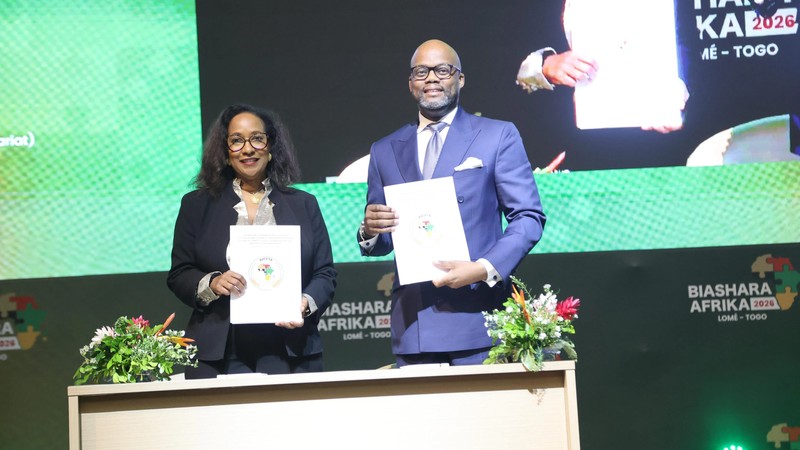
The agreement was signed on 23 June 2025 on the sidelines of Biashara Afrika 2026, a high-level convening of policymakers, financiers, and trade partners focused on operationalising intra-African commerce. AfCFTA Secretary-General Wamkele Mene and ITC Executive Director Pamela Coke-Hamilton formalised the renewed cooperation before an audience that included senior trade ministers and private sector representatives from across the continent.
The renewed MOU structures collaboration around four institutional pillars: market access and trade facilitation, inclusive entrepreneurship, institutional capacity building, and access to market intelligence and trade information. Critically, both organisations committed to co-creating programmes that deliver measurable outcomes for small and medium-sized enterprises (SMEs) and regional value chains, rather than producing policy documents that rarely reach the trading floor.
Coke-Hamilton was direct about the intent: “Our renewed partnership is about translating the AfCFTA into real trading opportunities for African businesses, especially small businesses, so they are better able to access new markets on the continent.”
The Numbers Behind the Implementation Deficit
The AfCFTA’s headline figures remain compelling. The Secretariat estimates that full implementation of tariff liberalisation and trade facilitation measures could increase intra-African trade by more than 52%. ITC research projects an additional US$22 billion in annual intra-African trade by 2029, driven by tariff reductions and the development of regional value chains.
Yet intra-African trade currently accounts for roughly 15% to 17% of the continent’s total trade, compared to over 60% within the European Union and approximately 58% in Asia. That structural underperformance is not primarily a consequence of absent agreements. It reflects deficits in customs harmonisation, logistics infrastructure, trade finance availability, and the institutional capacity of national revenue authorities to implement agreed protocols consistently.
West Africa illustrates the tension acutely. The ECOWAS Trade Liberalisation Scheme (ETLS), in operation since 1990, has never achieved full implementation across all member states. Non-tariff barriers, including informal checkpoints, duplicative documentation requirements, and inconsistent rules-of-origin application, continue to fragment what should be a relatively integrated regional market of over 400 million people. If ECOWAS has not resolved these frictions after three decades, the AfCFTA’s ambition to cover 55 AU member states demands a more rigorous implementation architecture than previous frameworks have delivered.
West African Stakes in Continental Market Integration
For West African economies, the AfCFTA-ITC partnership carries specific institutional implications. Ghana, which hosts the AfCFTA Secretariat in Accra, carries both symbolic and operational responsibility for the agreement’s credibility. The country’s own trade facilitation performance, including the efficiency of its port systems, the predictability of its customs administration, and the accessibility of its business registration environment, directly shapes regional perceptions of the agreement’s seriousness.
Côte d’Ivoire, West Africa’s second-largest economy and a member of the West African Economic and Monetary Union (WAEMU), presents a different governance dynamic. WAEMU’s monetary union and relatively harmonised trade regulations give its members a structural head start in AfCFTA compliance, but also create questions about regulatory layering: where WAEMU rules and AfCFTA protocols diverge, businesses face compliance uncertainty that suppresses cross-border activity.
Nigeria, the continent’s largest economy by GDP, ratified the AfCFTA in 2019 after initial hesitation driven by domestic industrial policy concerns. Its full, consistent participation remains essential to the agreement’s commercial viability. Without Nigerian market depth, the AfCFTA’s projected trade gains are arithmetically constrained. The renewed ITC partnership’s focus on SME market intelligence is particularly relevant here: Nigerian and Ghanaian small businesses consistently cite lack of market information and regulatory opacity as primary barriers to regional expansion, not tariff levels.
Geopolitical Context: Why Implementation Urgency Has Increased
The MOU renewal arrives at a moment when the external trade environment has deteriorated significantly. Disruptions in global supply chains, escalating protectionism in major economies, and geopolitical fragmentation have collectively weakened the case for African export dependence on distant markets. The AfCFTA’s logic, building productive capacity and demand within the continent, has become more commercially rational, not merely politically aspirational.
The ITC’s institutional mandate, supporting SME internationalisation and trade capacity in developing economies, aligns technically with what AfCFTA implementation requires at the enterprise level. Its SheTrades programme and Trade for Sustainable Development initiatives have demonstrated measurable results in connecting women-owned businesses and agricultural cooperatives to export pathways. Embedding similar methodologies within the AfCFTA implementation framework represents a concrete institutional upgrade over generic capacity-building rhetoric.
The agreement also explicitly aligns with the African Union’s Agenda 2063 and the UN 2030 Sustainable Development Goals, anchoring it within the broader continental governance architecture rather than treating it as a standalone technical exercise.
Institutional Pathways: What Effective Implementation Requires
The AfCFTA entered into force in 2019 and began trading in January 2021, making it one of the fastest-negotiated multilateral trade agreements in AU history. Speed of negotiation, however, has not translated into depth of implementation. Several protocols, including those governing investment, intellectual property, and e-commerce, remain under negotiation or in early ratification stages.
For the AfCFTA-ITC partnership to move beyond symbolism, three institutional mechanisms warrant particular attention. First, the AfCFTA Guided Trade Initiative, launched in 2022 with a small group of participating states, needs to scale its operational lessons into a replicable compliance model that national customs authorities across ECOWAS and beyond can adopt without requiring bilateral negotiations each time.
Second, the market intelligence component of the renewed MOU must produce accessible, real-time trade data that SMEs can actually use. Dashboards that aggregate tariff schedules, rules-of-origin requirements, and logistics costs by corridor, published in French, English, Portuguese, and Swahili, would represent a material reduction in information asymmetry for the small traders who constitute the majority of cross-border commerce in West Africa.
Third, the institutional capacity building pillar must target national trade ministries and revenue authorities directly. Implementation failures in regional trade agreements consistently originate at the national level, where political commitments made in summit communiqués are not translated into administrative instruction, budget allocation, or staff training. The ITC’s country-level presence gives it a credible channel to address this gap, but only if the partnership is resourced and monitored against specific, time-bound deliverables rather than activity outputs.
The AfCFTA covers a market of 1.3 billion people across all 55 AU member states, with a combined GDP exceeding US$3.4 trillion. Whether that market becomes commercially real for African businesses in the next five years depends less on further negotiation and more on whether institutions like the ITC and the AfCFTA Secretariat can deliver the unglamorous work of regulatory harmonisation, trader education, and customs modernisation at scale.